
Insider Brief
SEAFOOD Puts OCTOPUS and Quantum Computers on the Same Menu
Insider Brief PRESS RELEASE — Researchers at D3 Center and the Center for Quantum Information and Quantum Biology (QIQB), the University of Osaka, have created SEAFOOD, a platform that allows the university’s OCTOPUS supercomputer and…
Matt Swayne
Publisher The Quantum Insider
Nov 11, 2026 at 9:25 AM UTC · Updated hace 11 horas · 2 min de lectura
Traduciendo…
- University of Osaka researchers developed SEAFOOD, a platform integrating its OCTOPUS supercomputer and superconducting quantum computers into a single workflow for hybrid computing research.
- A demonstration involving four hydrogen atoms produced a ground-state energy matching a conventional reference calculation, with quantum and classical computers handling different tasks.
- SEAFOOD is scheduled to begin operating in December 2026, with trial access for selected university research teams planned for fiscal year 2027.
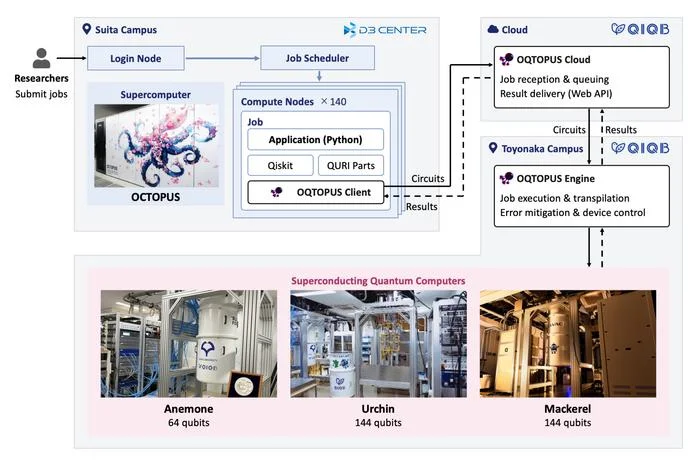
PRESS RELEASE — Researchers at D3 Center and the Center for Quantum Information and Quantum Biology (QIQB), the University of Osaka, have created SEAFOOD, a platform that allows the university’s OCTOPUS supercomputer and superconducting quantum computers to work together in a single computing workflow. It is the first case in Japan of integrating a domestically developed quantum computer and a supercomputer installed at the same university. The team has demonstrated the system through a quantum chemistry calculation, opening new possibilities for quantum chemistry, materials science, and other computationally intensive research.
Understanding how electrons interact is crucial to developing new materials and drugs, but the calculations can be demanding even for powerful supercomputers. Quantum computers may help with some of these problems, yet today’s machines have limited numbers of qubits and are prone to errors. Combining quantum and conventional computing offers a way to make use of their different strengths.
Article Intelligence
Topics
Related Coverage
View all related
Sponsored
Ad
NewsLayerLearn more
NewsLayer Premium
Unlock deeper intelligence.
Ad-free reading, exclusive research, and real-time onchain insights.
Go Premium