
- Imperial College London researchers developed a modular photonic processor called Clavina that combines programmable linear optical circuits with nonlinear quantum modules in one reconfigurable architecture.
- The system demonstrated 100-mode Gaussian boson sampling, quantum correlations across 8,000 time bins, Schrödinger cat states and quasi-deterministic production of error-correction resources called GKP states at roughly 2,000 per second.
- Clavina is not yet a fault-tolerant quantum computer, but its ability to reuse and swap functional modules could help photonic machines move beyond specialized experiments toward more general-purpose quantum processors.
‘Shape-shifting’ quantum computer uses light to switch between different tasks
Light may become one of the most powerful tools for future quantum computers. Photons, the tiny particles that make up light, can carry quantum information quickly and with relatively low noise. But they also create a stubborn problem:…
The Brighter Side of News
Publisher
Sep 7, 2026 at 11:07 PM UTC · 6 min de lectura
Key Signal
100-mode Gaussian boson sampling test
Last Updated
hace un día
Traduciendo…
Light may become one of the most powerful tools for future quantum computers. Photons, the tiny particles that make up light, can carry quantum information quickly and with relatively low noise. But they also create a stubborn problem: they do not naturally interact very strongly.
That weak interaction has limited many light-based quantum machines. They can perform useful linear operations, but they struggle with the nonlinear steps needed for full quantum computing.
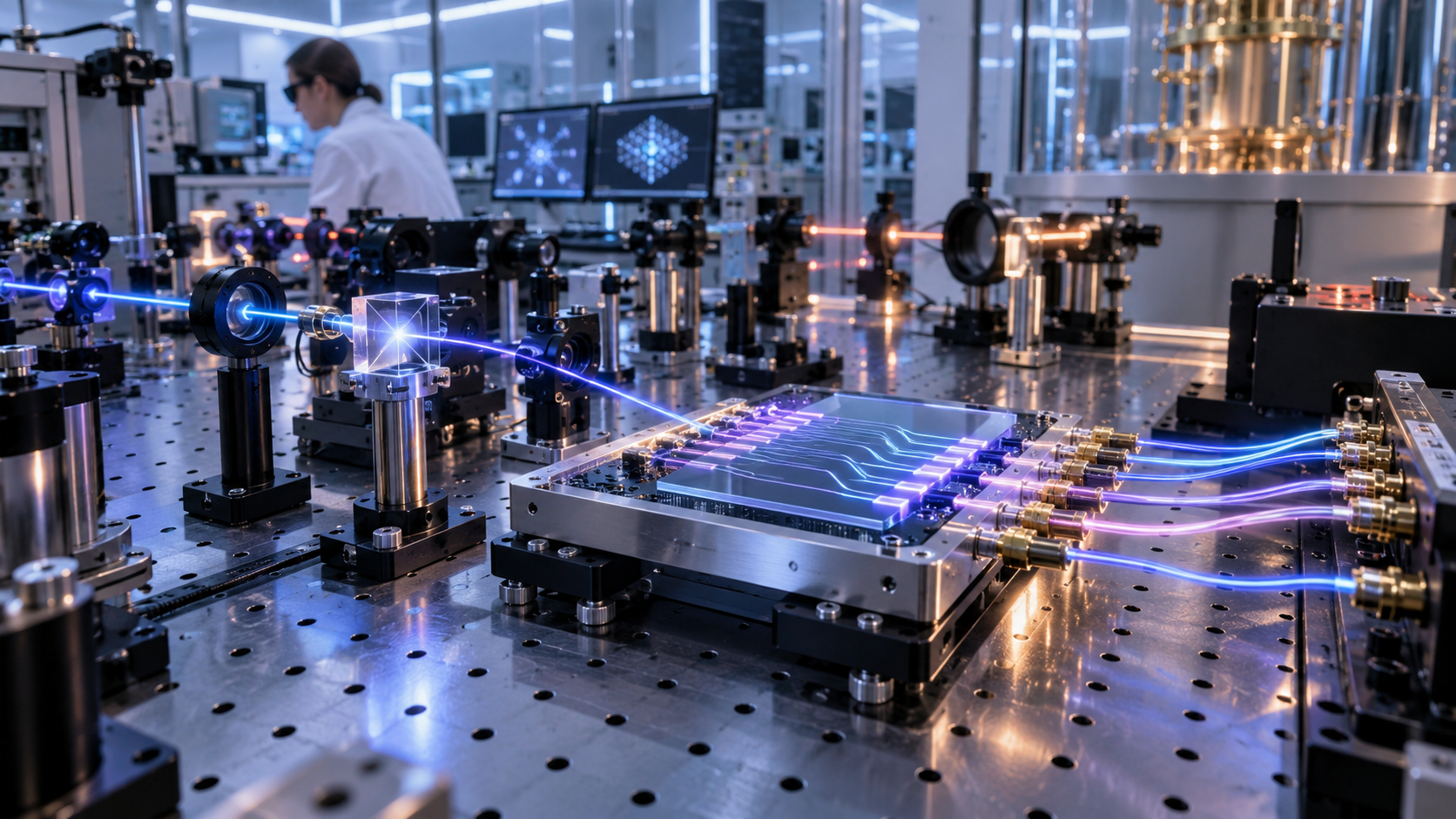
Researchers from Imperial College London’s Department of Physics and external collaborators have now developed a new architecture called Clavina, which combines programmable linear optics with specialized nonlinear quantum modules in one system.
Article Intelligence
Topics
Sponsored
Ad
NewsLayerLearn more
NewsLayer Premium
Unlock deeper intelligence.
Ad-free reading, exclusive research, and real-time onchain insights.
Go Premium