We use cookies to personalise content and ads, to provide social media features and to analyse our traffic. We also share information about your use of our site with our social media, advertising and analytics partners who may combine it with other information that you’ve provided to them or that they’ve collected from your use of their services.
Necessary cookies help make a website usable by enabling basic functions like page navigation and access to secure areas of the website. The website cannot function properly without these cookies.
_cfuvidThis cookie is a part of the services provided by Cloudflare - Including load-balancing, deliverance of website content and serving DNS connection for website operators.
Maximum Storage Duration: SessionType: HTTP Cookie
__cf_bm [x7]This cookie is used to distinguish between humans and bots. This is beneficial for the website, in order to make valid reports on the use of their website.
CookieConsentStores the user's cookie consent state for the current domain
Maximum Storage Duration: 1 yearType: HTTP Cookie
Preference cookies enable a website to remember information that changes the way the website behaves or looks, like your preferred language or the region that you are in.
We do not use cookies of this type.
Statistic cookies help website owners to understand how visitors interact with websites by collecting and reporting information anonymously.
We do not use cookies of this type.
Marketing cookies are used to track visitors across websites. The intention is to display ads that are relevant and engaging for the individual user and thereby more valuable for publishers and third party advertisers.
We do not use cookies of this type.
Unclassified cookies are cookies that we are in the process of classifying, together with the providers of individual cookies.
List of domains your consent applies to: [#BULK_CONSENT_DOMAINS#]
Cookie declaration last updated on 8/12/26 by Cookiebot
[#IABV2_TITLE#]
[#IABV2_BODY_INTRO#]
[#IABV2_BODY_LEGITIMATE_INTEREST_INTRO#]
[#IABV2_BODY_PREFERENCE_INTRO#]
[#IABV2_BODY_PURPOSES_INTRO#]
[#IABV2_BODY_PURPOSES#]
[#IABV2_BODY_FEATURES_INTRO#]
[#IABV2_BODY_FEATURES#]
[#IABV2_BODY_PARTNERS_INTRO#]
[#IABV2_BODY_PARTNERS#]
About
Cookies are small text files that can be used by websites to make a user's experience more efficient.
The law states that we can store cookies on your device if they are strictly necessary for the operation of this site. For all other types of cookies we need your permission.
This site uses different types of cookies. Some cookies are placed by third party services that appear on our pages.
You can at any time change or withdraw your consent from the Cookie Declaration on our website.
Learn more about who we are, how you can contact us and how we process personal data in our Privacy Policy.
Please state your consent ID and date when you contact us regarding your consent.
Install NewsLayer
Get the app experience — one tap from your home screen, instant loads and breaking-news alerts.
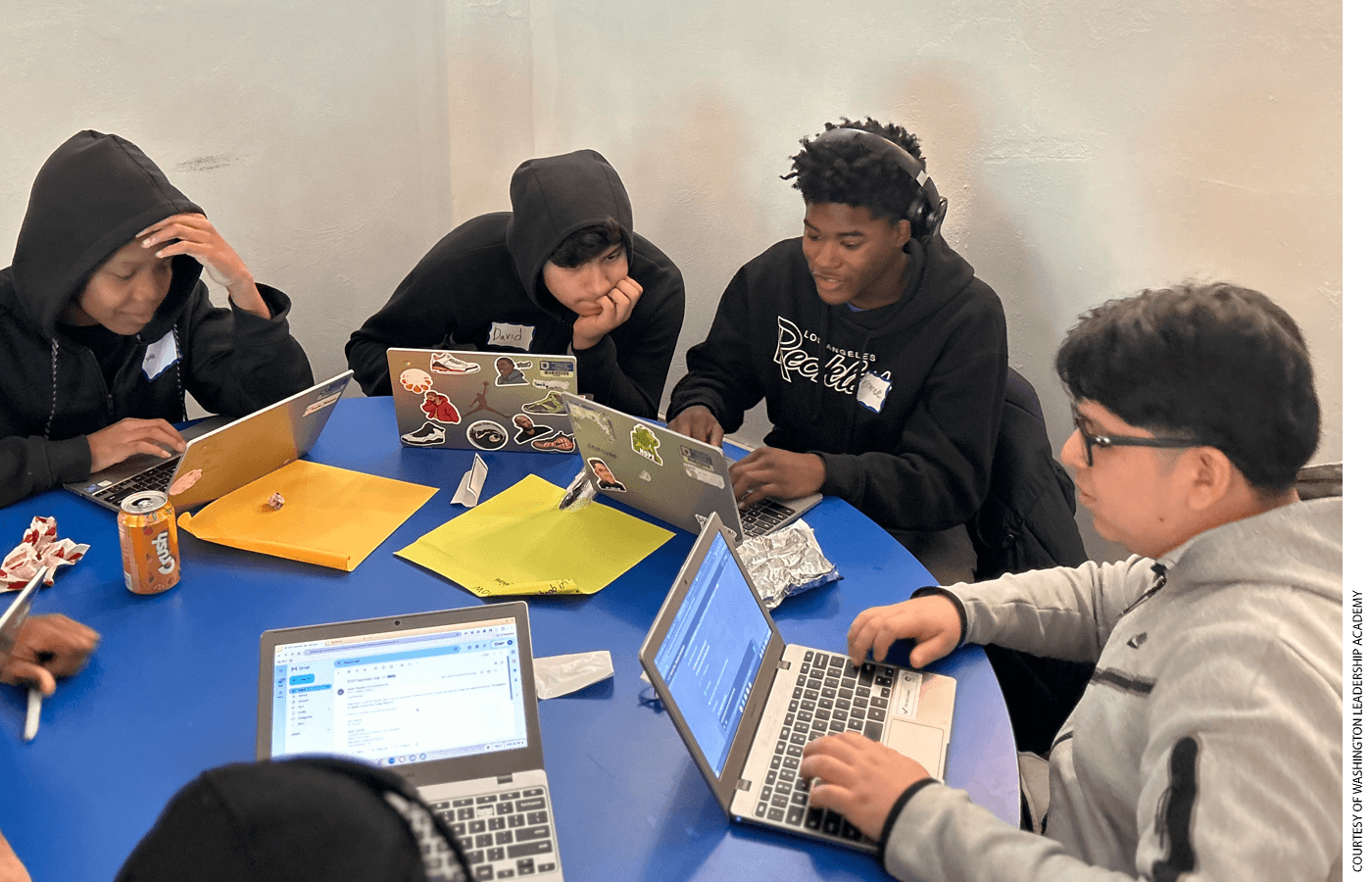
WLA teachers have deployed AI in instruction in a variety of innovative ways.
In Giani Clarkson’s AP Government class, for example, students studied imperialism by designing a country’s resources to resist being conquered by “Clarksonia,” a fictional nation Clarkson controls. They input their country into a chatbot to see whether they could survive a three-year simulated war against Clarksonia, allocating its population across soldiers, scientists, artists, and educators, and selecting a key natural resource. The bot delivered a verdict on each simulated country, revealing Clarksonia’s resources for comparison but not explaining why a country won or lost; this forced students to think through the causes themselves. “It’s not good enough to just tell them, ‘This is how it happened,’” Clarkson said. “They have to see it in real time and kick the tires themselves.”
Beyond teaching students how AI works and how to use it, WLA is exposing students to AI’s limitations.
Niyesha Coleman, the school’s math instructional coach, built a gamified chatbot that walked students through practice problems, offering hints and feedback in a voice trained to sound like hers. Students had to explain their reasoning for every answer, and sometimes, Coleman noted, the bot got the answer wrong, and students had to defend their thinking against the incorrect response. It was a lesson in both mathematical reasoning and the limits of AI.
WLA students seem to be getting the message. In a fall 2025 survey, two-thirds of the school’s students reported that they had learned strategies for effectively using AI tools, such as crafting prompts, evaluating output, and selecting the right tool—key components of AI literacy. But 70 percent said they thought AI could be both helpful and harmful in their schoolwork.
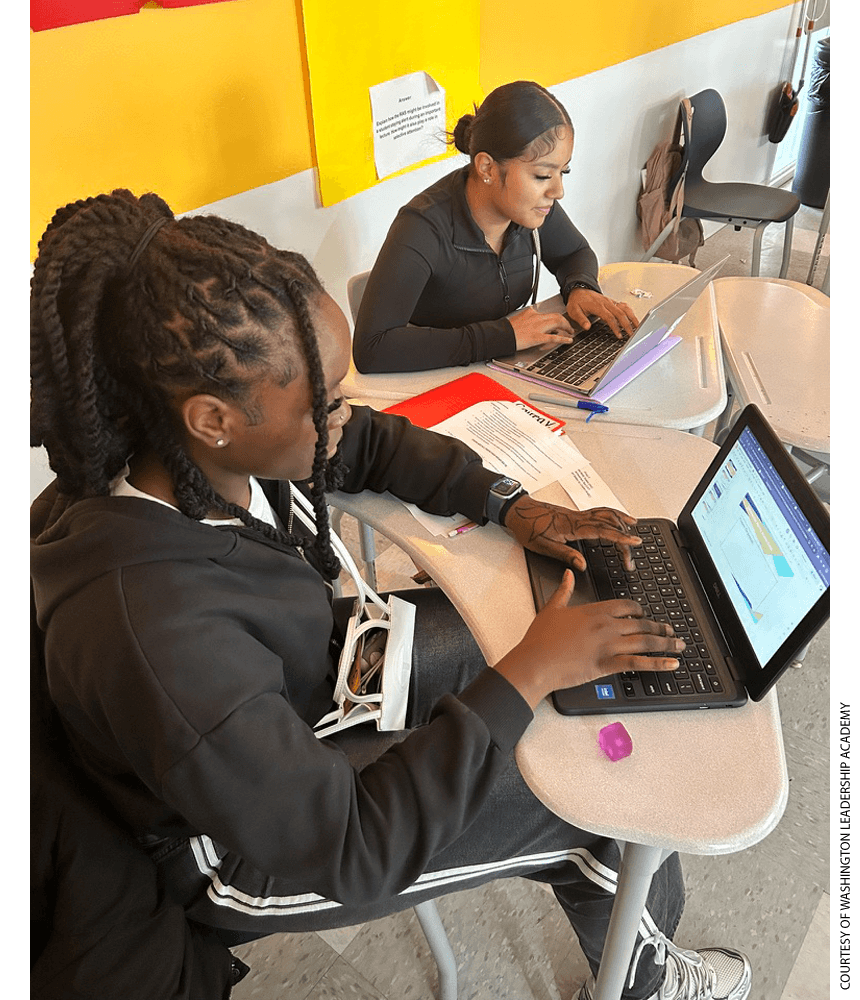
Juniors Cairea and Keilly work on a presentation for their AP Psychology class. Teacher Adam Browning used AI to adapt the course’s curriculum after College Board changed the exam for the 2024–25 school year.
That raises an obvious question: Does AI help students learn? A March 2026 Stanford review of 14 AI research studies revealed mixed results: Students performed better in math, writing, economics, and physics when they were able to use AI tools in their schoolwork. But gains often disappeared when they lost access to AI. The review also found that AI could reduce students’ “cognitive burden,” making academic tasks feel easier, but sometimes at the expense of deeper thinking and long-term retention. Tools designed with “guardrails”—such as tutoring chatbots that offer students hints rather than direct answers—show more promise in supporting long-term learning than general-purpose chatbots that hand students the answer, the review found. The lesson is not that AI inherently helps or harms learning but that its effects depend on how it is designed and deployed.
WLA leaders believe it’s too early to draw conclusions about AI’s impact on their students’ learning, that the relationship between AI use and test scores or other formal measures isn’t yet clear. But some teachers are encouraged by what they’ve seen in their classrooms. Since implementing the chatbot for practice problems in her math class, Coleman has watched students who once struggled to engage with content or tasks become more confident, more willing to take risks, and more invested in their learning—changes she believes will translate into stronger academic outcomes over time. Teachers at WLA, meanwhile, are using AI to support students in ways that weren’t previously possible.
Adam Browning, WLA’s director of academic innovation and AP Psychology teacher, used the new technology to address a typical problem. The College Board, the organization that writes Advanced Placement exams, recently overhauled the AP Psychology curriculum, leaving teachers with few practice questions to give their students. So, he created an AI tool that generated questions modeled on the few already released by the College Board. Students submitted answers to a chatbot, which gave them immediate feedback and flagged Browning if they continued to struggle. The system has more than doubled scores on practice questions.
WLA teachers are also using AI to address the day-to-day administrative challenges that plague their professional lives.
Clarkson, for example, uses AI to generate a weekly newsletter for the parents of his 86 students, something he says he would never have time to do otherwise. The newsletter keeps parents informed about upcoming assignments and office hours and offers words of encouragement, bridging the gap between home and the classroom. Informed parents often mean better supported students, both at home and in school, Clarkson says.
Educators across the nation are also experimenting with using AI for administrative tasks. In the 2024–25 school year, 3 in 10 teachers nationwide reported reducing the time they spend on such tasks by up to 11 percent, or roughly six hours a week, by using AI.
While WLA teachers have embraced AI to handle the behind-the-scenes work of teaching, the school has also begun integrating AI into its operations. Mark Deegan, the school’s chief innovation officer, has led the effort to automate workflows that staff once managed manually. AI now centralizes daily attendance data on a single dashboard, synthesized with a historical record of absences so that staff can identify and reach out to struggling students before their truancy becomes chronic.