
Why PKI May Be One of the Hardest Parts of the Post Quantum Migration
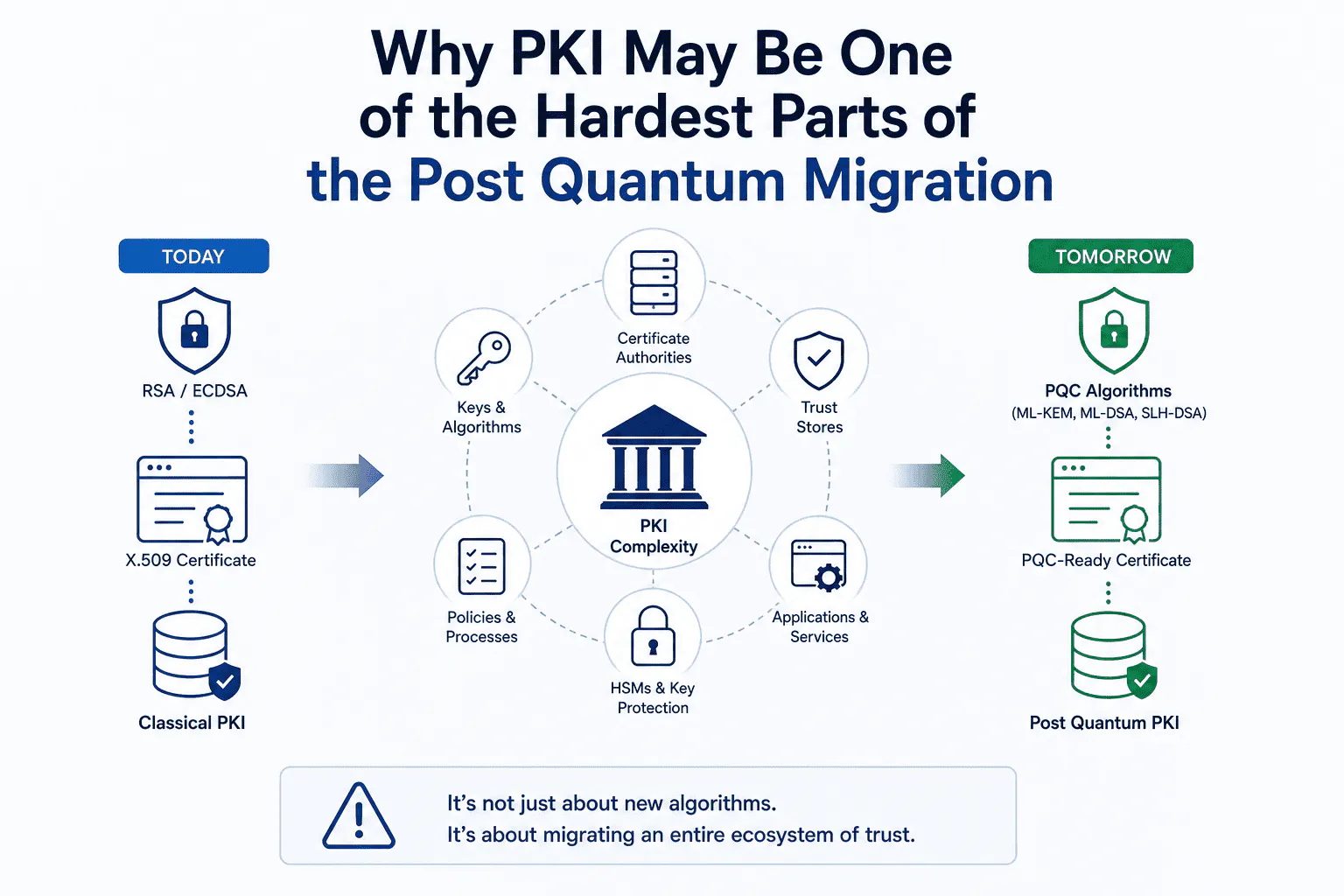
Post-quantum migration is often described as an algorithm replacement exercise: move from RSA and elliptic curve cryptography to quantum-resistant alternatives such as ML KEM, ML DSA, and SLH DSA. That description is technically incomplete.
HackerNoon
Publisher
Sep 1, 2026 at 12:50 PM UTC · 13 min de lectura
Traduciendo…
Post-quantum migration is often described as an algorithm replacement exercise: move from RSA and elliptic curve cryptography to quantum-resistant alternatives such as ML KEM, ML DSA, and SLH DSA. That description is technically incomplete.
The difficult part is not simply selecting a new algorithm. It is replacing cryptographic mechanisms embedded across certificate authorities, trust stores, certificate profiles, HSMs, validation systems, workload identities, applications and automated certificate workflows without breaking the trust relationships connecting them.
NIST finalized FIPS 203 for ML KEM, FIPS 204 for ML DSA, and FIPS 205 for SLH DSA in August 2024. ML KEM addresses key establishment, while ML DSA and SLH DSA provide digital signatures designed to withstand future quantum attacks. NIST now advises organizations to begin migrating systems to quantum-resistant cryptography and to identify where vulnerable algorithms are being used.
The harder question is therefore operational: how can enterprises migrate the public key infrastructure surrounding those primitives without creating outages, broken trust chains or unmanageable operational complexity?
This is closely related to the broader problem of treating post-quantum migration as a distributed systems problem rather than a library upgrade. A modern application can depend on cryptography at the load balancer, API gateway, service mesh, identity provider, KMS, certificate authority and application layer simultaneously.
Article Intelligence
Topics
Sponsored
Ad
NewsLayerLearn more
NewsLayer Premium
Unlock deeper intelligence.
Ad-free reading, exclusive research, and real-time onchain insights.
Go Premium