
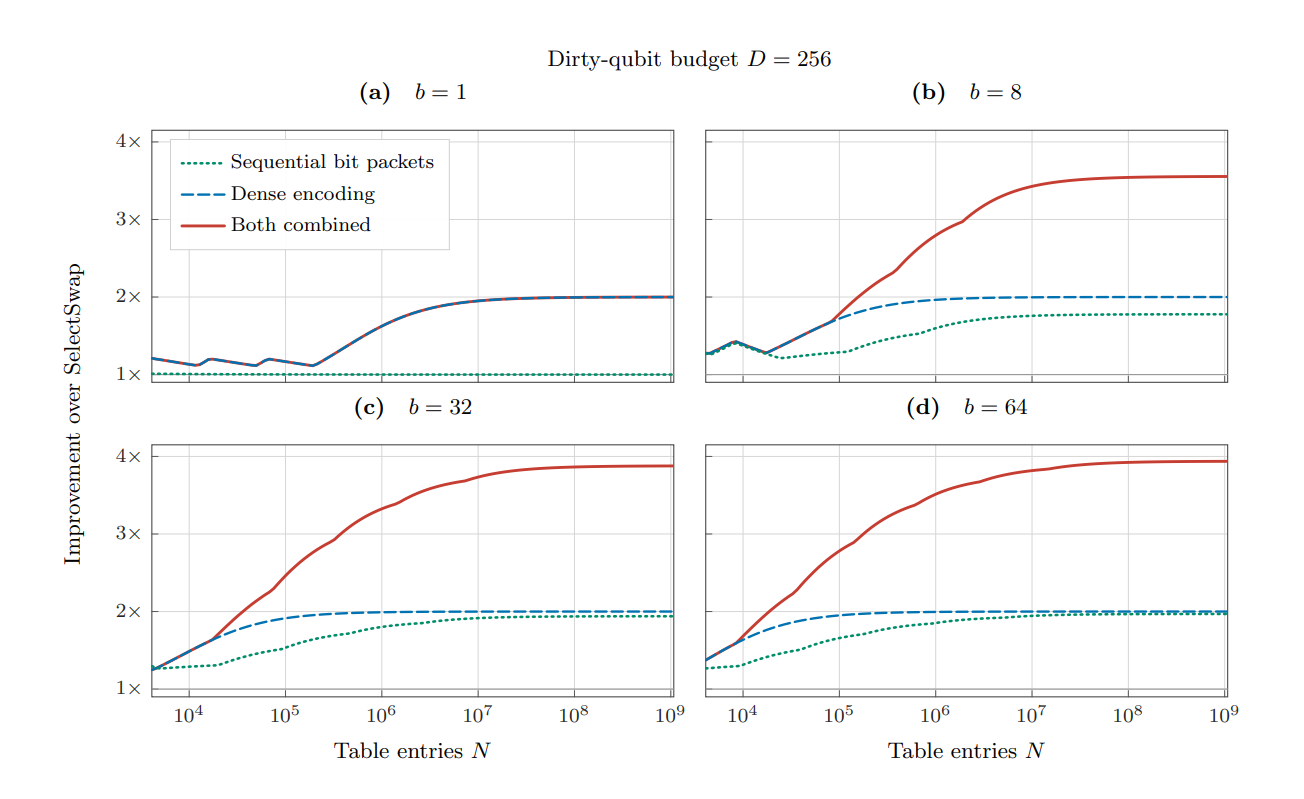
In a pair of research papers published on arXiv, Xanadu Lead Quantum Scientist Danial Motlagh and co-author Matthew Pocrnic have demonstrated an algorithmic technique that reduces the non-Clifford gate cost of Quantum Read-Only Memory (QROM) by nearly 4-fold compared to long-standing industry benchmarks.
Xanadu Cuts Quantum Read-Only Memory Costs by ~4x via Dense Encoding
In a pair of research papers published on arXiv, Xanadu Lead Quantum Scientist Danial Motlagh and co-author Matthew Pocrnic have demonstrated an algorithmic technique that reduces the non-Clifford gate cost of Quantum Read-Only Memory…
Quantum Computing Report
Publisher
Oct 10, 2026 at 7:19 PM UTC · 3 min de lectura
Key Signal
3.9x Toffoli gate reduction
Last Updated
hace 21 horas
Traduciendo…
QROM is the foundational subroutine used to load classical data (like molecular Hamiltonians or financial matrices) into fault-tolerant quantum algorithms. Because table lookups account for most of the Toffoli gate overhead in practical applications, reducing QROM costs directly shrinks hardware runtimes and qubit requirements.
Xanadu achieved this ~4-fold reduction using two core innovations:
1. Sequential Bit Packets and SelectCopy (May 2026): By replacing controlled swaps with copies and overlapping consecutive data passes, the leading Toffoli gate cost was cut in half, matching clean-qubit performance while using borrowed “dirty” workspace qubits (arXiv:2605.20334).
2. Dense Encoding in Z and X Bases (October 2026): The new construction temporarily writes two classical bits onto a single dirty qubit simultaneously using both its Z and X Pauli bases, doubling the data loaded per pass (arXiv:2610.02321).
Article Intelligence
Sponsored
Ad
NewsLayerLearn more
NewsLayer Premium
Unlock deeper intelligence.
Ad-free reading, exclusive research, and real-time onchain insights.
Go Premium