
Council of Europe: Law-enforcement practitioners exchange strategies to investigate crypto-enabled financial crime
Council of Europe exchange on investigating money laundering, terrorist financing and other economic crimes involving crypto-assets
Digital Watch Observatory
Publisher
Sep 24, 2026 at 9:51 AM UTC · 3 min de lecture
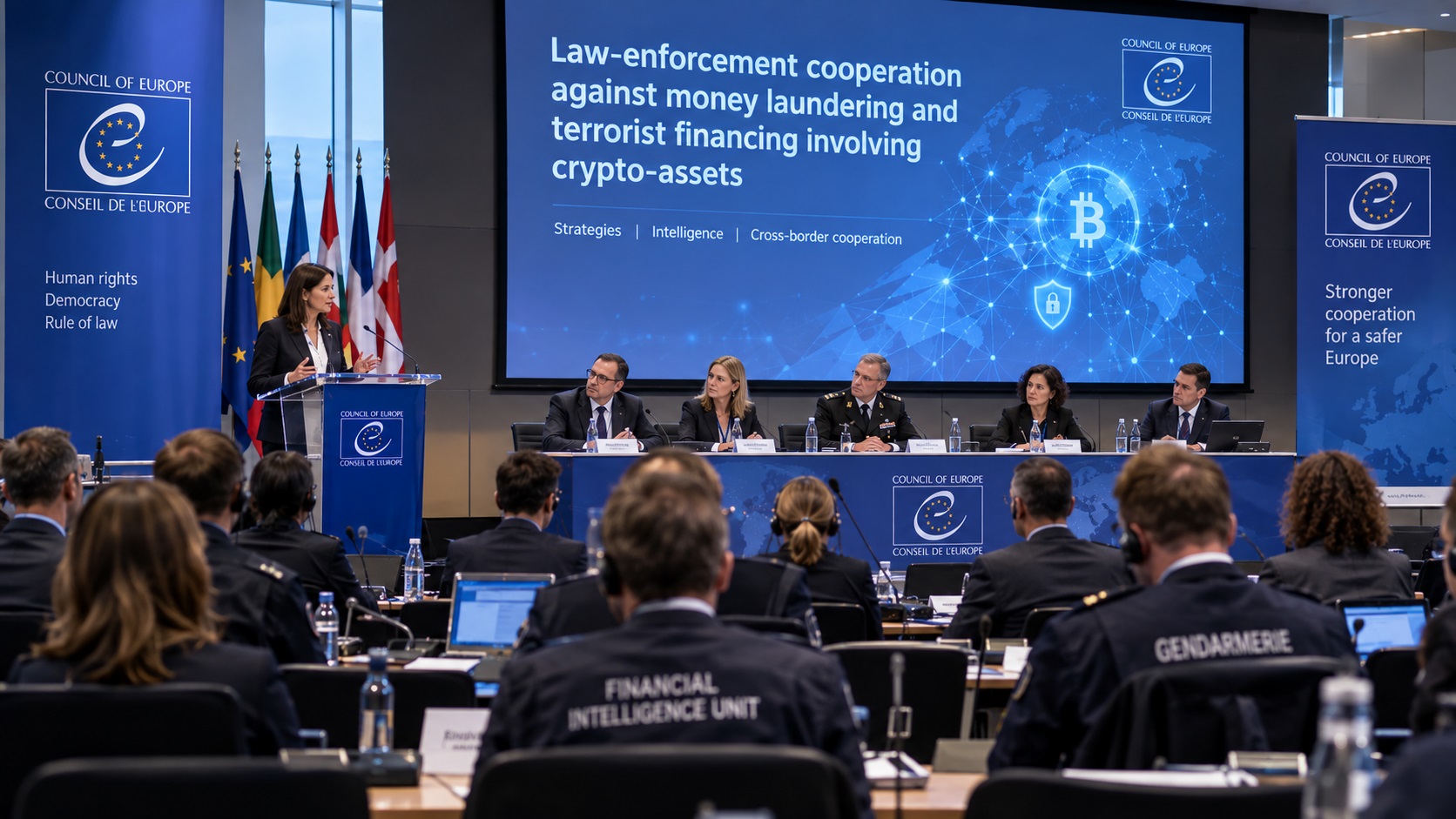
Council of Europe exchange on investigating money laundering, terrorist financing and other economic crimes involving crypto-assets
Law-enforcement and criminal justice practitioners from Council of Europe member States met in Strasbourg on 22–23 September 2026 to exchange practical experience on investigating money laundering, terrorist financing and other economic crimes involving crypto-assets and decentralised finance (DeFi). Organised by the Council of Europe’s Economic Crime and Cooperation Division (ECCD), the roundtable brought together competent authorities to examine how investigative, prosecutorial and judicial systems can adapt to increasingly complex forms of digital finance.
The meeting comes as crypto-assets and DeFi become increasingly integrated into the financial ecosystem while also creating new opportunities for criminal networks. Virtual assets can facilitate the rapid movement of funds across borders, obscure the origins of criminal proceeds and support transnational networks. Their misuse can intersect with cybercrime, informal value-transfer mechanisms, sanctions evasion, terrorist financing and other forms of economic crime. DeFi introduces additional challenges because permissionless access, automated transactions and the absence of conventional intermediaries can make it more difficult for authorities to identify relevant actors, establish jurisdiction and obtain reliable evidence.
Article Intelligence
Topics
Related Coverage
 CryptoRUSI Launches Crypto and International Security Taskforceil y a 25 minutes · 2 min read
 PolicySDNY’s $61 Million Crypto Forfeiture Action Reflects Growing Convergence of Civil Forfeiture and Sanctions Enforcementil y a une heure · 1 min read
 Crypto$16M Coinbase Crypto Thief 'Lolimfeelingevil' Gets 12 Yrs.il y a 2 heures · 1 min read
Sponsored
Ad
NewsLayer Premium
Unlock deeper intelligence.
Ad-free reading, exclusive research, and real-time onchain insights.
Go Premium