This website uses cookies
We use cookies to personalise content and ads, to provide social media features and to analyse our traffic. We also share information about your use of our site with our social media, advertising and analytics partners who may combine it with other information that you’ve provided to them or that they’ve collected from your use of their services.
Consent Selection
Details
  • Necessary cookies help make a website usable by enabling basic functions like page navigation and access to secure areas of the website. The website cannot function properly without these cookies.
  • Preference cookies enable a website to remember information that changes the way the website behaves or looks, like your preferred language or the region that you are in.
    • We do not use cookies of this type.

  • Statistic cookies help website owners to understand how visitors interact with websites by collecting and reporting information anonymously.
    • We do not use cookies of this type.

  • Marketing cookies are used to track visitors across websites. The intention is to display ads that are relevant and engaging for the individual user and thereby more valuable for publishers and third party advertisers.
    • We do not use cookies of this type.

  • Unclassified cookies are cookies that we are in the process of classifying, together with the providers of individual cookies.
    • __emg_sidPending
      Maximum Storage Duration: 1 dayType: HTTP Cookie
      __emg_vidPending
      Maximum Storage Duration: 1 yearType: HTTP Cookie
      nl-read-countPending
      Maximum Storage Duration: PersistentType: HTML Local Storage
Cookie declaration last updated on 8/12/26 by Cookiebot
[#IABV2_TITLE#]
[#IABV2_BODY_INTRO#]
[#IABV2_BODY_LEGITIMATE_INTEREST_INTRO#]
[#IABV2_BODY_PREFERENCE_INTRO#]
[#IABV2_BODY_PURPOSES_INTRO#]
[#IABV2_BODY_PURPOSES#]
[#IABV2_BODY_FEATURES_INTRO#]
[#IABV2_BODY_FEATURES#]
[#IABV2_BODY_PARTNERS_INTRO#]
[#IABV2_BODY_PARTNERS#]
About
Cookies are small text files that can be used by websites to make a user's experience more efficient.

The law states that we can store cookies on your device if they are strictly necessary for the operation of this site. For all other types of cookies we need your permission.

This site uses different types of cookies. Some cookies are placed by third party services that appear on our pages.

You can at any time change or withdraw your consent from the Cookie Declaration on our website.

Learn more about who we are, how you can contact us and how we process personal data in our Privacy Policy.

Please state your consent ID and date when you contact us regarding your consent.
NewsLayer

Install NewsLayer

Get the app experience — one tap from your home screen, instant loads and breaking-news alerts.

NewsLayer.com
NewsLayer PulseLIVEBTC$62,859-0.89%ETH$1,874-0.56%SOL$75.72-0.64%XRP$1-0.37%DOGE$0.0698-0.39%ADA$0.1822-0.03%Total Cap$2.26T-0.97%Layer Index43 Neutral
External ReportingPublié il y a 33 minutes

Crypto payments barely register among euro area merchants, ECB finds

Crypto acceptance was just 0.2% online and remained below 1% at physical points of sale, while mobile payments gained ground.

Crypto payments barely register among euro area merchants, ECB finds
Par Cointelegraph by Helen PartzPublisher Cointelegraph 2 min de lecture
Image via Cointelegraph

Layer Index

43

↓ 1 pts in 24h

Crypto remains a marginal payment option among euro area businesses even as other forms of digital payments gain ground, according to a new European Central Bank (ECB) report.

Just 0.2% of companies selling goods and services online accept crypto assets, the ECB said in its survey on companies’ cash use, published Thursday. Cash remains the most widely accepted payment method, with 92% of companies with physical points of sale accepting it.

The ECB surveyed 8,205 businesses across the 21 euro area countries, covering retail, restaurants and cafes, hotels, and arts, entertainment and recreation. Market research firm Ipsos conducted the telephone interviews from Feb. 23 to April 10.

The findings come as the ECB advances work on a digital euro, a central bank digital currency (CBDC) designed to complement cash and preserve the euro’s role.

Mobile payments are catching up

Mobile payments recorded the biggest shift among payment methods at physical locations, with acceptance jumping to 68% in 2026 from 36% in 2024.

The most commonly accepted mobile options include instant payments and digital wallets, such as Apple Pay and Google Pay.
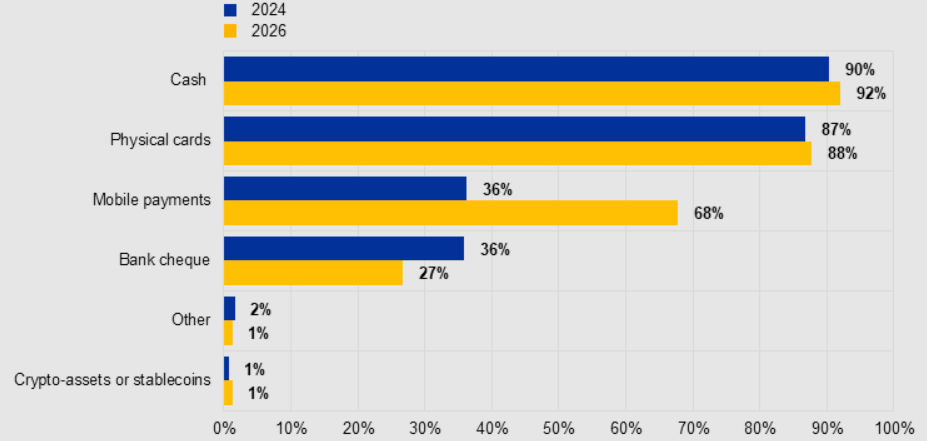
Acceptance of various payment instruments, 2024 versus 2026. Source: ECB

Cash edged up to 92% from 90%, while physical card acceptance rose to 88% from 87%. Crypto assets and stablecoins showed virtually no momentum at physical points of sale, remaining below 1% acceptance in both 2024 and 2026. Acceptance of bank checks, meanwhile, fell to 27% from 36%.

Merchants cite consumer preference as top payment factor

Consumer preference was the biggest factor companies considered when choosing which payment methods to accept, cited by 26% of respondents, followed by security at 22% and ease of handling at 15%.

Businesses that reject cash most often cited weak customer demand, at 36%, and difficulties depositing or withdrawing it, at 35%, while 29% pointed to security risks.

Most important criteria when choosing to accept a means of payment, euro area, 2026. Source: ECB

The longer-term outlook varies sharply by country, with 51% of cash-accepting small and medium-sized enterprises in Cyprus saying they may stop accepting cash, compared with 23% in Greece and 18% in Bulgaria.

What counts as accepting crypto?

The ECB survey asked companies whether they accept crypto assets or stablecoins, citing Bitcoin (BTC), Ether (ETH) and Tether’s USDt (USDT) as examples.

Some crypto payment services allow merchants to receive settlement in traditional currency even when customers pay with crypto. The survey does not specify whether merchants should count such payments as crypto acceptance.

Related: Western Union brings stablecoin remittances to Visa network with Stablecard

Cointelegraph asked the ECB whether converted crypto payments could therefore go unreported by merchants and whether regulatory uncertainty could affect companies’ answers. The ECB said it “prefer[s] not to speculate.”

Asked whether euro area merchants are permitted to accept crypto under European Union rules, the ECB said it does not set payment regulation and referred Cointelegraph to the European Commission and national lawmakers.

Magazine: El Salvador’s Bitcoin experiment turns 5: ‘It was for us, not them’

Dernière Minute

Ne manquez aucune actualité de dernière minute

Advertisement

House — Advertise on NewsLayer
NewsLayerAd

Sourced by

Originally reported by Cointelegraph

NewsLayer coverage based on externally reported material.

The Daily Brief

The onchain economy, before your day starts.

Curated markets, onchain insights, and key headlines — delivered every weekday morning.

Weekdays · Free · ~5 minute read

Articles Liés