
This website uses cookies
We use cookies to personalise content and ads, to provide social media features and to analyse our traffic. We also share information about your use of our site with our social media, advertising and analytics partners who may combine it with other information that you’ve provided to them or that they’ve collected from your use of their services.
Consent Selection
Details
  • Necessary cookies help make a website usable by enabling basic functions like page navigation and access to secure areas of the website. The website cannot function properly without these cookies.
  • Preference cookies enable a website to remember information that changes the way the website behaves or looks, like your preferred language or the region that you are in.
    • We do not use cookies of this type.

  • Statistic cookies help website owners to understand how visitors interact with websites by collecting and reporting information anonymously.
    • We do not use cookies of this type.

  • Marketing cookies are used to track visitors across websites. The intention is to display ads that are relevant and engaging for the individual user and thereby more valuable for publishers and third party advertisers.
    • We do not use cookies of this type.

  • Unclassified cookies are cookies that we are in the process of classifying, together with the providers of individual cookies.
    • __emg_sidPending
      Maximum Storage Duration: 1 dayType: HTTP Cookie
      __emg_vidPending
      Maximum Storage Duration: 1 yearType: HTTP Cookie
      nl-read-countPending
      Maximum Storage Duration: PersistentType: HTML Local Storage
Cookie declaration last updated on 8/12/26 by Cookiebot
[#IABV2_TITLE#]
[#IABV2_BODY_INTRO#]
[#IABV2_BODY_LEGITIMATE_INTEREST_INTRO#]
[#IABV2_BODY_PREFERENCE_INTRO#]
[#IABV2_BODY_PURPOSES_INTRO#]
[#IABV2_BODY_PURPOSES#]
[#IABV2_BODY_FEATURES_INTRO#]
[#IABV2_BODY_FEATURES#]
[#IABV2_BODY_PARTNERS_INTRO#]
[#IABV2_BODY_PARTNERS#]
About
Cookies are small text files that can be used by websites to make a user's experience more efficient.

The law states that we can store cookies on your device if they are strictly necessary for the operation of this site. For all other types of cookies we need your permission.

This site uses different types of cookies. Some cookies are placed by third party services that appear on our pages.

You can at any time change or withdraw your consent from the Cookie Declaration on our website.

Learn more about who we are, how you can contact us and how we process personal data in our Privacy Policy.

Please state your consent ID and date when you contact us regarding your consent.
NewsLayer.com
NewsLayer PulseLIVEBTC$78,485-0.61%ETH$2,439-1.75%SOL$96.51-2.51%XRP$1.43-3.41%DOGE$0.0857-4.89%ADA$0.2088-5.85%Total Cap$2.77T-0.55%Layer Index57 Neutral

Crypto Wallet Phishing by Letter: the QR Code Scam

If a letter arrives in your postbox urging an urgent security update for your crypto wallet and supplying a QR code for it, that is phishing. No manufacturer and no exchange announces a wallet update by post, and there is no legitimate…

CryptoTicker

Publisher

Aug 25, 2026 at 9:31 PM UTC · Updated il y a 29 minutes · 12 min de lecture
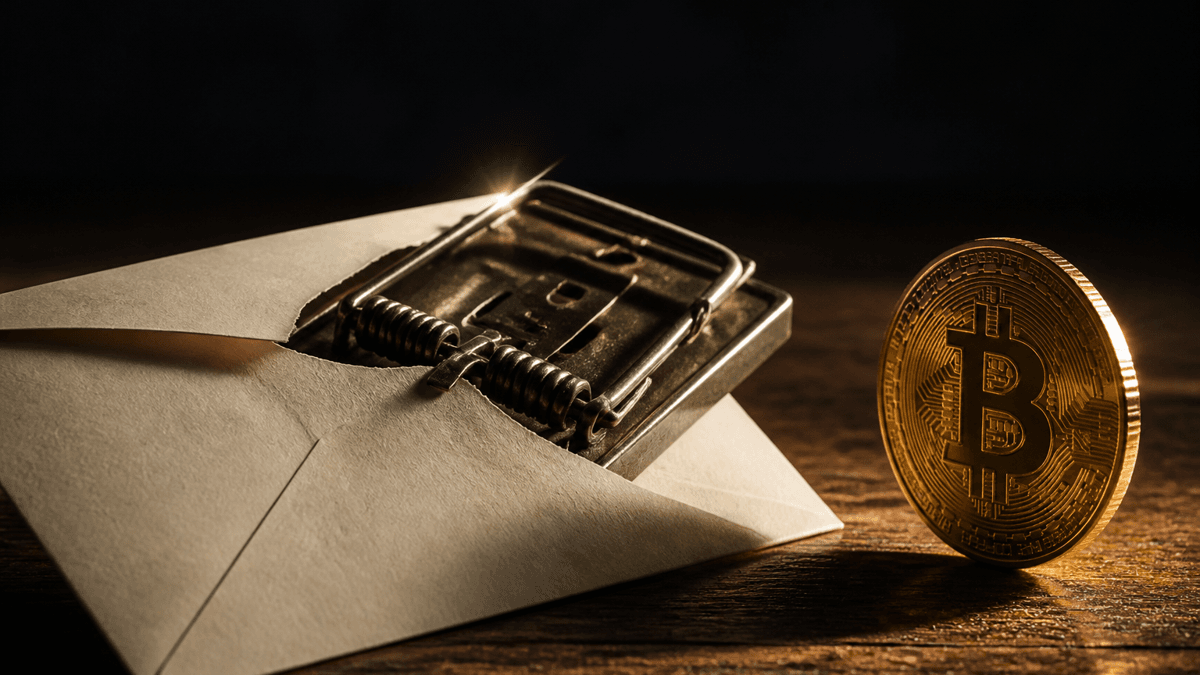
Crypto Wallet Phishing by Letter: the QR Code Scam
Image via CryptoTicker
Traduction…

If a letter arrives in your postbox urging an urgent security update for your crypto wallet and supplying a QR code for it, that is phishing. No manufacturer and no exchange announces a wallet update by post, and there is no legitimate process in which you type your recovery phrase into a website. The Federal Office for Cybersecurity BACS reported on August 18, 2026, in its weekly review for week 33, that it had received various reports about precisely such letters.

What is new about this wave is the delivery route rather than the ploy. Phishing normally arrives by email or text message, because both cost nothing. A letter costs printing, enveloping and postage, and anyone going to that effort is counting on a hit rate that justifies it. That is exactly why the postal route became interesting to attackers only once they had address lists they knew belonged to crypto owners.

Crypto wallet phishing by letter: what BACS reported on August 18

The sequence the authority describes is short. A letter calls on the recipient to download an urgent update for various crypto wallets. A QR code is enclosed for that purpose. Anyone who scans it lands on a phishing website on which the recovery phrase is to be entered. Anyone typing it in there hands over complete control of the crypto wallet concerned, according to BACS.

Article Intelligence

Topics

Sponsored

Ad

House — Advertise on NewsLayer
NewsLayerLearn more

NewsLayer Premium

Unlock deeper intelligence.

Ad-free reading, exclusive research, and real-time onchain insights.

Go Premium