



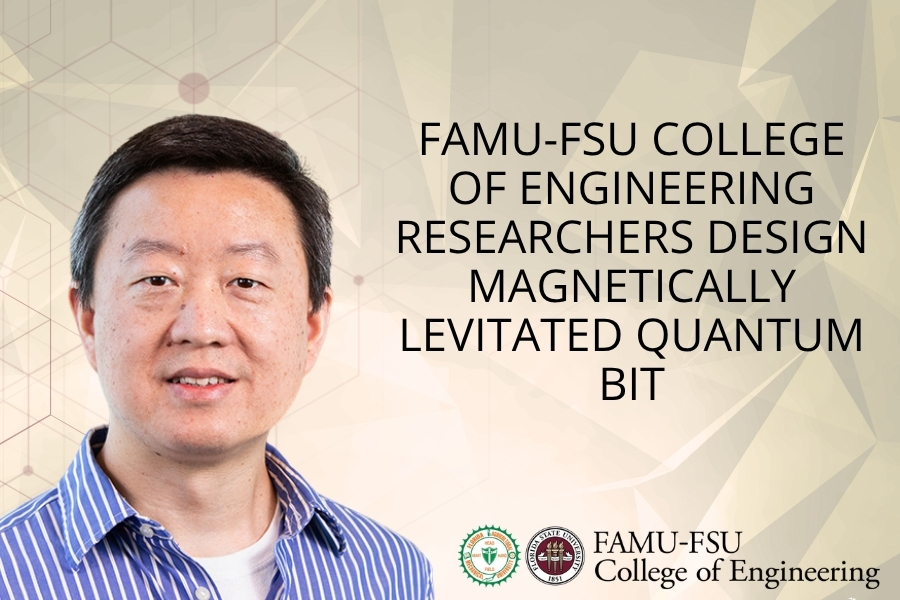
FAMU-FSU College of Engineering researchers design magnetically levitated quantum bit
Researchers at the FAMU-FSU College of Engineering and the Florida State University-headquartered National High Magnetic Field Laboratory have designed new quantum computing architecture that uses magnetic levitation to smooth over…
Florida State University News
Publisher
Aug 20, 2026 at 12:15 PM UTC · 4 min de lecture
Traduction…
Researchers at the FAMU-FSU College of Engineering and the Florida State University-headquartered National High Magnetic Field Laboratory have designed new quantum computing architecture that uses magnetic levitation to smooth over design flaws in the intricate bits necessary to run a quantum computer.
Quantum bits, or qubits, can be as small as a few nanometers, and manufacturing them inevitably introduces random flaws onto their surface. By using superconducting magnets to levitate neon particles, the research addresses a challenge in electron-on-neon qubit devices: the tendency for electrons to become trapped by random tiny bumps on the neon surface, making them function unpredictably.
The study, published in the American Physical Society journal PRX Quantum, could help pave the way for more reproducible and scalable quantum computing technologies.
“Instead of hoping that the right nanoscale feature appears in the right place, we want to decide where each electron qubit sits,” said study co-author Wei Guo, a professor at Florida State University, the FAMU-FSU College of Engineering and the National High Magnetic Field Laboratory, or MagLab. “Magnetic levitation gives us a way to place a clean neon carrier above the chip, while the chip still provides the circuitry needed to control and read the qubit. In this architecture, the qubit is no longer found by chance. It is built by design.”
Article Intelligence
Related Coverage
 QuantumQuantinuum Expands Research Operations in Albuquerqueil y a 3 heures · 3 min read
 QuantumMeurice Receives DOE Quantum Technology Outposts Award for Quantum Computing Researchil y a 19 heures · 1 min read
 ResearchKorean Researchers Identifies Cause of ‘Beat’ Signal in Topological Insulator Nanowiresil y a un jour · 3 min read
Sponsored
Ad
NewsLayerLearn more
NewsLayer Premium
Unlock deeper intelligence.
Ad-free reading, exclusive research, and real-time onchain insights.
Go Premium