
Post-quantum migration appears to be moving from laboratory research toward commercial identity products, as governments prepare national identity infrastructure for the quantum era.
G+D advances post-quantum identity cards through EU research project
Post-quantum migration appears to be moving from laboratory research toward commercial identity products, as governments prepare national identity infrastructure for the quantum era.
Biometric Update
Publisher
Sep 2, 2026 at 8:41 PM UTC · 3 min de lecture
Key Signal
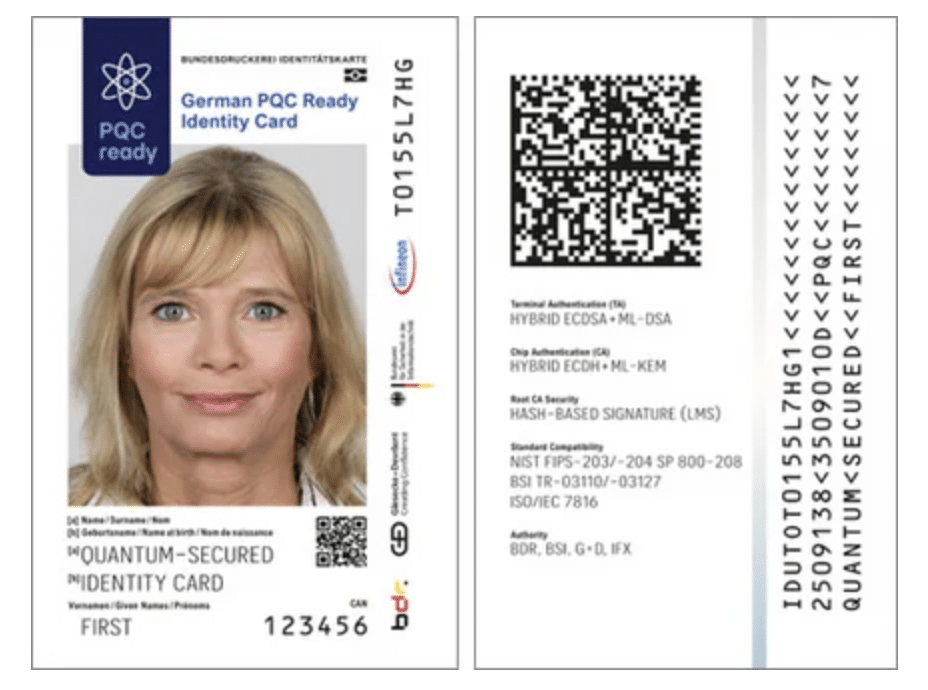
2025 German ID proof of concept
Last Updated
il y a 19 heures
Traduction…
The latest example comes from Giesecke+Devrient (G+D) which plans to integrate prototype post-quantum cryptography protocols and security mechanisms into its Java Card operating system for identity cards as part of the European uPQComing research project.
The work will be part of the European research project uPQComing, which aims to prepare critical digital infrastructure for the migration to post-quantum cryptography (PQC). The project reflects a broader European effort to ensure today’s digital identity credentials remain secure against future quantum computers capable of breaking widely used public-key cryptography.
“With uPQComing, we are taking the next step, working together with our partners to develop the foundations for the next generation of quantum-safe identities,” says Gabriel von Mitschke-Collande, group chief digital officer at G+D.
G+D’s contribution can be seen as the next step to the 2025 German national ID card proof of concept developed with Bundesdruckerei, the German Federal Office for Information Security (BSI) and Infineon.
Article Intelligence
Related Coverage
 ResearchScientists observe Einstein's gravity in the quantum worldil y a un jour · 1 min read
 QuantumDual-purpose qubit design could speed operations while cutting quantum errorsil y a une heure · 1 min read
 ResearchPasqal and True Nexus Encode Protein Gelation Structures on Neutral-Atom QPUsil y a 15 heures · 2 min read
Sponsored
Ad
NewsLayerLearn more
NewsLayer Premium
Unlock deeper intelligence.
Ad-free reading, exclusive research, and real-time onchain insights.
Go Premium