
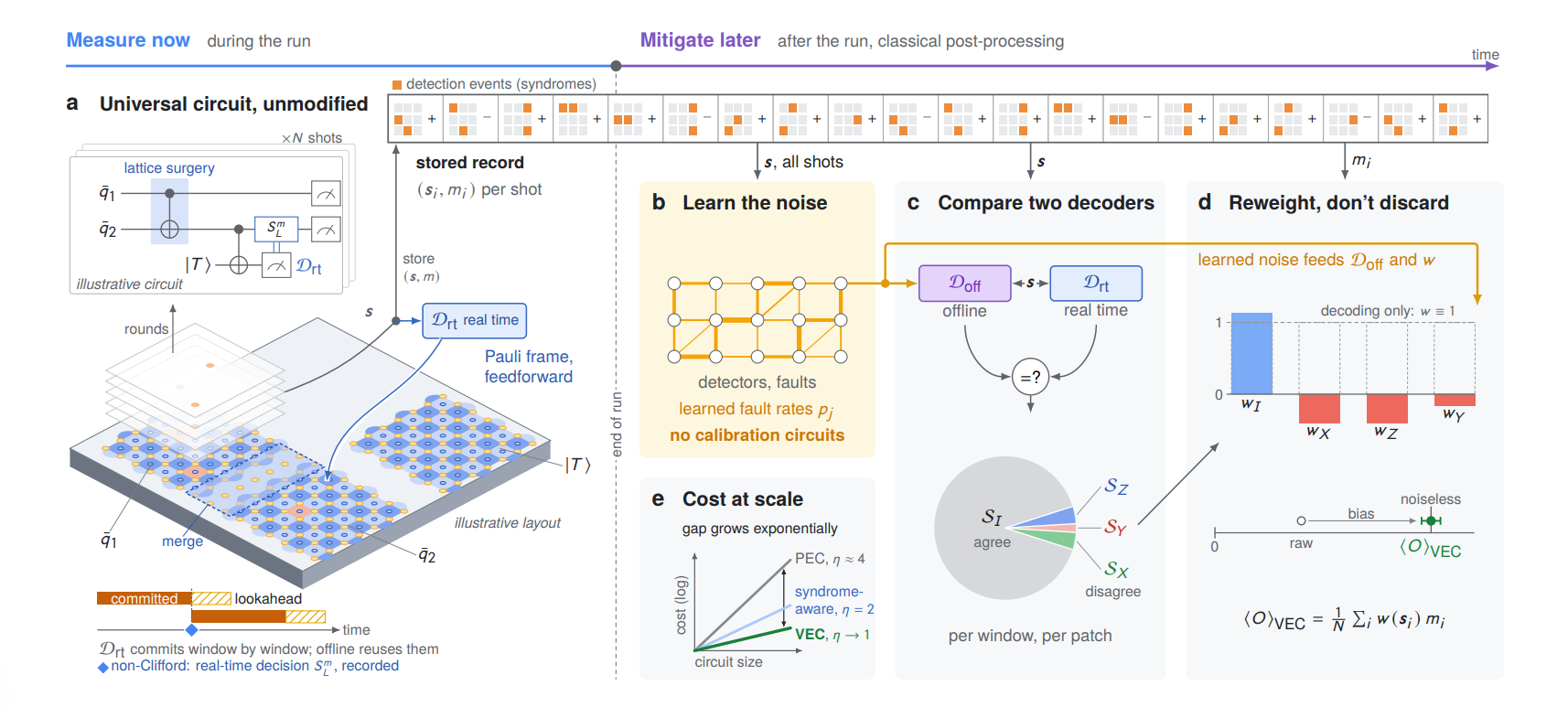
Google Quantum AI researchers have introduced Virtual Error Cancellation (VEC), a classical post-processing protocol that eliminates residual logical errors in fault-tolerant quantum circuits without modifying physical execution or running separate calibration routines.
Google Quantum AI Introduces Virtual Error Cancellation for Universal Logical Circuits
Google Quantum AI researchers have introduced Virtual Error Cancellation (VEC), a classical post-processing protocol that eliminates residual logical errors in fault-tolerant quantum circuits without modifying physical execution or…
Quantum Computing Report
Publisher
Oct 13, 2026 at 3:08 AM UTC · 3 min de lecture
Traduction…
By leveraging recorded syndrome data from stabilizer measurements and pairing a fast real-time hardware decoder with a high-accuracy offline reference decoder, VEC reweights experimental outcomes in software, suppressing logical error rates by over three orders of magnitude.
In fault-tolerant architectures using surface codes, real-time decoders (such as minimum-weight perfect matching) must evaluate syndromes within microsecond deadlines to perform Pauli frame feedforward. However, offline post-processing can run high-complexity decoders (such as tensor-network maximum likelihood) without hardware latency constraints. Rather than discarding disagreement shots via postselection, which introduces systematic bias and wastes quantum processor runtime, VEC assigns signed filter weights to experimental shots:
1. Consensus Shots: Shots where both decoders agree receive a positive weight greater than one.
2. Disagreement Shots: Shots where decoders disagree receive a negative weight corresponding to the directional fault (X, Y, or Z).
Article Intelligence
Related Coverage
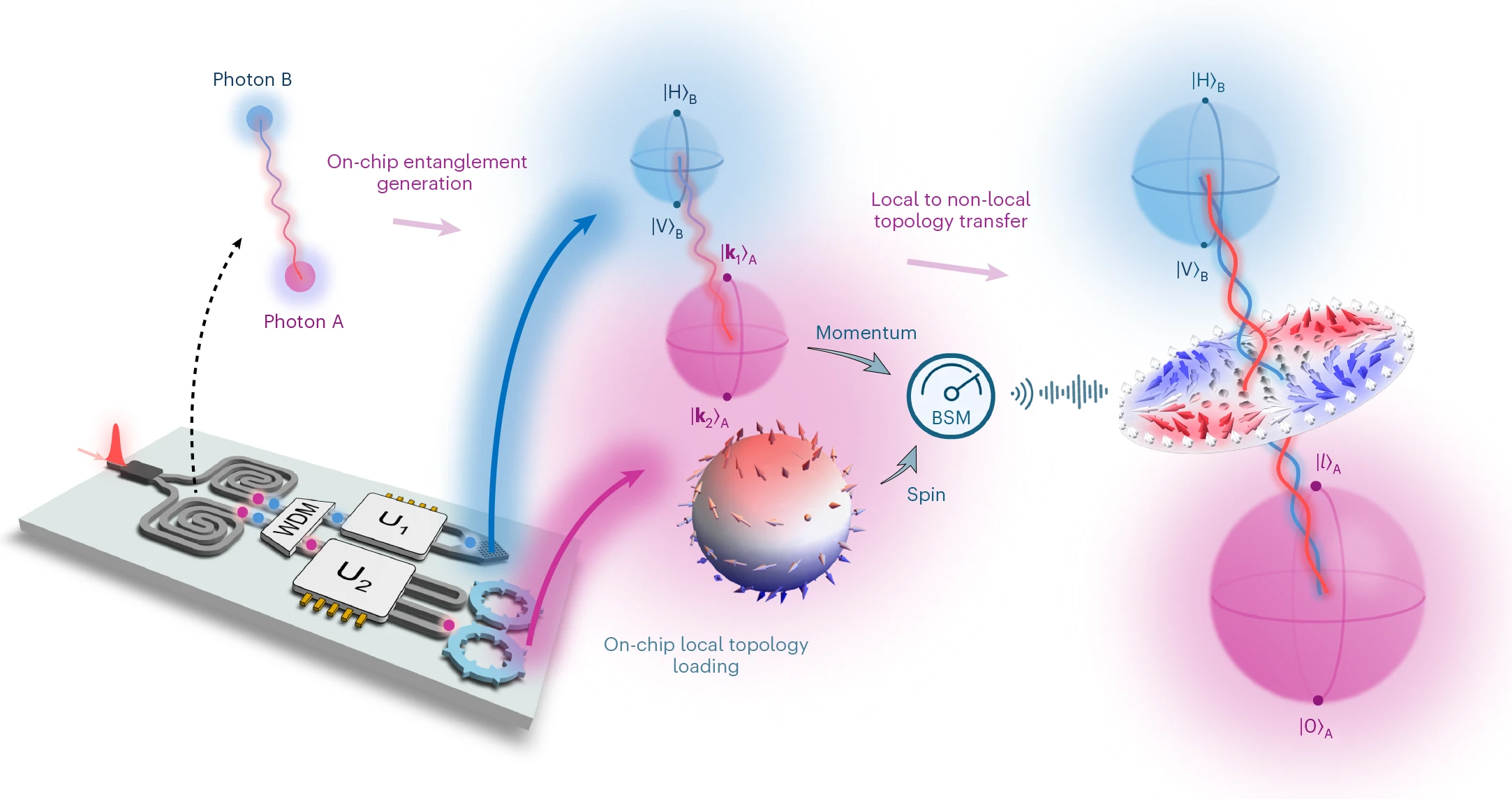 QuantumUniversity of Pennsylvania Team Demonstrates On-Chip Photonic Quantum Skyrmion Transfer in Nature Physicsil y a 7 heures · 2 min read
 ResearchGravity and quantum information linked through a derivation of Einstein's equationsil y a 10 heures · 1 min read
Sponsored
Ad
NewsLayerLearn more
NewsLayer Premium
Unlock deeper intelligence.
Ad-free reading, exclusive research, and real-time onchain insights.
Go Premium