
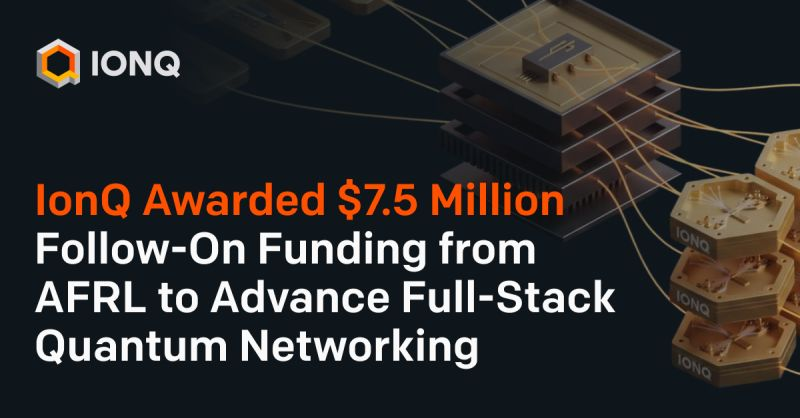
Trapped-ion quantum developer IonQ (NYSE: IONQ) has received a $7.5 million Phase 2 follow-on allocation from the Air Force Research Laboratory (AFRL) to expand its quantum networking installation in Rome, New York. The milestone exercises planned options under the broader $21.1 million multi-year collaboration initiated following IonQ’s acquisition of quantum networking specialist Qubitekk.
IonQ Secures $7.5 Million Phase 2 AFRL Allocation to Expand Rome, NY Quantum Network with Free-Space Optics and Frequency Conversion
Trapped-ion quantum developer IonQ (NYSE: IONQ) has received a $7.5 million Phase 2 follow-on allocation from the Air Force Research Laboratory (AFRL) to expand its quantum networking installation in Rome, New York. The milestone…
Quantum Computing Report
Publisher
Oct 27, 2026 at 6:58 PM UTC · Updated il y a 10 heures · 3 min de lecture
Traduction…
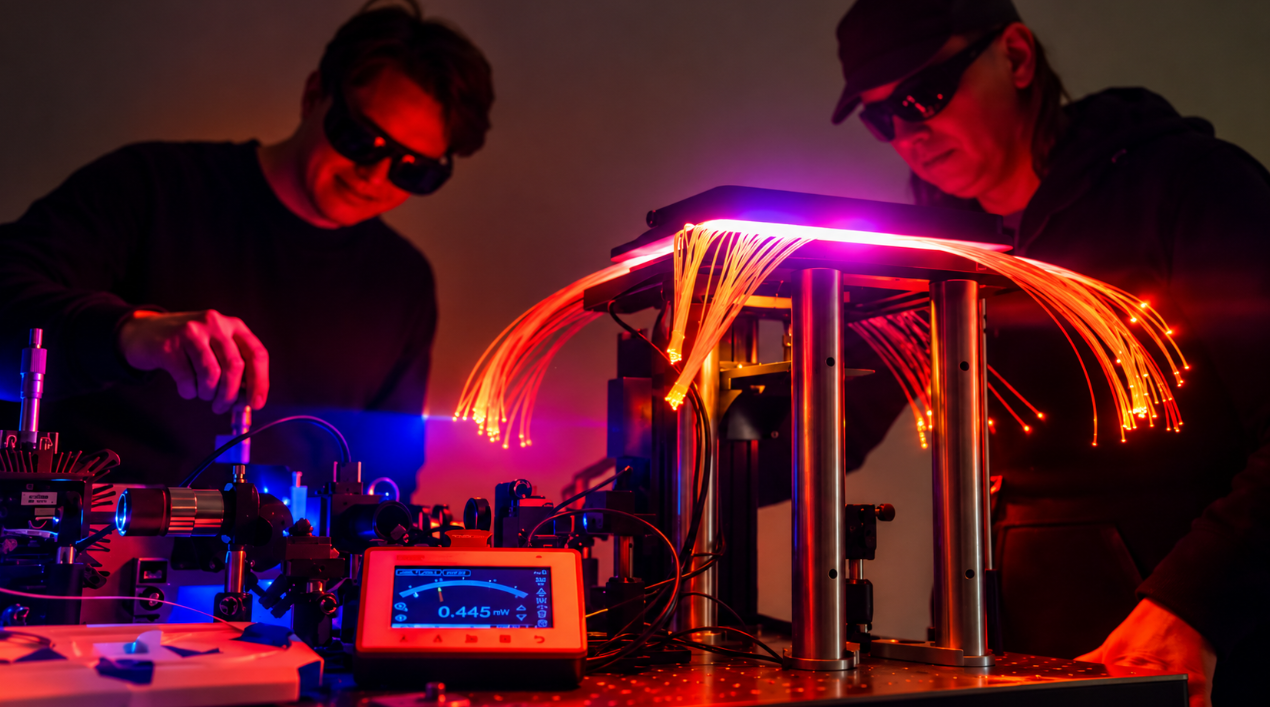
While Phase 1 focused on building a foundational fiber-bound entanglement distribution link, Phase 2 equips the AFRL facility with hardware and control systems to connect heterogeneous quantum computers across both commercial telecom fiber and open air. Key upgrades focus on mitigating the optical transmission losses and wavelength incompatibilities that complicate multi-node quantum networking in operational defense environments.
| [ IonQ / AFRL Phase 2 Quantum Networking Architecture ] | ||
|---|---|---|
| Subsystem Layer | Hardware & Software Upgrades | Operational Functionality |
| • Free-Space Optical Channels | • C-band optical transceivers with Pointing, Acquisition, and Tracking (PAT) | • Establishes line-of-sight quantum entanglement routing outside fiber enclosures for terrestrial and mobile tactical communication nodes. |
| • Frequency Conversion | • Dual Quantum Frequency Converter (QFC) modules | • Translates native trapped-ion emission wavelengths into standard telecom C- and O-bands to link heterogeneous quantum devices. |
| • Interface & Endpoint Hardware | • Upgraded Quantum NICs (QNICs) & active polarization controllers | • Stabilizes polarization drift and photon collection efficiency across commercial fiber-optic and atmospheric links. |
| • Control Plane Automation | • On-premises autonomous orchestration software | • Performs automated system self-tests, dynamic route failover, link monitoring, and real-time experiment data logging. |
Bridging Closed Cryostats to Open Tactical Channels
A primary bottleneck in scaling distributed quantum architectures is the interface between disparate hardware modalities and long-haul communications lines. Trapped-ion systems emit single photons at specific atomic transition wavelengths that experience severe optical attenuation when routed through standard telecommunications fiber or the atmosphere.
Article Intelligence
Topics
Regulation Signal
in progressUpdated il y a 3 mois
SEC Crypto Asset Market Structure RulemakingRelated Coverage
 QuantumUbiQD Wins New Mexico Grant for Quantum Light Source Developmentil y a 3 heures · 4 min read
 ResearchIonQ Receives $7.5 Million from AFRL for Quantum Networkingil y a 4 heures · 2 min read
 CryptoOSBI warns public of cryptocurrency scam after suspects reportedly impersonate bank employeesil y a 2 heures · 1 min read
Sponsored
Ad
NewsLayerLearn more
NewsLayer Premium
Unlock deeper intelligence.
Ad-free reading, exclusive research, and real-time onchain insights.
Go Premium