
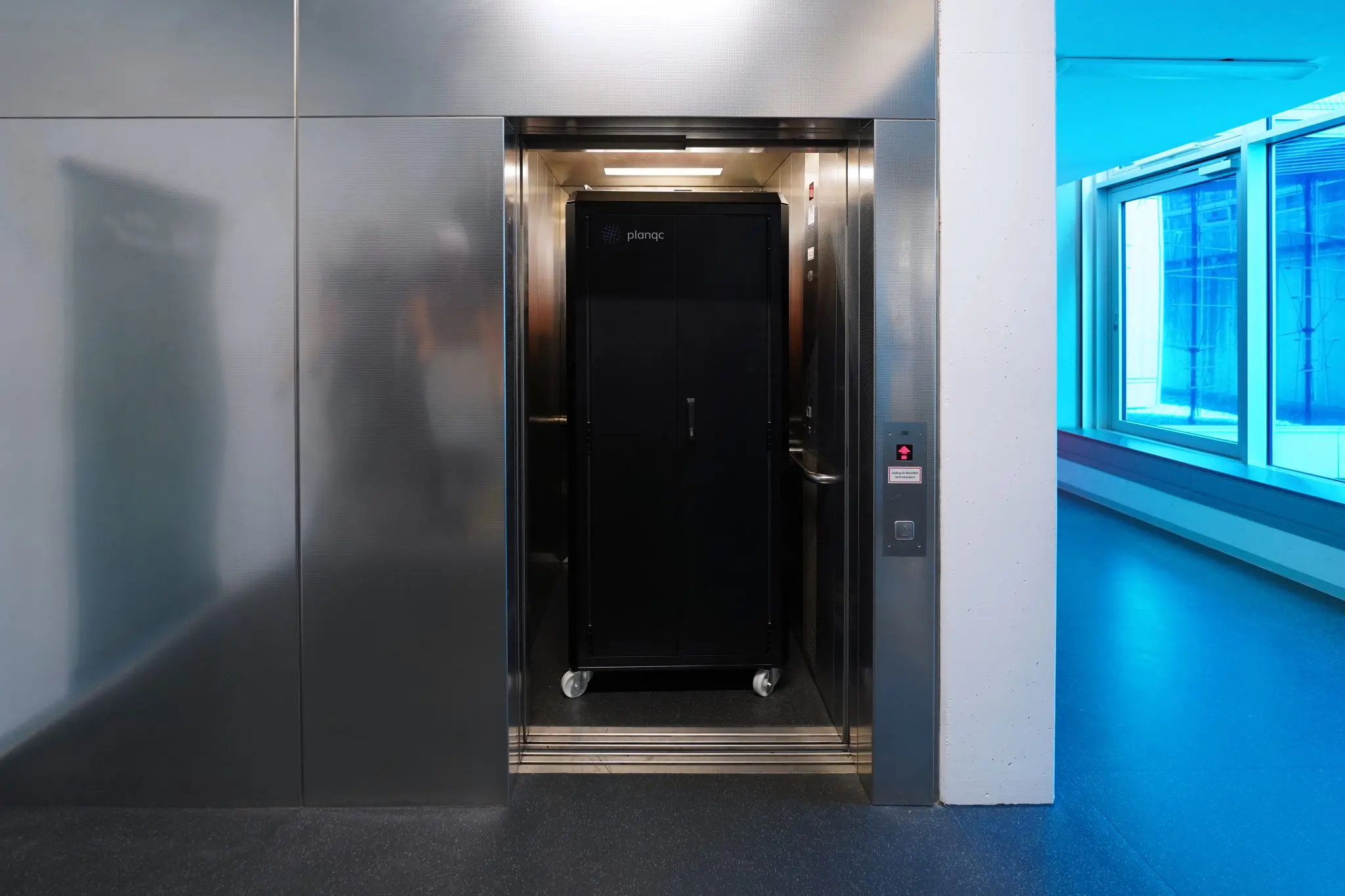
Approximately 800 kilograms of equipment, including a custom server cabinet, laser hardware, and a computing rack, has arrived at the Leibniz Supercomputing Centre, marking a shift from demonstration to deployment for planqc’s 1,000-qubit neutral-atom quantum computer. The delivery signifies the project is on schedule, having already achieved Technology Readiness Level 5 with its 1,000-qubit demonstrator, MAQCS says.
Planqc’s 1,000-qubit System Gains First Hardware At LRZ
Approximately 800 kilograms of equipment, including a custom server cabinet, laser hardware, and a computing rack, has arrived at the Leibniz Supercomputing Centre, marking a shift from demonstration to deployment for planqc’s…
quantumzeitgeist.com
Publisher
Sep 10, 2026 at 6:12 AM UTC · 2 min de lecture
Traduction…
Funded with nearly €20 million from the German Federal Ministry of Research, Technology and Space, the MAQCS project pairs planqc, LRZ, and the Max Planck Institute of Quantum Optics in building a universally programmable quantum computer. “The next stage of MAQCS is focused on reaching TRL 6–7,” says a project spokesperson, “turning a proven 1,000-qubit demonstrator into a system that can operate reliably as part of LRZ’s day-to-day computing environment.”
MAQCS Project: 1,000-Qubit Hardware Arrives at LRZ
The arrival of an 800-kilogram shipment at the Leibniz Supercomputing Centre (LRZ) marks a critical transition for the MAQCS project; planqc’s hardware now undergoes on-site testing in preparation for integration with LRZ’s existing infrastructure. Unlike superconducting qubit systems, neutral-atom architectures do not require extensive cryogenic cooling, though they still demand precise environmental control to maintain laser system stability. Planqc addressed this need by designing a dedicated server cabinet to isolate the sensitive laser hardware from vibrations, humidity, and acoustic noise while providing necessary water cooling.
Article Intelligence
Topics
Sponsored
Ad
NewsLayerLearn more
NewsLayer Premium
Unlock deeper intelligence.
Ad-free reading, exclusive research, and real-time onchain insights.
Go Premium