



Hazync's developer reports that a 1.7 MB standalone verifier checked a 226,434-byte cryptographic receipt covering the first 1,789 blocks of Bitcoin in 27 milliseconds. The Aug. 15 disclosure limits that result to an early stretch of Bitcoin's history. A complete genesis-to-tip proof campaign remains unfinished.
Reaching instant 27ms validation on Bitcoin will take 17 GPU years of compute power
Hazync's developer reports that a 1.7 MB standalone verifier checked a 226,434-byte cryptographic receipt covering the first 1,789 blocks of Bitcoin in 27 milliseconds. The Aug. 15 disclosure limits that result to an early stretch of…
CryptoSlate
Publisher
Aug 22, 2026 at 8:45 PM UTC · 4 min de lecture

Entities
bitcoin
Market Impact
BTC-0.20%$77,342
Last Updated
il y a 2 minutes
Hazync is a research prototype that uses RISC Zero's zero-knowledge virtual machine, or zkVM, to make Bitcoin validation reusable. The zkVM executes the validation program, and the resulting receipt gives other users a compact file to check. The developer's design concentrates proof generation among provers and leaves receipt verification to a much larger population.
Those two jobs have radically different costs. The developer estimates roughly 17 GPU-years for the historical backfill, followed by capacity equivalent to about six Nvidia L40S GPUs to keep pace with new blocks. Cheap receipt checks arrive after provers, auditors and archive operators have supplied the expensive work upstream.
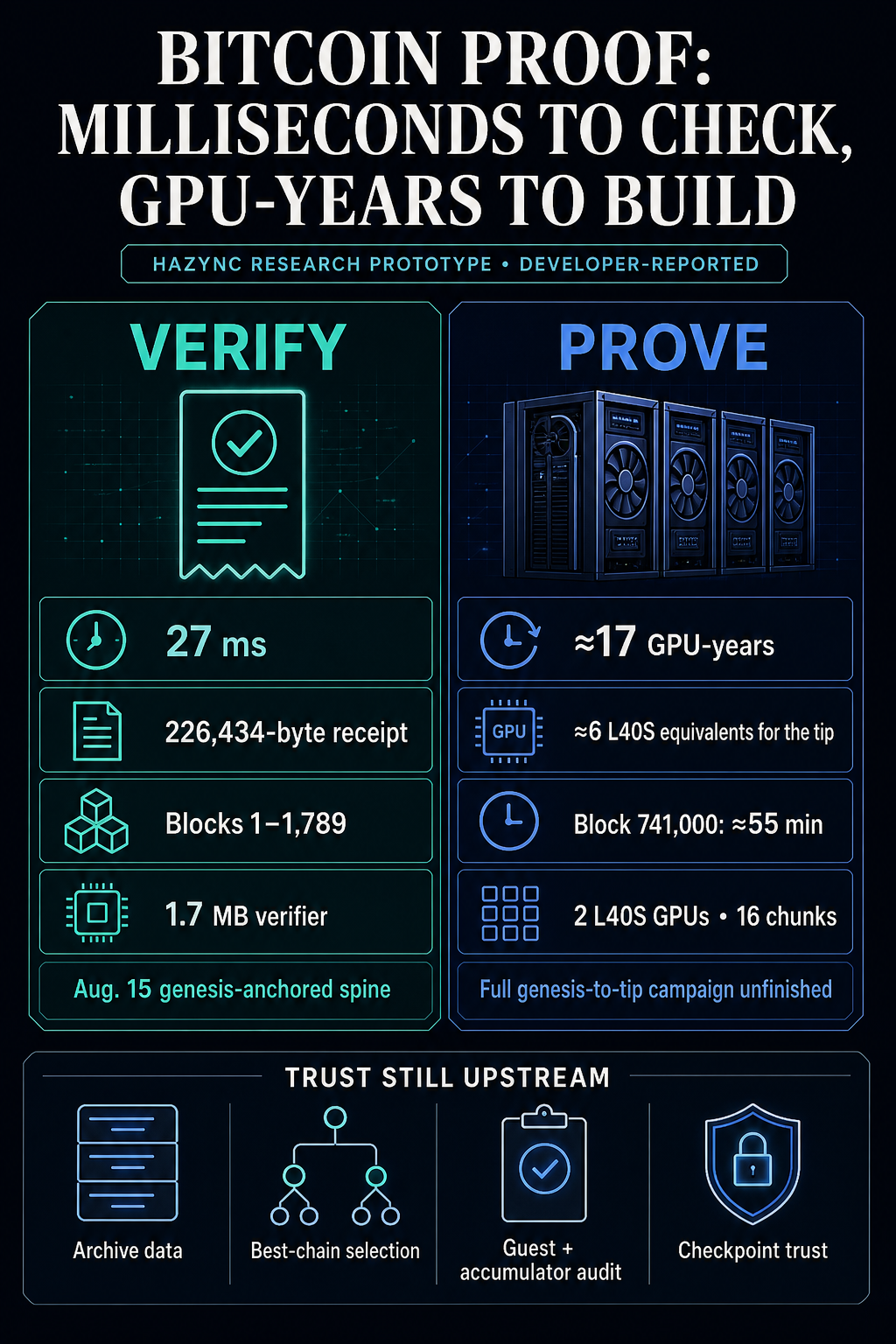
Verification is cheap; proving is expensive
A conventional new Bitcoin node independently replays the chain. Hazync runs Bitcoin's rules inside the zkVM, proves that those rules accepted each covered block, and recursively folds block proofs into a single receipt.
Market Context
Bitcoin
BTC
$77,343
-0.19% (24H)
Market Cap
$1.55T
24H Volume
$33.7B
24H High
$78,800
Article Intelligence
Key Entities
Topics
Related Coverage
 CryptoBitcoin RSI Hits 86: Strongest Overbought Signal in Two Years as BTC Nears $80Kil y a 4 heures · 3 min read
 CryptoWhale sells $576M in Bitcoin as BTC nears $80K amid strong weekly rallyil y a 16 minutes · 1 min read
 CryptoStrategy (MSTR) Is Up 28.2% After Bitcoin Rebounds Above Average Cost Basis - Has The Bull Case Changed?il y a 21 minutes · 3 min read
Sponsored
Ad
NewsLayerLearn more
NewsLayer Premium
Unlock deeper intelligence.
Ad-free reading, exclusive research, and real-time onchain insights.
Go Premium