

After what feels like a lifetime in the making, the SEC’s proposed new Regulation Crypto Assets rules could finally make public token sales easier in the United States.
SEC’s proposed crypto rules probably won’t spark new ICO boom
The SEC’s ‘regulation crypto assets’ proposals could create early-round FOMO. But some tokens may still fall into the no-man’s land between security and non-security.
Cointelegraph by Christina Comben
Publisher Cointelegraph
Aug 26, 2026 at 1:30 PM UTC · 6 min de lecture

The proposal would allow qualifying issuers to raise up to $75 million during any 12-month period, and potentially allow projects to return to investors to raise more funds year after year as they build out their networks.
That could create a new, staged model for token fundraising, and potentially make early allocations more attractive to investors betting on higher valuations later.
But before you put the champagne on ice, it’s unlikely to bring back the freewheeling initial coin offering mania of 2017, according to Lee Reiners, a Duke University lecturing fellow and financial regulation expert. He tells Magazine:
“My initial view is that the $75 million exemption could make public token offerings more feasible, but it is unlikely to produce a return to the ICO boom.”
Could projects raise $75M every year?
The Securities and Exchange Commission’s proposal, unveiled Aug. 18, creates two exemptions for certain investment contracts involving crypto assets.
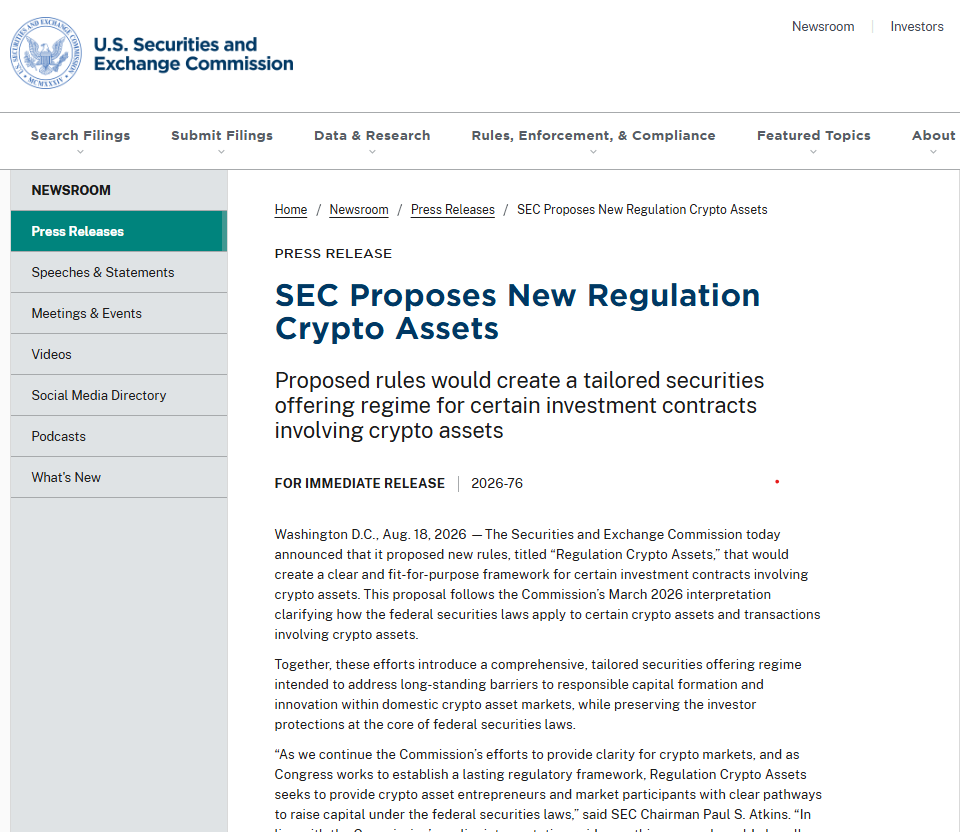
SEC Proposes New Regulation Crypto Assets. Source: SEC
The first is a one-time exemption for startups for offerings of up to $5 million over four years, and the second is a larger fundraising exemption allowing up to $75 million in each 12-month period.
Article Intelligence
Regulation Signal
in progressUpdated il y a 19 jours
SEC Crypto Asset Market Structure RulemakingRelated Coverage
 PolicySEC Cites Crowdfunding Professional Association Ten Times In Proposed Regulation Crypto Assetsil y a 2 heures · 3 min read
 CryptoSEC Preps Overhaul of Crypto Custody Rules for Investment Firmsil y a 36 minutes · 1 min read
 CryptoClarity Act stalls as SEC, FASB, and OCC write crypto rulesil y a 2 heures · 1 min read
Sponsored
Ad
NewsLayerLearn more
NewsLayer Premium
Unlock deeper intelligence.
Ad-free reading, exclusive research, and real-time onchain insights.
Go Premium