This website uses cookies
We use cookies to personalise content and ads, to provide social media features and to analyse our traffic. We also share information about your use of our site with our social media, advertising and analytics partners who may combine it with other information that you’ve provided to them or that they’ve collected from your use of their services.
Consent Selection
Details
  • Necessary cookies help make a website usable by enabling basic functions like page navigation and access to secure areas of the website. The website cannot function properly without these cookies.
  • Preference cookies enable a website to remember information that changes the way the website behaves or looks, like your preferred language or the region that you are in.
    • We do not use cookies of this type.

  • Statistic cookies help website owners to understand how visitors interact with websites by collecting and reporting information anonymously.
    • We do not use cookies of this type.

  • Marketing cookies are used to track visitors across websites. The intention is to display ads that are relevant and engaging for the individual user and thereby more valuable for publishers and third party advertisers.
    • We do not use cookies of this type.

  • Unclassified cookies are cookies that we are in the process of classifying, together with the providers of individual cookies.
    • __emg_sidPending
      Maximum Storage Duration: 1 dayType: HTTP Cookie
      __emg_vidPending
      Maximum Storage Duration: 1 yearType: HTTP Cookie
      nl-read-countPending
      Maximum Storage Duration: PersistentType: HTML Local Storage
Cookie declaration last updated on 8/12/26 by Cookiebot
[#IABV2_TITLE#]
[#IABV2_BODY_INTRO#]
[#IABV2_BODY_LEGITIMATE_INTEREST_INTRO#]
[#IABV2_BODY_PREFERENCE_INTRO#]
[#IABV2_BODY_PURPOSES_INTRO#]
[#IABV2_BODY_PURPOSES#]
[#IABV2_BODY_FEATURES_INTRO#]
[#IABV2_BODY_FEATURES#]
[#IABV2_BODY_PARTNERS_INTRO#]
[#IABV2_BODY_PARTNERS#]
About
Cookies are small text files that can be used by websites to make a user's experience more efficient.

The law states that we can store cookies on your device if they are strictly necessary for the operation of this site. For all other types of cookies we need your permission.

This site uses different types of cookies. Some cookies are placed by third party services that appear on our pages.

You can at any time change or withdraw your consent from the Cookie Declaration on our website.

Learn more about who we are, how you can contact us and how we process personal data in our Privacy Policy.

Please state your consent ID and date when you contact us regarding your consent.
NewsLayer

Install NewsLayer

Get the app experience — one tap from your home screen, instant loads and breaking-news alerts.

NewsLayer.com
NewsLayer PulseLIVEBTC$63,328-0.34%ETH$1,876-0.26%SOL$75.42-1.04%XRP$1-1.89%DOGE$0.0694-3.40%ADA$0.1818-2.73%Total Cap$2.27T-0.29%Layer Index36 Fear

South Korea puts crypto exchanges on a seven-day clock under new seizure rules

Publié il y a 2 jours 2 min de lecture
South Korea puts crypto exchanges on a seven-day clock under new seizure rules

South Korea puts crypto exchanges on a seven-day clock under new seizure rules CryptoSlate

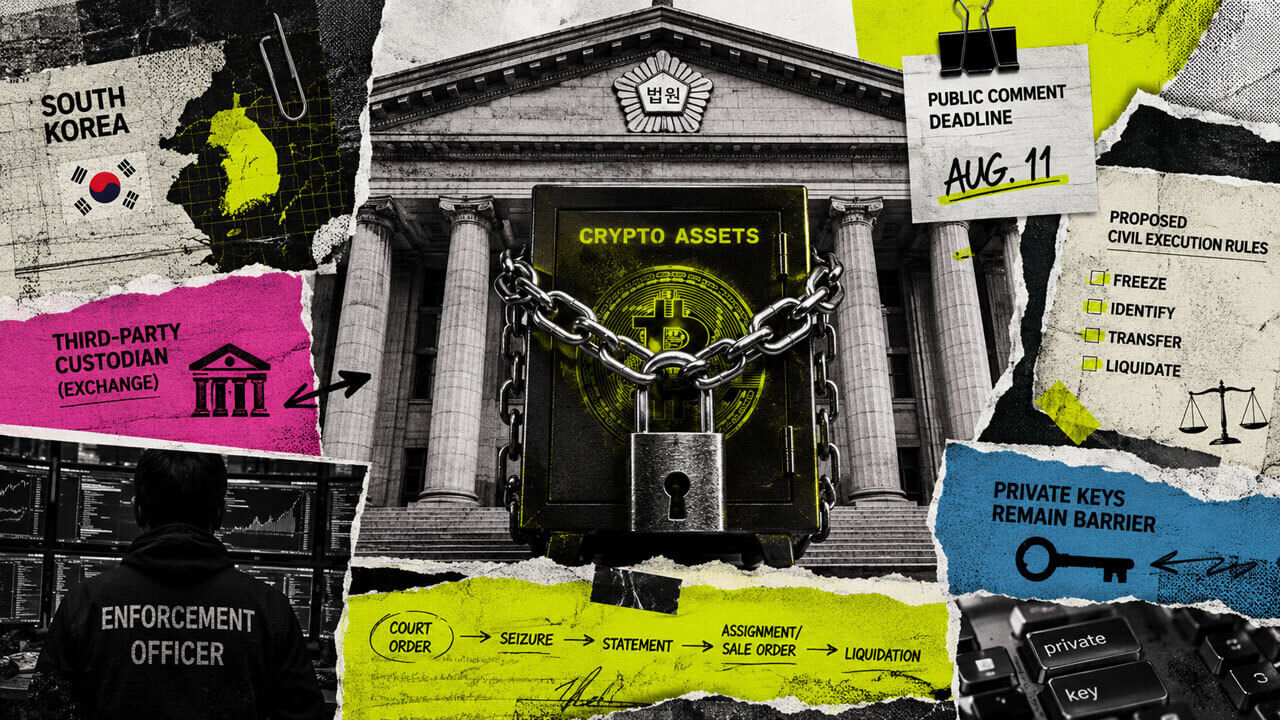
South Korea is nearing an Aug. 11 deadline for public comments on proposed crypto seizure rules that could give exchanges just seven days to disclose customer holdings once served with a court order.

The Supreme Court’s proposed amendments to the Civil Execution Rules would create a standardized process for creditors to freeze, identify and liquidate virtual assets held by debtors. If finalized on the current timetable, the rules are expected to take effect Oct. 1.

That would leave exchanges and other virtual asset service providers roughly seven weeks after the consultation closes to prepare for a more formal role in civil debt enforcement.

For crypto held through a custodian, a court could attach the debtor’s right to receive the assets rather than initially seizing the coins themselves. Once served, the provider would be barred from transferring the corresponding assets to the debtor, who would also lose the ability to dispose of the claim.

Creditors could then ask the court to require the provider to disclose what it holds. The exchange would have one week to state whether it recognizes the debtor’s claim, identify the type and quantity of assets, and disclose competing seizures, provisional orders, or priority rights.

The framework could have broad reach in one of the world’s most retail-heavy crypto markets. As of February 2025, 16.29 million people held accounts across South Korea’s five largest exchanges, equivalent to nearly 32% of the population. The figure exceeded the roughly 14.2 million people who held domestic listed stocks at the end of 2024.

Once assets are identified and frozen, courts could assign them to creditors or order their liquidation. A virtual asset service provider could execute the sale, while crypto could also be transferred to an enforcement officer’s account or converted into more liquid assets before disposal.

CryptoSlate Daily Brief

Daily signals, zero noise.

Market-moving headlines and context delivered every morning in one tight read.

5-minute digest 100k+ readers

Free. No spam. Unsubscribe any time.

Whoops, looks like there was a problem. Please try again.

You’re subscribed. Welcome aboard.

However, the process becomes harder when a debtor controls the crypto directly.

A court could prohibit disposal and order a transfer to an enforcement officer, but seizure would take effect only when the officer actually receives the assets, leaving private-key control as a practical constraint.

The proposal also fits into South Korea’s broader effort to build formal rules around a crypto market that has moved deep into the financial mainstream.

Authorities have already introduced statutory protections for virtual asset users and are tightening exchange registration and anti-money laundering requirements, including planned expansion of the travel rule and additional controls around personal wallets and stablecoins.

The seizure rules would extend that regulatory build-out into civil debt collection. They would also apply to proceedings already underway when they take effect, making the period between the Aug. 11 consultation deadline and the proposed Oct. 1 rollout particularly relevant for exchanges preparing to handle court orders.

Attribution

Originally reported by CryptoSlate

Get stories like this, daily.

Daily crypto + regulation intelligence, straight to your inbox. Free.

Articles Liés