


This website uses cookies
We use cookies to personalise content and ads, to provide social media features and to analyse our traffic. We also share information about your use of our site with our social media, advertising and analytics partners who may combine it with other information that you’ve provided to them or that they’ve collected from your use of their services.
Consent Selection
Details
  • Necessary cookies help make a website usable by enabling basic functions like page navigation and access to secure areas of the website. The website cannot function properly without these cookies.
  • Preference cookies enable a website to remember information that changes the way the website behaves or looks, like your preferred language or the region that you are in.
    • We do not use cookies of this type.

  • Statistic cookies help website owners to understand how visitors interact with websites by collecting and reporting information anonymously.
    • We do not use cookies of this type.

  • Marketing cookies are used to track visitors across websites. The intention is to display ads that are relevant and engaging for the individual user and thereby more valuable for publishers and third party advertisers.
    • We do not use cookies of this type.

  • Unclassified cookies are cookies that we are in the process of classifying, together with the providers of individual cookies.
    • __emg_sidPending
      Maximum Storage Duration: 1 dayType: HTTP Cookie
      __emg_vidPending
      Maximum Storage Duration: 1 yearType: HTTP Cookie
      nl-read-countPending
      Maximum Storage Duration: PersistentType: HTML Local Storage
Cookie declaration last updated on 8/12/26 by Cookiebot
[#IABV2_TITLE#]
[#IABV2_BODY_INTRO#]
[#IABV2_BODY_LEGITIMATE_INTEREST_INTRO#]
[#IABV2_BODY_PREFERENCE_INTRO#]
[#IABV2_BODY_PURPOSES_INTRO#]
[#IABV2_BODY_PURPOSES#]
[#IABV2_BODY_FEATURES_INTRO#]
[#IABV2_BODY_FEATURES#]
[#IABV2_BODY_PARTNERS_INTRO#]
[#IABV2_BODY_PARTNERS#]
About
Cookies are small text files that can be used by websites to make a user's experience more efficient.

The law states that we can store cookies on your device if they are strictly necessary for the operation of this site. For all other types of cookies we need your permission.

This site uses different types of cookies. Some cookies are placed by third party services that appear on our pages.

You can at any time change or withdraw your consent from the Cookie Declaration on our website.

Learn more about who we are, how you can contact us and how we process personal data in our Privacy Policy.

Please state your consent ID and date when you contact us regarding your consent.
NewsLayer

Install NewsLayer

Get the app experience — one tap from your home screen, instant loads and breaking-news alerts.

NewsLayer.com
NewsLayer PulseLIVEBTC$62,781-1.01%ETH$1,873-0.61%SOL$75.36-1.12%XRP$1-0.70%DOGE$0.0693-1.16%ADA$0.1796-1.47%Total Cap$2.26T-0.73%Layer Index41 Neutral
External ReportingPublié il y a un jour

Study finds 65,340 risky crypto addresses tied to $574 million in losses

A study presented at USENIX Security '26 identified 65,340 risky crypto addresses involved in misuse across Ethereum and BNB Smart Chain, with 126,982.94 ETH and 17,726.7 BNB in associated native-token losses.

Study finds 65,340 risky crypto addresses tied to $574 million in losses
Publisher CryptoSlate 3 min de lecture
Image via CryptoSlate

Market Context

Ethereum

ETH

$1,873

-0.61% 24h

Layer Index

41

↓ 3 pts in 24h

A study presented at USENIX Security '26 identified 65,340 risky crypto addresses involved in misuse across Ethereum and BNB Smart Chain, with 126,982.94 ETH and 17,726.7 BNB in associated native-token losses.

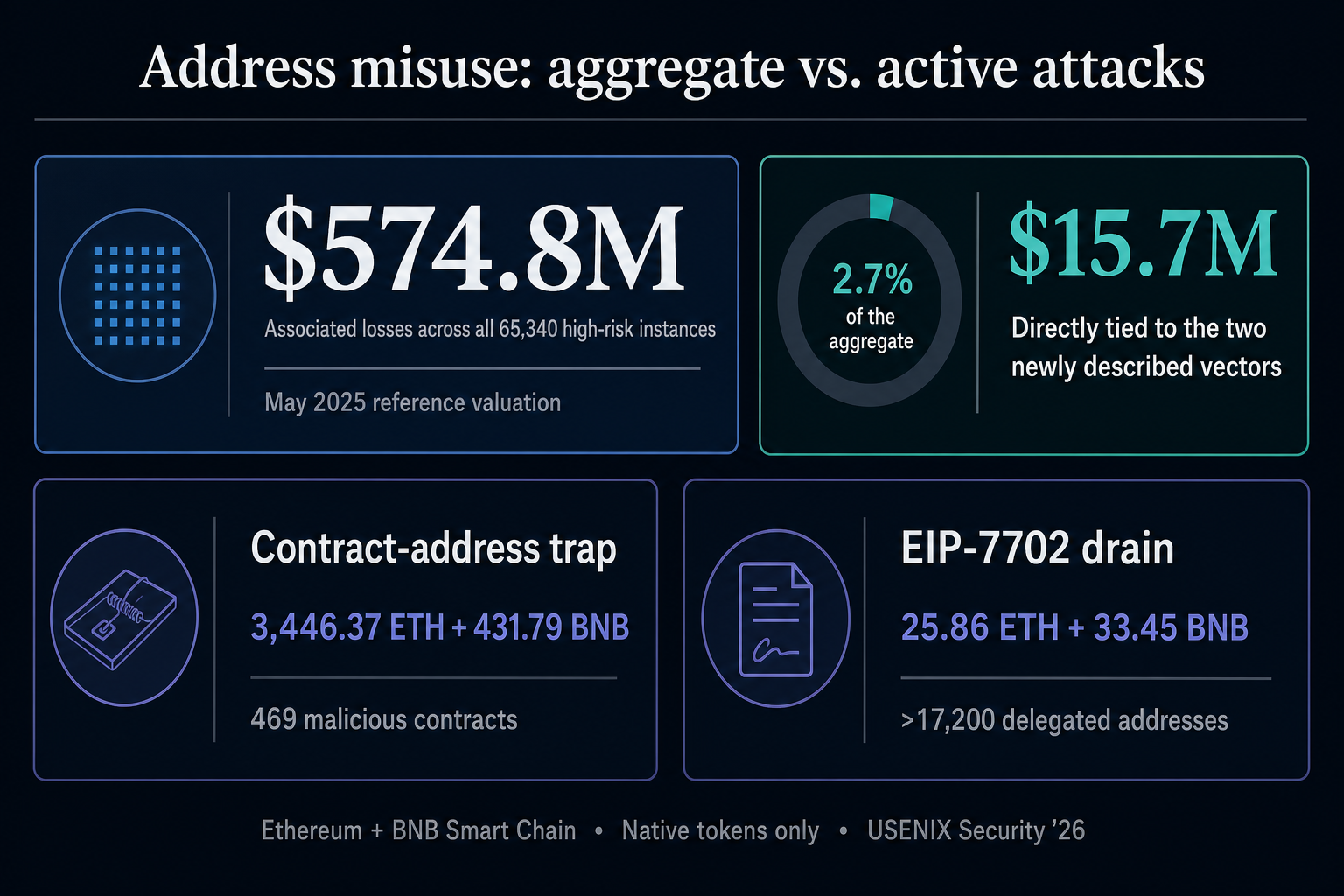
The researchers valued losses associated with those risky crypto addresses at more than $574.8 million. But the two newly described active attack vectors directly account for about $15.7 million, or 2.7%, of that figure. The full paper also used May 2025 reference prices of $4,408 per ETH and $847 per BNB, rather than each token's dollar value when the losses occurred.

How risky crypto addresses become traps

The study separates the problem into contract-account misuse and externally owned account misuse.

Contract-account misuse occurs when someone sends a function call, sometimes with ETH or BNB attached, to an address that has no contract code on the selected network. The transaction can still succeed as a simple transfer without executing the intended function. Funds then sit at that address unless later-deployed code can move them.

That enables the first active vector. An attacker can deploy a contract at a testnet address, wait for users to mistakenly send funds to the corresponding no-code address on mainnet, then exploit deterministic contract addressing to deploy malicious withdrawal code at the same location. The paper identified 469 malicious contracts tied to 3,446.37 ETH and 431.79 BNB in losses.

Externally owned account misuse starts with a public or otherwise exposed private key. Anyone who has the key can control the account, and automated sweepers can race to remove incoming funds.

The second vector uses EIP-7702 to make that drain more direct. An attacker can use the exposed key to delegate the account to malicious code that forwards a deposit to the attacker in the same transaction. The detailed analysis identified more than 17,200 delegated addresses and losses of 25.86 ETH plus 33.45 BNB.

CryptoSlate Daily Brief

Daily signals, zero noise.

Market-moving headlines and context delivered every morning in one tight read.

5-minute digest 100k+ readers

Free. No spam. Unsubscribe any time.

Whoops, looks like there was a problem. Please try again.

You’re subscribed. Welcome aboard.

Together, the two active vectors account for 3,472.23 ETH and 465.24 BNB. The rest of the paper's aggregate covers the broader set of detected contract-account and exposed-key misuse rather than those two attacks alone.

To build the dataset, the team mined 63,004 GitHub repositories created from January 2015 through May 2025 and used an April 2025 Stack Exchange archive. It extracted more than 16.3 million deduplicated private keys from GitHub, derived their addresses and combined direct key matches with transaction-pattern rules and lightweight symbolic execution on Ethereum and BNB Smart Chain.

The authors reported 99.11% precision for their overall address-misuse detection results. They randomly sampled the inferred contract-account and pattern-based EOA cases, had two researchers independently judge whether each detection matched the study's definitions, and separately treated addresses derived from public private keys as confirmed. The precision figure measures detection accuracy, not whether the full dollar estimate was directly caused by the two active vectors.

The researchers said they began disclosing the findings to wallet developers and exchanges and tried to contact affected projects. However, the paper does not provide a complete remediation rate or a current funded-address count for all 65,340 instances.

Users can reduce the immediate risk by checking both the address and chain against official sources. Developers should keep test accounts and hardcoded keys out of production, while wallet providers can warn before transactions reach no-code or exposed-key destinations.

Dernière Minute

Ne manquez aucune actualité de dernière minute

Advertisement

House — Advertise on NewsLayer
NewsLayerAd

Sourced by

Originally reported by CryptoSlate

NewsLayer coverage based on externally reported material.

The Daily Brief

The onchain economy, before your day starts.

Curated markets, onchain insights, and key headlines — delivered every weekday morning.

Weekdays · Free · ~5 minute read

Articles Liés