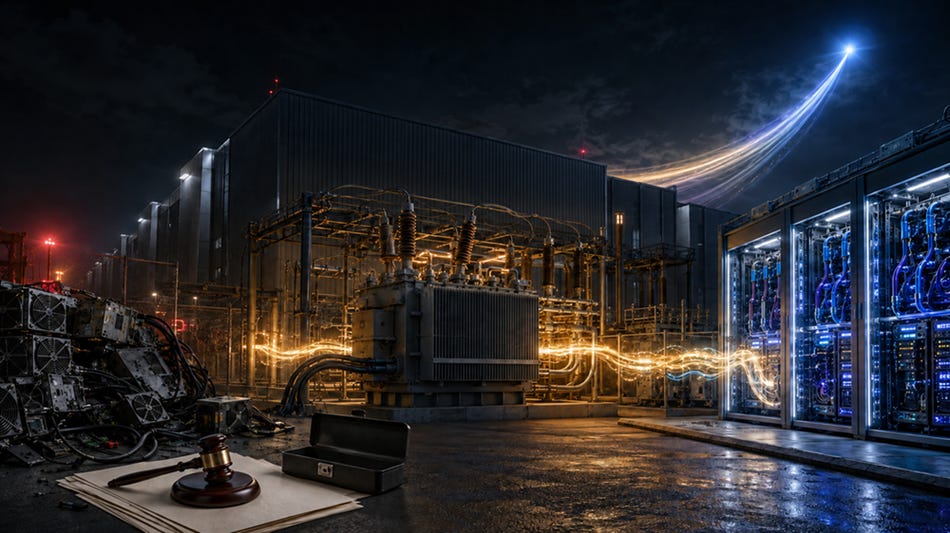
Under the initial agreement, CoreWeave would fund approximately $300 million in project capital expenditures, which would be credited against future hosting fees. This arrangement reduced Core Scientific’s upfront construction burden and allowed it to gradually convert existing mining sites into high-density data centers suitable for GPU clusters.
The companies subsequently expanded their partnership several times. The long-term capacity contracted in 2024 grew from approximately 200 MW to approximately 502 MW through successive additions of roughly 70 MW, 112 MW, and 120 MW. This figure excluded the earlier approximately 16 MW Austin project.
In February 2025, the companies added another approximately 70 MW at the Denton project in Texas. Core Scientific expected to fund approximately $104 million of capital expenditures for the expansion, with CoreWeave funding the remaining related capital investment.
Including the earlier Austin project, the agreements between the two companies covered approximately 588 MW, which Core Scientific reported as approximately 590 MW. The contracts had 12-year terms and represented approximately $10.2 billion in potential cumulative revenue.
These contracts changed the way capital markets assessed Core Scientific. Investors had previously focused primarily on its Bitcoin output, hash rate, mining-machine efficiency, and BTC holdings. After the pivot, the more important metrics became contracted capacity, the number of megawatts generating billable revenue, the value of long-term contracts, and project delivery timelines.
When one megawatt of power is used for Bitcoin mining, its value depends on the price of Bitcoin, network difficulty, and mining-machine efficiency. When it is used for AI compute hosting, that same power capacity can potentially be converted into comparatively stable revenue through contracts lasting more than a decade. Core Scientific’s assets did not change completely, but their use case and the duration of the resulting cash flows did.
A $9 Billion Acquisition That Never Closed
CoreWeave was not only one of Core Scientific’s largest AI hosting customers; it also tried twice to acquire the company outright.
In 2024, CoreWeave offered to acquire Core Scientific for $5.75 per share in cash, but Core Scientific’s board rejected the proposal. At the time, Core Scientific said the offer significantly undervalued the company and its growth prospects.
The two companies reached another acquisition agreement in July 2025. Under its terms, Core Scientific shareholders would receive 0.1235 shares of CoreWeave Class A common stock for each CORZ share they held.
Based on the transaction terms announced at the time and CoreWeave’s five-day volume-weighted average price, the deal valued Core Scientific’s fully diluted equity at approximately $9 billion. Based on CoreWeave’s closing share price on July 3, 2025, the consideration was worth approximately $20.40 per Core Scientific share.
However, this was a fixed-exchange-ratio transaction with no fixed cash price. As CoreWeave’s share price declined, the implied value of the consideration offered to Core Scientific shareholders fell with it. By September 2, 2025, the implied value had dropped to approximately $11.41 per share.
Some Core Scientific shareholders were also concerned that the transaction would require the company to give up the potential upside from remaining independent in exchange for shares in another AI infrastructure company that likewise faced high capital expenditures, customer concentration, and debt pressures.
On October 30, 2025, Core Scientific shareholders voted against the transaction, and the two companies subsequently terminated the merger agreement. Although the transaction never closed, the approximately $9 billion valuation nevertheless became an important reference point as the market reassessed the value of Core Scientific’s power and data center assets.
From the $5.75-per-share cash offer in 2024 to the approximately $9 billion all-stock transaction in 2025, CoreWeave’s two acquisition attempts showed that Core Scientific’s core value no longer lay only in its mining machines and Bitcoin output. It increasingly lay in power capacity that could be delivered within a relatively short period.
AMD Took the Story Into Its Second Phase
The CoreWeave contracts demonstrated that Bitcoin mining sites could be converted into AI data centers. The AMD-related partnership could also reduce Core Scientific’s dependence on a single customer and a single project.
In 2026, Core Scientific announced a large-scale infrastructure partnership with AMD. According to the disclosures accompanying Core Scientific’s second-quarter 2026 results, the partnership could ultimately support up to approximately 2.5 GW of leasable capacity. Signed 15-year agreements covered five projects and approximately 529 MW, representing more than $14 billion in potential base contract revenue.
In addition to the contracted capacity, AMD received reservation rights for approximately 1.925 GW of additional capacity. If all of these rights are converted into definitive projects, the partnership’s total potential scale could reach approximately 2.5 GW. However, reserved capacity is not the same as revenue under signed contracts. Its eventual conversion will still depend on site selection, grid access, project construction, and end-customer demand.
As part of the partnership, AMD received warrants to purchase up to 30 million shares of Core Scientific common stock at an exercise price of $23.47 per share. Following the execution of the related leases on July 27, 2026, warrants covering approximately 6.5 million shares had vested and become exercisable. The arrangement means AMD is not only an equipment and industry partner but could also participate in the upside from an increase in Core Scientific’s share price.
Of the AMD-related contracted capacity, approximately 152 MW was leased by AI infrastructure operator Neocloud. Core Scientific, Neocloud, and AMD also entered into a tripartite credit support agreement designed primarily to protect AMD equipment deployed at the sites and to give AMD the option to cure certain defaults by Neocloud. The relevant documents, however, did not characterize AMD as an unconditional guarantor of all of Neocloud’s payment obligations.
By July 2026, Core Scientific had contracted approximately 1.1 GW of customer power capacity, representing more than $24 billion in potential contract revenue. Approximately 437 MW had begun generating billable revenue, corresponding to approximately $635 million in annualized GAAP hosting revenue.
From approximately 590 MW under the CoreWeave agreements to approximately 529 MW under the AMD- and Neocloud-related agreements, Core Scientific was beginning to move beyond a model driven by a single customer at the contracted-capacity level and to reposition itself as a data center developer serving multiple AI industry participants.
The Financials Are Beginning to Validate the Pivot, but the “Windfall” Remains a Valuation Narrative
Core Scientific’s revenue mix has changed markedly.
In the second quarter of 2026, the company generated approximately $164.2 million in total revenue. High-density colocation revenue was approximately $136.7 million, or about 83% of the total, while self-mining digital asset revenue was approximately $21.5 million.
The high-density colocation business generated approximately $80 million in quarterly gross profit, with a gross margin of approximately 59%. By contrast, the self-mining business recorded a gross loss of approximately $12.2 million and a gross margin of approximately -56%. The company reported adjusted EBITDA of approximately $41.1 million for the quarter.
This means high-density colocation is no longer merely a future plan. It has become Core Scientific’s largest source of revenue and gross profit. The mining business that once supported the company is becoming a smaller, less profitable residual operation.
There is, however, still a significant gap between contract value and accounting profit.
Core Scientific reported a second-quarter net loss of approximately $1.155 billion, of which approximately $1.046 billion came from fair value changes in warrants and contingent value rights. These losses were driven primarily by the increase in the company’s share price and were non-cash accounting items; they did not mean the company had incurred an equivalent amount of actual cash outflow during the quarter.
Even so, the company still recorded a GAAP operating loss of approximately $78.5 million in the second quarter, indicating that it had not yet achieved stable profitability on an accounting basis.
Core Scientific generated approximately $230.9 million in net cash from operating activities in the first half of 2026, but this figure included approximately $208.2 million in proceeds from the sale of digital assets, as well as customer prepayments and other changes in working capital. Positive operating cash flow therefore cannot be taken to mean that the data center business can already fund all construction and financing expenditures on a standalone basis.
The AI data center pivot also requires enormous capital investment.
In the first half of 2026, Core Scientific spent approximately $954 million in cash on purchases of property, plant, and equipment, of which approximately $181 million was funded by CoreWeave. The company also paid approximately $233 million to acquire land and development rights, bringing the combined cash investment in these two categories to approximately $1.187 billion.
To support project construction, the company issued $3.3 billion of 7.75% senior secured notes due 2031 in May 2026. As of June 30, 2026, Core Scientific’s long-term debt had risen to approximately $4.3 billion from approximately $1.06 billion at the end of 2025.
The more than $24 billion in potential contract revenue therefore should not be interpreted as $24 billion in cash that the company has already secured. This revenue must be recognized gradually over more than a decade and depends on projects being completed on schedule, customers continuing to perform their contractual obligations, and data centers operating reliably.
Core Scientific shares closed at $21.77 on August 5, 2026, ET, up approximately 533% from their $3.44 closing price on the first day of relisting on January 24, 2024. Based on approximately 321.3 million shares outstanding as of July 23, the company’s market capitalization was approximately $7 billion.
This rally reflects capital markets pricing in future cash flows ahead of their realization. Investors are not buying profits that the company has already earned; they are buying the possibility that its power resources can be converted into AI data center revenue in the years ahead.
What Core Scientific Is Really Selling Is “Time to Power”
Core Scientific’s turnaround was not simply the result of a bankrupt miner returning to profitability on the back of a Bitcoin rebound. It was a transformation in both infrastructure use and valuation framework.
In the Bitcoin mining era, the company’s primary assets were mining machines, hash rate, and mining sites capable of securing a continuous supply of low-cost electricity. In the AI data center era, mining machines have become less important, while land, grid access, substations, fiber connectivity, cooling systems, and project execution capabilities have become the core assets.
As demand for AI data centers grows rapidly in the United States and grid interconnection can take years, what customers are actually buying is not merely electricity but the ability to obtain large-scale energized capacity within a defined timeframe. A mining site that has already been selected, secured grid access, and retained room for expansion may be brought online faster than a data center built from scratch.
What Core Scientific sells, therefore, is not merely megawatts. It can also be understood as “time to power.” By securing land and power resources in advance and then signing long-term contracts with AI customers, the company is converting infrastructure once used for Bitcoin mining into longer-duration hosting cash flows.
This model has not eliminated risk; it has changed the source of that risk.
Core Scientific’s primary risks once came from Bitcoin prices, electricity prices, and network mining difficulty. Now, they are more likely to come from capital expenditures, financing costs, customer concentration, construction delays, and contract performance. If projects cannot be delivered on schedule, or if customer demand and financing conditions change, the more than $24 billion in potential contract revenue may still not be fully realized.
From approximately $4 million in cash and Chapter 11 bankruptcy protection to a market capitalization of approximately $7 billion and more than $24 billion in potential contract revenue, Core Scientific has unquestionably achieved a dramatic valuation reversal.
But the company’s real transformation is not that it suddenly owns more Bitcoin. It has evolved from a miner dependent on crypto prices into a data center developer whose core products are power capacity and speed to energization. Whether it has truly escaped the high-leverage risks of the previous cycle will ultimately depend on whether these power blueprints can be converted, on schedule, into data centers that generate recurring billable revenue.
Follow us
Twitter: https://twitter.com/WuBlockchain
Telegram: https://t.me/wublockchainenglish