

Insider Brief
Three-Dimensional Light Fields Could Help to Control Electrons
Insider Brief PRESS RELEASE — By superimposing two ultrashort laser pulses that converge from different directions, a team of physicists at the University of Oldenburg in Germany has succeeded in generating three-dimensional light…
Matt Swayne
Publisher The Quantum Insider
Oct 5, 2026 at 7:01 AM UTC · 3 min de lecture
Traduction…
- University of Oldenburg physicists combined two ultrashort laser pulses to create controllable three-dimensional light fields and generate electronic quantum states previously inaccessible in experiments.
- The team demonstrated the method with potassium atoms, exciting and releasing electrons while capturing successive stages of their quantum-state evolution.
- The approach could help distinguish mirror-image forms of chiral molecules and provide new ways to investigate and control interactions between light and matter.
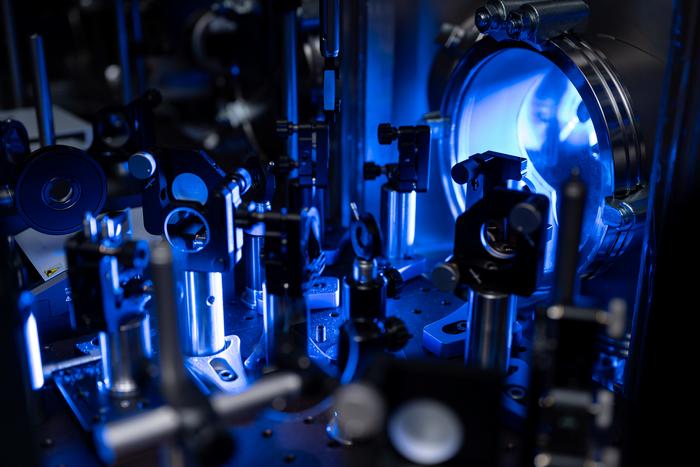
- Image: Using an interferometer, the researchers split laser light into two beams of different colours. They then superimposed these in a vacuum chamber to create 3D light fields, which they used to manipulate electrons. (University of Oldenburg / Matthias Knust)
PRESS RELEASE — By superimposing two ultrashort laser pulses that converge from different directions, a team of physicists at the University of Oldenburg in Germany has succeeded in generating three-dimensional light fields. Using the same method, they were also able to excite electrons into quantum states that had been previously inaccessible in experiments.
This approach opens up new experimental avenues for identifying chiral structures, controlling interactions between light and matter, and generating specific electronic quantum states, the researchers report in the science journal Physical Review Research.
Article Intelligence
Sponsored
Ad
NewsLayerLearn more
NewsLayer Premium
Unlock deeper intelligence.
Ad-free reading, exclusive research, and real-time onchain insights.
Go Premium