This website uses cookies
We use cookies to personalise content and ads, to provide social media features and to analyse our traffic. We also share information about your use of our site with our social media, advertising and analytics partners who may combine it with other information that you’ve provided to them or that they’ve collected from your use of their services.
Consent Selection
Details
  • Necessary cookies help make a website usable by enabling basic functions like page navigation and access to secure areas of the website. The website cannot function properly without these cookies.
  • Preference cookies enable a website to remember information that changes the way the website behaves or looks, like your preferred language or the region that you are in.
    • We do not use cookies of this type.

  • Statistic cookies help website owners to understand how visitors interact with websites by collecting and reporting information anonymously.
    • We do not use cookies of this type.

  • Marketing cookies are used to track visitors across websites. The intention is to display ads that are relevant and engaging for the individual user and thereby more valuable for publishers and third party advertisers.
    • We do not use cookies of this type.

  • Unclassified cookies are cookies that we are in the process of classifying, together with the providers of individual cookies.
    • __emg_sidPending
      Maximum Storage Duration: 1 dayType: HTTP Cookie
      __emg_vidPending
      Maximum Storage Duration: 1 yearType: HTTP Cookie
      nl-read-countPending
      Maximum Storage Duration: PersistentType: HTML Local Storage
Cookie declaration last updated on 8/12/26 by Cookiebot
[#IABV2_TITLE#]
[#IABV2_BODY_INTRO#]
[#IABV2_BODY_LEGITIMATE_INTEREST_INTRO#]
[#IABV2_BODY_PREFERENCE_INTRO#]
[#IABV2_BODY_PURPOSES_INTRO#]
[#IABV2_BODY_PURPOSES#]
[#IABV2_BODY_FEATURES_INTRO#]
[#IABV2_BODY_FEATURES#]
[#IABV2_BODY_PARTNERS_INTRO#]
[#IABV2_BODY_PARTNERS#]
About
Cookies are small text files that can be used by websites to make a user's experience more efficient.

The law states that we can store cookies on your device if they are strictly necessary for the operation of this site. For all other types of cookies we need your permission.

This site uses different types of cookies. Some cookies are placed by third party services that appear on our pages.

You can at any time change or withdraw your consent from the Cookie Declaration on our website.

Learn more about who we are, how you can contact us and how we process personal data in our Privacy Policy.

Please state your consent ID and date when you contact us regarding your consent.
NewsLayer

Install NewsLayer

Get the app experience — one tap from your home screen, instant loads and breaking-news alerts.

NewsLayer.com

22.7% of Major Bitcoin Miners Now Operating at Daily Loss

公開 5日前 3 分で読める
22.7% of Major Bitcoin Miners Now Operating at Daily Loss

22.7% of Major Bitcoin Miners Now Operating at Daily Loss KuCoin

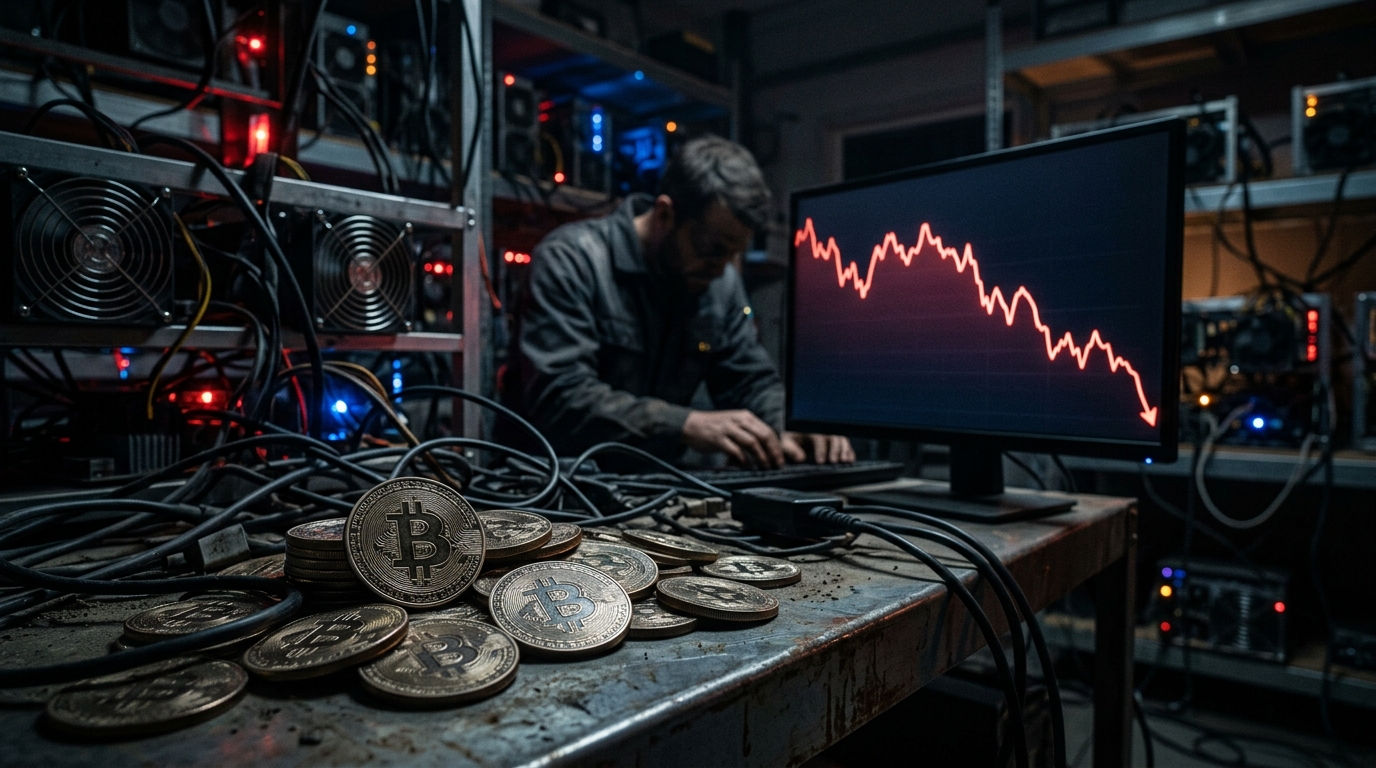
The profitability clock is ticking louder for Bitcoin miners. On August 6, nearly one in four mainstream mining machines tracked by data centers was operating in the red. According to the original report from WuBlockchain Data Center, 22.7% of 22 major ASIC models were generating negative daily net returns after accounting for electricity costs and current network assumptions. For an industry that lives on thin margins, that is a signal the market ignores at its own risk.

The figure does not mean all those machines have shut down—yet. But it places a spotlight on the shutdown price of even the most energy-efficient hardware, pegged at an estimated $46,787. Below that Bitcoin level, top-tier units would only break even. For older, less efficient rigs, the pain threshold is higher. When spot prices flirt with levels that make daily operation a losing game, operators face a stark choice: power down or bleed cash.

Hashrate and the Inevitable Adjustment

When unprofitable miners disconnect, network hashrate initially drops. That triggers Bitcoin’s built-in difficulty adjustment, which resets lower roughly every two weeks. In turn, the cost to mine per coin falls for those who remain, slowly restoring equilibrium. The cycle is well understood, but it does not erase the short-term risks. If BTC slides further and stays below $47,000 for an extended period, the speed of the exodus could outpace the difficulty recalibration, leaving a temporary gap where transaction processing slows and mining centralization increases among well-capitalized fleets.

Another variable is the broader energy market. Many large-scale miners have locked in power purchase agreements, meaning their actual breakeven may differ from this generic estimate. Still, the headline number from the data center captures sentiment. It tells exchanges, hedge funds, and futures markets that a chunk of the network is underwater, and any forced selling of mined coins to cover operational costs could amplify downward pressure.

Post-Halving Margins and Strategic Shifts

Since the 2024 halving slashed block rewards to 3.125 BTC, the industry has been on a constant hunt for cheaper electricity and higher-performance chips. Several public miners have pivoted toward high-performance computing and AI data center hosting, recognizing that Bitcoin mining alone may not sustain valuations if hashprice—the revenue per unit of hashrate—stays depressed. This latest profitability snapshot reinforces why diversification became a survival strategy. It also explains the wave of mergers, acquisitions, and fleet upgrades that defined the past year.

What the data does not show is how much of the current hashrate belongs to machines that are financially hedged. Miners can use derivatives or bitcoin-backed loans to smooth out cash flows, buying time even when daily returns turn negative. That means the 22.7% figure is a warning light, not a death sentence. However, it strips away the narrative that all major operators are comfortably profitable at current spot prices. A large segment is not, and the market is now acutely aware of the level at which deeper problems begin.

What Matters Next

The path of Bitcoin price will determine whether this data point becomes a footnote or a catalyst. Above $48,000, most top-tier miners stay in the green, and the network hums along without major disruption. But if the price retests or breaks below $46,500, the conversation shifts from “miner profitability” to “miner surrender,” a phase historically linked to local price bottoms. For now, the market is watching whether these marginally unprofitable units actually stop hashing—and if their operators choose to sell inventory instead of waiting. That dynamic, more than any single profitability percentage, will shape the next move in both hashrate and price.

Attribution

Originally reported by KuCoin

Get stories like this, daily.

Daily crypto + regulation intelligence, straight to your inbox. Free.

関連記事