This website uses cookies
We use cookies to personalise content and ads, to provide social media features and to analyse our traffic. We also share information about your use of our site with our social media, advertising and analytics partners who may combine it with other information that you’ve provided to them or that they’ve collected from your use of their services.
Consent Selection
Details
  • Necessary cookies help make a website usable by enabling basic functions like page navigation and access to secure areas of the website. The website cannot function properly without these cookies.
  • Preference cookies enable a website to remember information that changes the way the website behaves or looks, like your preferred language or the region that you are in.
    • We do not use cookies of this type.

  • Statistic cookies help website owners to understand how visitors interact with websites by collecting and reporting information anonymously.
    • We do not use cookies of this type.

  • Marketing cookies are used to track visitors across websites. The intention is to display ads that are relevant and engaging for the individual user and thereby more valuable for publishers and third party advertisers.
    • We do not use cookies of this type.

  • Unclassified cookies are cookies that we are in the process of classifying, together with the providers of individual cookies.
    • __emg_sidPending
      Maximum Storage Duration: 1 dayType: HTTP Cookie
      __emg_vidPending
      Maximum Storage Duration: 1 yearType: HTTP Cookie
      nl-read-countPending
      Maximum Storage Duration: PersistentType: HTML Local Storage
Cookie declaration last updated on 8/12/26 by Cookiebot
[#IABV2_TITLE#]
[#IABV2_BODY_INTRO#]
[#IABV2_BODY_LEGITIMATE_INTEREST_INTRO#]
[#IABV2_BODY_PREFERENCE_INTRO#]
[#IABV2_BODY_PURPOSES_INTRO#]
[#IABV2_BODY_PURPOSES#]
[#IABV2_BODY_FEATURES_INTRO#]
[#IABV2_BODY_FEATURES#]
[#IABV2_BODY_PARTNERS_INTRO#]
[#IABV2_BODY_PARTNERS#]
About
Cookies are small text files that can be used by websites to make a user's experience more efficient.

The law states that we can store cookies on your device if they are strictly necessary for the operation of this site. For all other types of cookies we need your permission.

This site uses different types of cookies. Some cookies are placed by third party services that appear on our pages.

You can at any time change or withdraw your consent from the Cookie Declaration on our website.

Learn more about who we are, how you can contact us and how we process personal data in our Privacy Policy.

Please state your consent ID and date when you contact us regarding your consent.
NewsLayer.com
NewsLayer PulseLIVEBTC$72,377+5.82%ETH$2,317+10.24%SOL$87.11+5.84%XRP$1.23+15.40%DOGE$0.08+9.46%ADA$0.1953+7.77%Total Cap$2.57T+6.10%Layer Index78 Greed

A new ingredient for quantum computing: krypton gas

To commercialize quantum computing, manufacturers need high-quality superconducting materials for microchips, but they also require a reliable, sustainable nanofabrication process.

Cornell Chronicle

Publisher

Aug 17, 2026 at 7:54 PM UTC · Updated 2日前 · 4 分で読める

A new ingredient for quantum computing: krypton gas
NewsLayer editorial artwork
翻訳中…

To commercialize quantum computing, manufacturers need high-quality superconducting materials for microchips, but they also require a reliable, sustainable nanofabrication process. 

Tantalum is a corrosion-resistant metal that meets the first criteria but not the second. That’s because it has to be deposited on a substrate at temperatures that typically exceed 400 degrees Celsius – too hot for many semiconductor foundries’ current tools.

Cornell researchers have developed a method that uses krypton gas to slash that deposition temperature to 200 degrees while depositing on silicon, a standard high-quality substrate. The process resulted in thin films that also have substantially higher electronic conductivity.

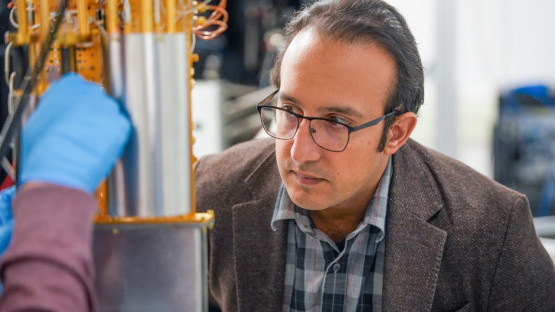
“Tantalum as a material has been shown to be very exciting from a device performance perspective, but its manufacturability had some question marks because of integration challenges such as required process temperatures,” said Valla Fatemi, assistant professor and Aref and Manon Lahham Faculty Fellow in the Cornell Duffield College of Engineering, who led the project. “We figured out a relatively simple change, by using some physical and materials insights, to bring that temperature down into a zone that is translatable to nanofabrication systems in industry, while showing that in our academic context we can have leading-edge performance of these devices.”

Article Intelligence

Topics

Sponsored

Ad

House — Advertise on NewsLayer
NewsLayerLearn more

NewsLayer Premium

Unlock deeper intelligence.

Ad-free reading, exclusive research, and real-time onchain insights.

Go Premium