This website uses cookies
We use cookies to personalise content and ads, to provide social media features and to analyse our traffic. We also share information about your use of our site with our social media, advertising and analytics partners who may combine it with other information that you’ve provided to them or that they’ve collected from your use of their services.
Consent Selection
Details
  • Necessary cookies help make a website usable by enabling basic functions like page navigation and access to secure areas of the website. The website cannot function properly without these cookies.
  • Preference cookies enable a website to remember information that changes the way the website behaves or looks, like your preferred language or the region that you are in.
    • We do not use cookies of this type.

  • Statistic cookies help website owners to understand how visitors interact with websites by collecting and reporting information anonymously.
    • We do not use cookies of this type.

  • Marketing cookies are used to track visitors across websites. The intention is to display ads that are relevant and engaging for the individual user and thereby more valuable for publishers and third party advertisers.
    • We do not use cookies of this type.

  • Unclassified cookies are cookies that we are in the process of classifying, together with the providers of individual cookies.
    • __emg_sidPending
      Maximum Storage Duration: 1 dayType: HTTP Cookie
      __emg_vidPending
      Maximum Storage Duration: 1 yearType: HTTP Cookie
      nl-read-countPending
      Maximum Storage Duration: PersistentType: HTML Local Storage
Cookie declaration last updated on 8/12/26 by Cookiebot
[#IABV2_TITLE#]
[#IABV2_BODY_INTRO#]
[#IABV2_BODY_LEGITIMATE_INTEREST_INTRO#]
[#IABV2_BODY_PREFERENCE_INTRO#]
[#IABV2_BODY_PURPOSES_INTRO#]
[#IABV2_BODY_PURPOSES#]
[#IABV2_BODY_FEATURES_INTRO#]
[#IABV2_BODY_FEATURES#]
[#IABV2_BODY_PARTNERS_INTRO#]
[#IABV2_BODY_PARTNERS#]
About
Cookies are small text files that can be used by websites to make a user's experience more efficient.

The law states that we can store cookies on your device if they are strictly necessary for the operation of this site. For all other types of cookies we need your permission.

This site uses different types of cookies. Some cookies are placed by third party services that appear on our pages.

You can at any time change or withdraw your consent from the Cookie Declaration on our website.

Learn more about who we are, how you can contact us and how we process personal data in our Privacy Policy.

Please state your consent ID and date when you contact us regarding your consent.
NewsLayer.com
NewsLayer PulseLIVEBTC$64,818+1.06%ETH$1,916+0.30%SOL$77.09+1.41%XRP$1-0.25%DOGE$0.0702-0.26%ADA$0.1753+0.22%Total Cap$2.31T+0.80%Layer Index49 Neutral
External ReportingUpdated 6時間前

Bitpanda Hit With Europe's First Published MiCA Penalty in Austria

Austria's Financial Market Authority has fined Vienna-based crypto exchange Bitpanda €70,000 for procedural and disclosure breaches. The published penalty is described as Europe's first under the EU's Markets in Crypto-Assets (MiCA)…

Bitpanda Hit With Europe's First Published MiCA Penalty in Austria
著者 Decrypt StaffPublisher Decrypt 2 分で読める
Image via Decrypt
翻訳中…

要点

  • Bitpanda received a €70,000 fine from Austria's Financial Market Authority.
  • The penalty concerns procedural and disclosure breaches.
  • The case is presented as Europe's first published MiCA penalty and an early sign of EU crypto enforcement.

Why This Matters

The first published MiCA penalty provides a concrete enforcement precedent as national transition periods end, signaling that even established, licensed platforms can face sanctions for procedural disclosure failures. While the fine is small, it could push crypto firms to tighten white-paper and marketing controls across the EU, where MiCA compliance requirements are intended to be harmonized.

Regulation Context

Track live crypto policy developments across jurisdictions.

Layer Index

49

↑ 5 pts in 24h

In brief

  • Austria's FMA fined Bitpanda 70,000 euros (~$82,000) in what stands as the first publicly disclosed enforcement penalty under the EU's Markets in Crypto-Assets Regulation (MiCA).
  • The breaches were procedural and disclosure-related—failing to submit a white paper to the regulator 20 working days before publishing it, running a marketing communication before publishing the underlying white paper, and omitting a required disclaimer and contact details—rather than fraud or investor-loss allegations; the ruling is legally final.
  • The case lands as MiCA's transition period for crypto firms winds down across the bloc, with Brussels also expected to revisit the framework in 2027 to tighten oversight of foreign stablecoin issuers.

Austrian regulators have fined crypto exchange Bitpanda 70,000 euros, roughly $82,000, in what stands as the first publicly disclosed enforcement penalty under the European Union's landmark crypto rulebook.

Austria's Financial Market Authority, known as the FMA, said the sanction stems from several breaches of the Markets in Crypto-Assets Regulation, or MiCA, the bloc's comprehensive framework for digital assets.
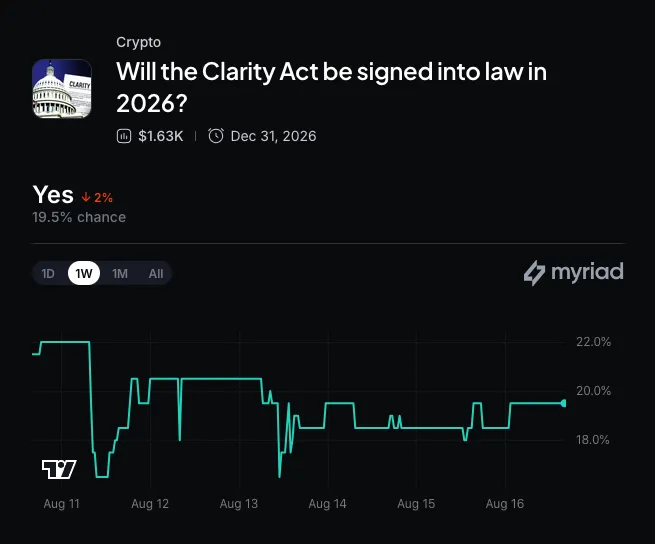
Myriad: Will the Clarity Act be signed into law in 2026? Click to make your prediction.

The regulator said the Vienna-based company failed to submit a required crypto-asset white paper to the FMA at least 20 working days before publishing it, as the rules mandate.

The FMA also found that Bitpanda circulated a marketing communication before publishing the underlying white paper, a sequencing MiCA prohibits. In a separate marketing message, the company omitted a mandatory disclaimer stating that the material had not been reviewed or approved by any regulator and that the offeror bears sole responsibility for its content, and left out a required phone number and email address.

The case was wrapped up through an accelerated procedure under Austrian financial-market law, and the FMA said the penalty ruling is legally final.

The violations are procedural and disclosure-related rather than allegations of fraud or investor losses, but the case is notable as an early marker of how European authorities intend to police the new regime. MiCA is designed to create a single set of rules across all 27 member states, with the stated goals of protecting investors and safeguarding the integrity of crypto markets.

The penalty lands as the industry navigates MiCA's rollout. The framework took full effect for crypto-asset service providers in late 2024, with a transition period letting existing firms keep operating while they secured authorization. That grace window has been winding down across the bloc, squeezing companies that hadn't yet come into full compliance. Brussels is also expected to revisit MiCA in 2027, with proposed revisions that would tighten oversight of foreign stablecoin issuers.

Bitpanda, one of Europe's larger crypto platforms, holds MiCA licensing and has expanded aggressively across the continent. The relatively modest fine suggests the FMA treated the lapses as compliance failures rather than serious misconduct.

Enjoyed this story?

Follow Decrypt Staff and get alerted the moment their next story goes live.

速報

速報を見逃さない

Advertisement

House — Advertise on NewsLayer
NewsLayerAd

クイック回答

What was Bitpanda fined for in Austria?

Austria's Financial Market Authority fined Bitpanda for procedural and disclosure breaches. The fine was €70,000.

How much was Bitpanda's MiCA penalty?

Bitpanda was fined €70,000 by Austria's Financial Market Authority.

Why is the Bitpanda fine significant for European crypto regulation?

It is described as Europe's first published penalty under MiCA. The case may indicate how EU regulators intend to enforce the new crypto rulebook.

Sourced by

Originally reported by Decrypt

NewsLayer coverage based on externally reported material.

The Daily Brief

The onchain economy, before your day starts.

Curated markets, onchain insights, and key headlines — delivered every weekday morning.

Weekdays · Free · ~5 minute read

関連記事