Franklin, A. Experiment, Right or Wrong (Cambridge Univ. Press, 1990).
Radder, H. The Philosophy of Scientific Experimentation (Univ. Pittsburgh Press, 2003).
Shamos, M. H. Great Experiments in Physics: Firsthand Accounts from Galileo to Einstein (Courier Corporation, 1987).
Krenn, M., Malik, M., Fickler, R., Lapkiewicz, R. & Zeilinger, A. Automated search for new quantum experiments. Phys. Rev. Lett. 116, 090405 (2016). This paper presents Melvin, an early AI-driven framework for the design of photonic quantum information experiments, with several of its proposed experimental configurations subsequently realized in laboratories.
Article ADS PubMed Google Scholar
Knott, P. A search algorithm for quantum state engineering and metrology. New J. Phys. 18, 073033 (2016). This paper presents Tachikoma, an early AI-driven framework for designing quantum metrology experiments, initially using genetic algorithms and later incorporating neural network surrogate models.
Article ADS Google Scholar
Ruiz-Gonzalez, C. et al. Digital discovery of 100 diverse quantum experiments with PyTheus. Quantum 7, 1204 (2023). This paper presents PyTheus, a discovery framework for photonic quantum optics that enables efficient exploration of experimental designs via an overcomplete, physics-inspired continuous search space, yielding 100 diverse quantum experiments.
Article Google Scholar
Fürrutter, F., Muñoz-Gil, G. & Briegel, H. J. Quantum circuit synthesis with diffusion models. Nat. Mach. Intell. 6, 515–524 (2024).
Article Google Scholar
Landgraf, J., Wanjura, C. C., Peano, V. & Marquardt, F. Artificial discovery of lattice models for wave transport. Preprint at https://doi.org/10.48550/arXiv.2508.10693 (2025).
Babazadeh, A. et al. High-dimensional single-photon quantum gates: concepts and experiments. Phys. Rev. Lett. 119, 180510 (2017).
Article ADS PubMed Google Scholar
Erhard, M., Malik, M., Krenn, M. & Zeilinger, A. Experimental Greenberger–Horne–Zeilinger entanglement beyond qubits. Nat. Photonics 12, 759–764 (2018).
Article ADS CAS Google Scholar
Qian, K. et al. Multiphoton non-local quantum interference controlled by an undetected photon. Nat. Commun. 14, 1480 (2023).
Article ADS CAS PubMed PubMed Central Google Scholar
Krenn, M., Hochrainer, A., Lahiri, M. & Zeilinger, A. Entanglement by path identity. Phys. Rev. Lett. 118, 080401 (2017).
Article ADS MathSciNet PubMed Google Scholar
Wang, K. et al. Entangling independent particles by path identity. Phys. Rev. Lett. 133, 233601 (2024).
Article ADS CAS PubMed Google Scholar
Arlt, S., Ruiz-Gonzalez, C. & Krenn, M. Emulating multiparticle emitters with pair-sources: digital discovery of a quantum optics building block. Quantum Sci. Technol. 10, 015042 (2024).
Article ADS Google Scholar
Paul, E., Landreman, M., Bader, A. & Dorland, W. An adjoint method for gradient-based optimization of stellarator coil shapes. Nucl. Fusion 58, 076015 (2018).
Article ADS Google Scholar
Goodman, A. G. et al. Quasi-isodynamic stellarators with low turbulence as fusion reactor candidates. PRX Energy 3, 023010 (2024).
Article Google Scholar
Baranov, A. et al. Optimising the active muon shield for the SHiP experiment at CERN. J. Phys. Conf. Ser. 934, 012050 (2017).
Article Google Scholar
Cisbani, E. et al. AI-optimized detector design for the future Electron-Ion Collider: the dual-radiator RICH case. J. Instrum. 15, P05009 (2020). This paper demonstrates the use of Bayesian optimization to improve the design of a large-scale particle physics detector within a fixed topology search space.
Article Google Scholar
Dorigo, T. et al. Toward the end-to-end optimization of particle physics instruments with differentiable programming. Rev. Phys. 10, 100085 (2023).
Article Google Scholar
Rolla, J. et al. Using evolutionary algorithms to design antennas with greater sensitivity to ultrahigh energy neutrinos. Phys. Rev. D 108, 102002 (2023). This paper demonstrates AI-driven design of highly sensitive ultrahigh energy neutrino antennas using evolutionary algorithms within a fixed topology search space.
Article ADS CAS Google Scholar
Haack, C. et al. Machine-learning aided detector optimization of the Pacific Ocean Neutrino Experiment. In Proc. 38th International Cosmic Ray Conference (ICRC2023) id.1059 (2024).
Dorigo, T. et al. Toward the end-to-end optimization of the SWGO array layout. Nucl. Phys. B 1017, 116934 (2025).
Article CAS Google Scholar
Krenn, M., Drori, Y. & Adhikari, R. X. Digital discovery of interferometric gravitational wave detectors. Phys. Rev. X 15, 021012 (2025). This paper demonstrates that AI-driven exploration of overcomplete interferometric topology search spaces can discover novel gravitational wave detector topologies that outperform current next-generation designs under realistic conditions.
CAS Google Scholar
Nehme, E. et al. DeepSTORM3D: dense 3D localization microscopy and PSF design by deep learning. Nat. Methods 17, 734–740 (2020).
Article CAS PubMed PubMed Central Google Scholar
Rodríguez, C., Arlt, S., Möckl, L. & Krenn, M. Automated discovery of experimental designs in super-resolution microscopy with XLuminA. Nat. Commun. 15, 10658 (2024).
Article ADS PubMed PubMed Central Google Scholar
Huang, P.-S., Boyken, S. E. & Baker, D. The coming of age of de novo protein design. Nature 537, 320–327 (2016).
Article ADS CAS PubMed Google Scholar
Sanchez-Lengeling, B. & Aspuru-Guzik, A. Inverse molecular design using machine learning: generative models for matter engineering. Science 361, 360–365 (2018).
Article ADS CAS PubMed Google Scholar
Butler, K. T., Davies, D. W., Cartwright, H., Isayev, O. & Walsh, A. Machine learning for molecular and materials science. Nature 559, 547–555 (2018).
Article ADS CAS PubMed Google Scholar
Sigmund, O. & Maute, K. Topology optimization approaches: a comparative review. Struct. Multidiscip. Optim. 48, 1031–1055 (2013).
Article MathSciNet Google Scholar
Duris, J. et al. Bayesian optimization of a free-electron laser. Phys. Rev. Lett. 124, 124801 (2020).
Article ADS CAS PubMed Google Scholar
Vendeiro, Z. et al. Machine-learning-accelerated Bose-Einstein condensation. Phys. Rev. Res. 4, 043216 (2022).
Article CAS Google Scholar
Degrave, J. et al. Magnetic control of tokamak plasmas through deep reinforcement learning. Nature 602, 414–419 (2022).
Article ADS CAS PubMed PubMed Central Google Scholar
Reinschmidt, M., Fortágh, J., Günther, A. & Volchkov, V. V. Reinforcement learning in cold atom experiments. Nat. Commun. 15, 8532 (2024).
Article ADS PubMed PubMed Central Google Scholar
Buchli, J. et al. Improving cosmological reach of a gravitational wave observatory using Deep Loop Shaping. Science 389, 1012–1015 (2025).
Article ADS CAS PubMed Google Scholar
Rainforth, T., Foster, A., Ivanova, D. R. & Bickford Smith, F. Modern Bayesian experimental design. Stat. Sci. 39, 100–114 (2024).
Article MathSciNet Google Scholar
DeZoort, G., Battaglia, P. W., Biscarat, C. & Vlimant, J.-R. Graph neural networks at the Large Hadron Collider. Nat. Rev. Phys. 5, 281–303 (2023).
Article CAS Google Scholar
Dax, M. et al. Real-time inference for binary neutron star mergers using machine learning. Nature 639, 49–53 (2025).
Article ADS CAS PubMed PubMed Central Google Scholar
Rajabzadeh, T., Boulton-McKeehan, A., Bonkowsky, S., Schuster, D. I. & Safavi-Naeini, A. H. A general framework for gradient-based optimization of superconducting quantum circuits using qubit discovery as a case study. Preprint at https://doi.org/10.48550/arXiv.2408.12704 (2024).
MacLellan, B. et al. Inverse design of photonic systems. Laser Photonics Rev. 18, 2300500 (2024).
Article ADS Google Scholar
Crafts, J., Fatemi, R., Horn, T. & Kalinkin, D. Performance optimization for a scintillating glass electromagnetic calorimeter at the EIC. J. Instrum. 19, C05049 (2024).
Article CAS Google Scholar
Wang, J., Bacharach, L., Larzabal, P. & El Korso, M. N. A comparison of antenna placement criteria based on the Cramér–Rao and Barankin bounds for radio interferometer arrays. Signal Process. 219, 109404 (2024).
Article Google Scholar
Miao, H., Yang, H., Adhikari, R. X. & Chen, Y. Quantum limits of interferometer topologies for gravitational radiation detection. Class. Quantum Gravity 31, 165010 (2014).
Article ADS Google Scholar
Shirobokov, S., Belavin, V., Kagan, M., Ustyuzhanin, A. & Baydin, A. G. Black-box optimization with local generative surrogates. Adv. Neural Inf. Process. Syst. 33, 14650–14662 (2020). This paper introduces a trust-region-constrained generative surrogate model as a novel optimization method for design tasks with black-box stochastic simulators.
Google Scholar
Fanelli, C. et al. AI-assisted optimization of the ECCE tracking system at the Electron Ion Collider. Nucl. Instrum. Methods Phys. Res. A 1047, 167748 (2023).
Article CAS Google Scholar
Schillings, P. & Erdmann, J. Fighting Newtonian noise with gradient-based optimization at the Einstein Telescope. Class. Quantum Gravity 42, 065025 (2025).
Article ADS Google Scholar
Badaracco, F., Harms, J. & Rei, L. Joint optimization of seismometer arrays for the cancellation of Newtonian noise from seismic body waves in the Einstein telescope. Class. Quantum Gravity 41, 025013 (2024).
Article ADS MathSciNet Google Scholar
Kagan, M. & Heinrich, L. Branches of a tree: taking derivatives of programs with discrete and branching randomness in high energy physics. Preprint at https://doi.org/10.48550/arXiv.2308.16680 (2023).
Hughes, T. W., Minkov, M., Williamson, I. A. & Fan, S. Adjoint method and inverse design for nonlinear nanophotonic devices. ACS Photonics 5, 4781–4787 (2018).
Article CAS Google Scholar
Sapra, N. V. On-chip integrated laser-driven particle accelerator. Science 367, 79–83 (2020). This paper demonstrates the AI-driven discovery of an on-chip integrated laser-driven particle accelerator by exploring a parametric topology search space encoded as a permittivity distribution.
Article ADS CAS PubMed Google Scholar
Huang, S.-Y. et al. Multiphoton quantum interference at ultracompact inverse-designed multiport beam splitter. Opt. Quantum 3, 576–582 (2025).
Article Google Scholar
Menke, T. et al. Automated design of superconducting circuits and its application to 4-local couplers. npj Quantum Inf. 7, 49 (2021). This paper demonstrates AI-driven discovery of novel superconducting quantum circuits through automated search over a slot-based topology search space.
Article ADS Google Scholar
Qasim, S. R., Owen, P. & Serra, N. Physics instrument design with reinforcement learning. Mach. Learn. Sci. Technol. 6, 035033 (2025).
Article ADS Google Scholar
Cervera-Lierta, A., Krenn, M. & Aspuru-Guzik, A. Design of quantum optical experiments with logic artificial intelligence. Quantum 6, 836 (2022).
Article Google Scholar
Liu, H., Simonyan, K. & Yang, Y. Darts: differentiable architecture search. In Proc. 7th International Conference on Learning Representations (ICLR 2019) (2019).
Zhang, S.-X., Hsieh, C.-Y., Zhang, S. & Yao, H. Differentiable quantum architecture search. Quantum Sci. Technol. 7, 045023 (2022).
Article ADS CAS Google Scholar
Sim, S., Johnson, P. D. & Aspuru-Guzik, A. Expressibility and entangling capability of parameterized quantum circuits for hybrid quantum-classical algorithms. Adv. Quantum Technol. 2, 1900070 (2019). This paper proposes practical metrics for evaluating the expressibility of parameterized quantum circuits, informing the design of overcomplete topology search spaces.
Article Google Scholar
Olle, J., Yevtushenko, O. M. & Marquardt, F. Scaling the automated discovery of quantum circuits via reinforcement learning with gadgets. Preprint at https://doi.org/10.48550/arXiv.2503.11638 (2025).
Mirhoseini, A. et al. A graph placement methodology for fast chip design. Nature 594, 207–212 (2021).
Article ADS CAS PubMed Google Scholar
Arlt, S. et al. Meta-designing quantum experiments with language models. Nat. Mach. Intell. 8, 148–157 (2026).
Article Google Scholar
Wallnöfer, J., Melnikov, A. A., Dür, W. & Briegel, H. J. Machine learning for long-distance quantum communication. PRX Quantum 1, 010301 (2020).
Article Google Scholar
Edelen, A. et al. Machine learning for orders of magnitude speedup in multiobjective optimization of particle accelerator systems. Phys. Rev. Accel. Beams 23, 044601 (2020).
Article ADS CAS Google Scholar
Kasim, M. F. et al. Building high accuracy emulators for scientific simulations with deep neural architecture search. Mach. Learn. Sci. Technol. 3, 015013 (2021).
Article ADS Google Scholar
Citrin, J. et al. Fast transport simulations with higher-fidelity surrogate models for ITER. Phys. Plasmas 30, 062501 (2023).
Article ADS CAS Google Scholar
Ruiz-Gonzalez, C. et al. Neural surrogates for designing gravitational wave detectors. Preprint at https://doi.org/10.48550/arXiv.2511.19364 (2025).
Woźniak, K. A. et al. End-to-end optimal detector design with mutual information surrogates. Mach. Learn. Sci. Technol. 6, 045047 (2025). This paper demonstrates end-to-end particle physics detector design using a trust-region-constrained surrogate model and a general information-theoretic objective function.
Article ADS Google Scholar
Schmidt, K. et al. End-to-end detector optimization with diffusion models: a case study in sampling calorimeters. Particles 8, 47 (2025).
Article CAS Google Scholar
Martínez, M. P., Vidal, X. C. & Vischia, P. Automatic optimization of a parallel-plate avalanche counter with optical readout. Particles 8, 26 (2025).
Article Google Scholar
Bein, S., Connor, P., Pedro, K., Schleper, P. & Wolf, M. Refining fast simulation using machine learning. In Proc. 26th International Conference on Computing in High Energy and Nuclear Physics (CHEP 2023) 09032 (EDP Sciences, 2024).
Schuetz, A.-K., Poon, A. W. & Li, A. RESuM: a rare event surrogate model for physics detector design. In Proc. Thirteenth International Conference on Learning Representations (ICLR 2025) (2025).
Adelmann, A. et al. New directions for surrogate models and differentiable programming for High Energy Physics detector simulation. In Proc. 2021 U.S. Community Study on the Future of Particle Physics (2022).
Krause, C. et al. CaloChallenge 2022: a community challenge for fast calorimeter simulation. Rep. Prog. Phys. 88, 116201 (2025). This paper documents the CaloChallenge, a popular competition in the AI and particle physics communities aimed at developing diverse generative models to accelerate calorimeter simulation.
Article ADS Google Scholar
Bradbury, J. et al. JAX: composable transformations of Python+NumPy programs. GitHub https://github.com/jax-ml/jax (2018).
Paszke, A. et al. PyTorch: an imperative style, high-performance deep learning library. Adv. Neural Inf. Process. Syst. 32, 8024–8035 (2019).
Google Scholar
Abadi, M. et al. TensorFlow: a system for large-scale machine learning. In Proc. 12th USENIX Symposium on Operating Systems Design and Implementation (OSDI ’16) 265–283 (2016).
Kaiser, J., Xu, C., Eichler, A. & Santamaria Garcia, A. Bridging the gap between machine learning and particle accelerator physics with high-speed, differentiable simulations. Phys. Rev. Accel. Beams 27, 054601 (2024).
Article ADS Google Scholar
Citrin, J. et al. TORAX: a fast and differentiable tokamak transport simulator in JAX. Preprint at https://doi.org/10.48550/arXiv.2406.06718 (2024).
Klimesch, J., Drori, Y., Adhikari, R. X. & Krenn, M. Differometor: a differentiable interferometer simulator for the computational design of gravitational wave detectors. GitHub https://github.com/artificial-scientist-lab/Differometor (2025).
El-Kishky, A. et al. Competitive programming with large reasoning models. Preprint at https://doi.org/10.48550/arXiv.2502.06807 (2025).
Novikov, A. et al. AlphaEvolve: a coding agent for scientific and algorithmic discovery. Preprint at https://doi.org/10.48550/arXiv.2506.13131 (2025).
Moses, W. & Churavy, V. Instead of rewriting foreign code for machine learning, automatically synthesize fast gradients. Adv. Neural Inf. Process. Syst. 33, 12472–12485 (2020).
Google Scholar
Sagebaum, M., Albring, T. & Gauger, N. R. High-performance derivative computations using CoDiPack. ACM Trans. Math. Softw. 45, 1–26 (2019).
Article MathSciNet Google Scholar
Sagan, D., Hoffstaetter, G., Signorelli, M. & Coxe, A. Bmad-Julia: a Julia environment for accelerator simulations including machine learning. In Proc. 15th International Particle Accelerator Conference (IPAC’24) 2562–2565 (2024).
Wan, J., Alamprese, H., Ratcliff, C., Qiang, J. & Hao, Y. JuTrack: a Julia package for auto-differentiable accelerator modeling and particle tracking. Comput. Phys. Commun. 309, 109497 (2025).
Article CAS Google Scholar
Aehle, M. et al. Optimization using pathwise algorithmic derivatives of electromagnetic shower simulations. Comput. Phys. Commun. 309, 109491 (2025).
Article CAS Google Scholar
Aehle, M., Blühdorn, J., Sagebaum, M. & Gauger, N. R. Forward-mode automatic differentiation of compiled programs. ACM Trans. Math. Softw. 51, 1–25 (2025).
Article MathSciNet Google Scholar
Aehle, M. et al. Efficient forward-mode algorithmic derivatives of Geant4. Preprint at https://doi.org/10.48550/arXiv.2407.02966 (2024).
Christodoulou, S. & Naumann, U. Differentiable programming: efficient smoothing of control-flow-induced discontinuities. Preprint at https://doi.org/10.48550/arXiv.2305.06692 (2023).
Arya, G., Schauer, M., Schäfer, F. & Rackauckas, C. Automatic differentiation of programs with discrete randomness. Adv. Neural Inf. Process. Syst. 35, 10435–10447 (2022).
Article Google Scholar
Aehle, M. et al. Exploration of differentiability in a proton computed tomography simulation framework. Phys. Med. Biol. 68, 244002 (2023).
Article Google Scholar
Silvano, C. et al. A survey on deep learning hardware accelerators for heterogeneous HPC platforms. ACM Comput. Surv. 57, 1–39 (2025).
Article Google Scholar
Li, M. et al. The deep learning compiler: a comprehensive survey. IEEE Trans. Parallel Distrib. Syst. 32, 708–727 (2020).
Article Google Scholar
Aycock, J. A brief history of just-in-time. ACM Comput. Surv. (CSUR) 35, 97–113 (2003).
Article Google Scholar
Bociort, F. Why are there so many system shapes in lens design? Proc. SPIE 7849, 114–126 (2010).
Google Scholar
Li, H., Xu, Z., Taylor, G., Studer, C. & Goldstein, T. Visualizing the loss landscape of neural nets. Adv. Neural Inf. Process. Syst. 31, 6391 (2018).
Google Scholar
Richardson, J. W., Pandey, S., Bytyqi, E., Edo, T. & Adhikari, R. X. Optimizing gravitational-wave detector design for squeezed light. Phys. Rev. D 105, 102002 (2022).
Article ADS CAS Google Scholar
Meyer, J. J., Borregaard, J. & Eisert, J. A variational toolbox for quantum multi-parameter estimation. npj Quantum Inf. 7, 89 (2021).
Article ADS Google Scholar
O’Driscoll, L., Nichols, R. & Knott, P. A. A hybrid machine learning algorithm for designing quantum experiments. Quantum Mach. Intell. 1, 5–15 (2019).
Article Google Scholar
Dorigo, T. et al. On the codesign of scientific experiments and industrial systems. Preprint at https://doi.org/10.48550/arXiv.2603.26613 (2026).
Nichols, R., Mineh, L., Rubio, J., Matthews, J. C. & Knott, P. A. Designing quantum experiments with a genetic algorithm. Quantum Sci. Technol. 4, 045012 (2019).
Article ADS Google Scholar
Bindel, D., Landreman, M. & Padidar, M. Understanding trade-offs in stellarator design with multi-objective optimization. J. Plasma Phys. 89, 905890503 (2023).
Article Google Scholar
Ruiz, F. J. et al. Quantum circuit optimization with AlphaTensor. Nat. Mach. Intell. 7, 374–385 (2025).
Article Google Scholar
Zen, R., Nägele, M. & Marquardt, F. Reusability report: optimizing T count in general quantum circuits with AlphaTensor-Quantum. Nat. Mach. Intell. 8, 113–117 (2025).
Article Google Scholar
Venugopalan, G., Salces-Cárcoba, F., Arai, K. & Adhikari, R. X. Global optimization of multilayer dielectric coatings for precision measurements. Opt. Express 32, 11751–11762 (2024).
Article ADS CAS PubMed Google Scholar
McClean, J. R., Boixo, S., Smelyanskiy, V. N., Babbush, R. & Neven, H. Barren plateaus in quantum neural network training landscapes. Nat. Commun. 9, 4812 (2018).
Article ADS PubMed PubMed Central Google Scholar
Kingma, D. P. & Ba, J. Adam: a method for stochastic optimization. In Proc. International Conference on Learning Representations (ICLR) (2015).
Krenn, M., Kottmann, J. S., Tischler, N. & Aspuru-Guzik, A. Conceptual understanding through efficient automated design of quantum optical experiments. Phys. Rev. X 11, 031044 (2021).
CAS Google Scholar
Landreman, M. et al. SIMSOPT: a flexible framework for stellarator optimization. J. Open Source Softw. 6, 3525 (2021).
Article ADS Google Scholar
Strong, G. C. et al. TomOpt: differential optimisation for task- and constraint-aware design of particle detectors in the context of muon tomography. Mach. Learn. Sci. Technol. 5, 035002 (2024).
Article ADS Google Scholar
Zaher, Z. et al. Optimization of a cosmic muon tomography scanner for cargo border control inspection. J. Appl. Phys. 138, 194903 (2025).
Article ADS CAS Google Scholar
Hvarfner, C., Hellsten, E. O. & Nardi, L. Vanilla Bayesian optimization performs great in high dimensions. In Proc. 41st International Conference on Machine Learning (ICML’24) 20793–20817 (PMLR, 2024).
Giuliani, A. Direct stellarator coil design using global optimization: application to a comprehensive exploration of quasi-axisymmetric devices. J. Plasma Phys. 90, 905900303 (2024).
Article Google Scholar
Roussel, R. et al. Bayesian optimization algorithms for accelerator physics. Phys. Rev. Accel. Beams 27, 084801 (2024).
Article ADS Google Scholar
Flam-Shepherd, D. et al. Learning interpretable representations of entanglement in quantum optics experiments using deep generative models. Nat. Mach. Intell. 4, 544–554 (2022).
Article Google Scholar
Olle, J., Zen, R., Puviani, M. & Marquardt, F. Simultaneous discovery of quantum error correction codes and encoders with a noise-aware reinforcement learning agent. npj Quantum Inf. 10, 126 (2024).
Article ADS Google Scholar
Trenkwalder, L. M., López-Incera, A., Nautrup, H. P., Flamini, F. & Briegel, H. J. Automated gadget discovery in the quantum domain. Mach. Learn. Sci. Technol. 4, 035043 (2023).
Article ADS Google Scholar
Sarra, L., Ellis, K. & Marquardt, F. Discovering quantum circuit components with program synthesis. Mach. Learn. Sci. Technol. 5, 025029 (2024).
Article ADS Google Scholar
Kundu, A. & Sarra, L. Reinforcement learning with learned gadgets to tackle hard quantum problems on real hardware. Commun. Phys. 9, 44 (2026).
Article Google Scholar
Melnikov, A. A., Sekatski, P. & Sangouard, N. Setting up experimental Bell tests with reinforcement learning. Phys. Rev. Lett. 125, 160401 (2020).
Article ADS CAS PubMed Google Scholar
Valcarce, X., Sekatski, P., Gouzien, E., Melnikov, A. & Sangouard, N. Automated design of quantum-optical experiments for device-independent quantum key distribution. Phys. Rev. A 107, 062607 (2023).
Article ADS CAS Google Scholar
Landgraf, J., Peano, V. & Marquardt, F. Automated discovery of coupled-mode setups. Phys. Rev. X 15, 021038 (2025). This paper introduces autoscatter, an AI-driven discovery framework for interpretable wave-scattering devices that can find counterintuitive and simpler architectures than human designs.
CAS Google Scholar
Côté, G., Lalonde, J.-F. & Thibault, S. Deep learning-enabled framework for automatic lens design starting point generation. Opt. Express 29, 3841–3854 (2021).
Article ADS PubMed Google Scholar
Fürrutter, F., Chandani, Z., Hamamura, I., Briegel, H. J. & Muñoz-Gil, G. Synthesis of discrete–continuous quantum circuits with multimodal diffusion models. Mach. Learn. Sci. Technol. 7, 025065 (2026).
Article ADS Google Scholar
Zoccheddu, S., Qasim, S. R., Owen, P. & Serra, N. Large language models for physics instrument design. Mach. Learn. Sci. Technol. 7, 045005 (2026).
Article Google Scholar
Wang, H. et al. Efficient evolutionary search over chemical space with large language models. In Proc. Thirteenth International Conference on Learning Representations (ICLR 2025) (2025).
Lu, D., Malof, J. M. & Padilla, W. J. An agentic framework for autonomous metamaterial modeling and inverse design. ACS Photonics 12, 6071–6080 (2025).
Article CAS Google Scholar
Barman, K. G. et al. Large physics models: towards a collaborative approach with large language models and foundation models. Eur. Phys. J. C 85, 1066 (2025).
Article ADS CAS Google Scholar
Foreback, M. et al. ECLIPSE: an Evolutionary Computation Library for Instrumentation Prototyping in Scientific Engineering. Preprint at https://doi.org/10.48550/arXiv.2601.05098 (2026).
Fasoli, A. et al. Computational challenges in magnetic-confinement fusion physics. Nat. Phys. 12, 411–423 (2016).
Article CAS Google Scholar
Lauro, L. D. et al. Optimization methods for integrated and programmable photonics in next-generation classical and quantum smart communication and signal processing systems. Adv. Opt. Photonics 17, 526–622 (2025).
Article Google Scholar
Kostelecký, V. A. & Russell, N. Data tables for Lorentz and CPT violation. Rev. Mod. Phys. 83, 11–31 (2011). This paper presents a systematic extension of the standard model with hundreds of parameters, each of them being a potential objective for AI-driven experimental design.
Article ADS Google Scholar
Russell, N. E. Mining the Data Tables for Lorentz and CPT Violation. In Proc. Eighth Meeting on CPT and Lorentz Symmetry 82–85 (World Scientific, 2020).
Will, C. M. in General Relativity and John Archibald Wheeler 73–93 (Springer, 2010).
DeMille, D., Doyle, J. M. & Sushkov, A. O. Probing the frontiers of particle physics with tabletop-scale experiments. Science 357, 990–994 (2017).
Article ADS CAS PubMed Google Scholar
Hamilton, P. et al. Atom-interferometry constraints on dark energy. Science 349, 849–851 (2015).
Article ADS CAS PubMed Google Scholar
Pikovski, I., Vanner, M. R., Aspelmeyer, M., Kim, M. & Brukner, Č. Probing Planck-scale physics with quantum optics. Nat. Phys. 8, 393–397 (2012).
Article CAS Google Scholar
Lo, A. et al. Acoustic tests of Lorentz symmetry using quartz oscillators. Phys. Rev. X 6, 011018 (2016).
Google Scholar
Arndt, M. & Hornberger, K. Testing the limits of quantum mechanical superpositions. Nat. Phys. 10, 271–277 (2014).
Article CAS Google Scholar
Safronova, M. et al. Search for new physics with atoms and molecules. Rev. Mod. Phys. 90, 025008 (2018).
Article ADS MathSciNet CAS Google Scholar
Arlt, S., Gu, X. & Krenn, M. Towards autonomous quantum physics research using LLM agents with access to intelligent tools. Preprint at https://doi.org/10.48550/arXiv.2511.11752 (2025).
Baek, J., Jauhar, S. K., Cucerzan, S. & Hwang, S. J. ResearchAgent: iterative research idea generation over scientific literature with large language models. In Proc. 2025 Conference of the Nations of the Americas Chapter of the Association for Computational Linguistics: Human Language Technologies (Volume 1: Long Papers) 6709–6738 (Association for Computational Linguistics, 2025).
Gu, X. & Krenn, M. Forecasting high-impact research topics via machine learning on evolving knowledge graphs. Mach. Learn. Sci. Technol. 6, 025041 (2025).
Article ADS Google Scholar
Sourati, J. & Evans, J. A. Accelerating science with human-aware artificial intelligence. Nat. Hum. Behav. 7, 1682–1696 (2023).
Article PubMed Google Scholar
Cadena, S. A. et al. ConStellaration: a dataset of QI-like stellarator plasma boundaries and optimization benchmarks. Adv. Neural Inf. Process. Syst. 38, 17351–17377 (2025).
Elitez, D. et al. ColliderML: the first release of an OpenDataDetector high-luminosity physics benchmark dataset. In Machine Learning and the Physical Sciences Workshop at NeurIPS 2025 (2025).
Carleo, G. & Troyer, M. Solving the quantum many-body problem with artificial neural networks. Science 355, 602–606 (2017).
Article ADS MathSciNet CAS PubMed Google Scholar
De Regt, H. W. Understanding Scientific Understanding (Oxford Univ. Press, 2017).
Krenn, M. et al. On scientific understanding with artificial intelligence. Nat. Rev. Phys. 4, 761–769 (2022).
Article PubMed PubMed Central Google Scholar
Brown, D. D. et al. FINESSE. Zenodo https://doi.org/10.5281/zenodo.12662017 (2025).
The LIGO Scientific Collaboration et al. Advanced LIGO. Class. Quantum Gravity 32, 074001 (2015).
Article ADS Google Scholar
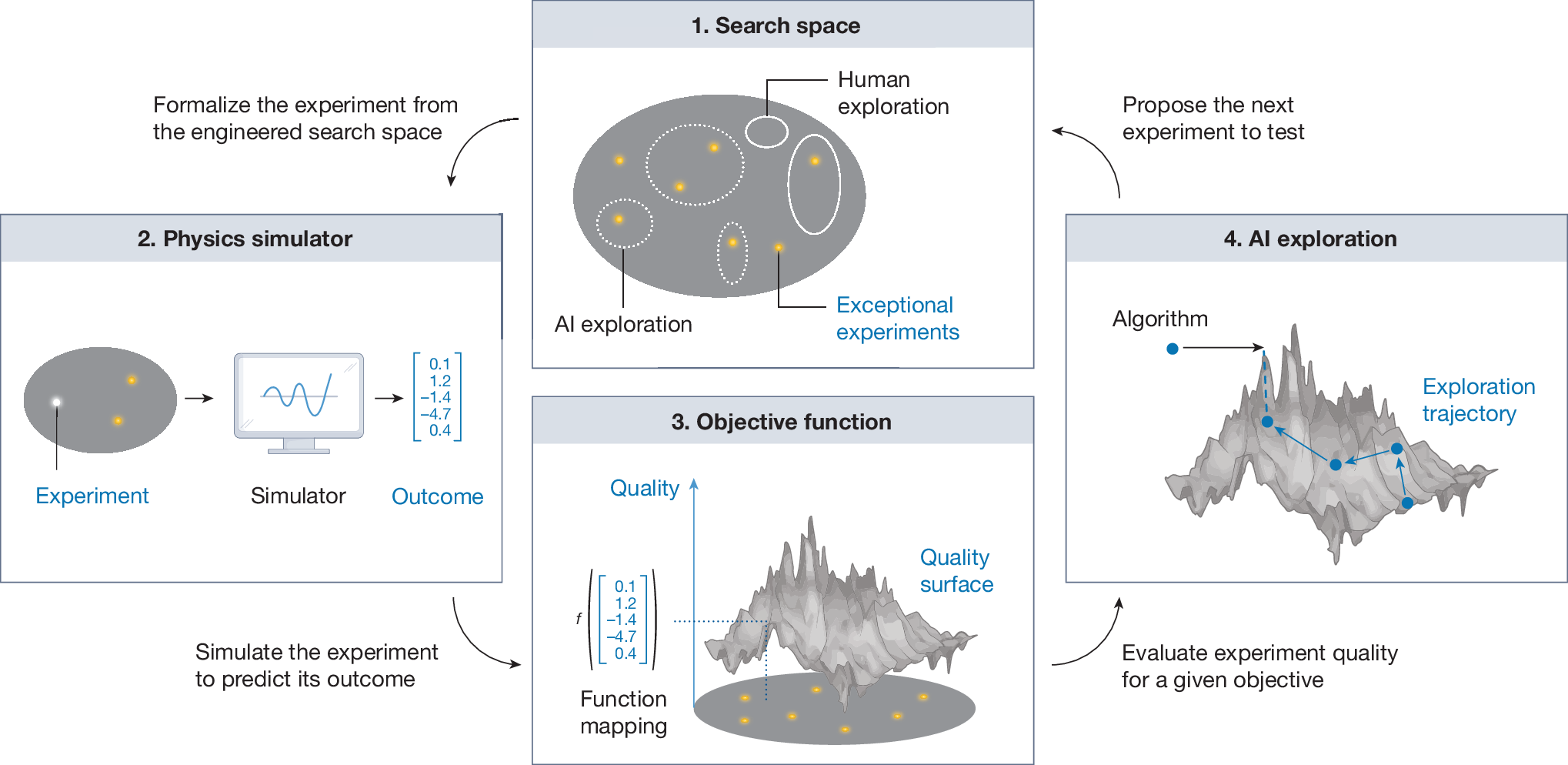
Designing physics experiments with artificial intelligence
Franklin, A. Experiment, Right or Wrong (Cambridge Univ. Press, 1990).
Nature
Publisher
Sep 2, 2026 at 4:30 PM UTC · Updated 3時間前 · 19 分で読める
翻訳中…
Sourced by
Originally reported by Nature
NewsLayer coverage based on externally reported material.
The Daily Brief
The onchain economy, before your day starts.
Curated markets, onchain insights, and key headlines — delivered every weekday morning.
Weekdays · Free · ~5 minute read
0
Applause
Was this article helpful?
Article Intelligence
Topics
Sponsored
Ad
NewsLayerLearn more
NewsLayer Premium
Unlock deeper intelligence.
Ad-free reading, exclusive research, and real-time onchain insights.
Go Premium