
This website uses cookies
We use cookies to personalise content and ads, to provide social media features and to analyse our traffic. We also share information about your use of our site with our social media, advertising and analytics partners who may combine it with other information that you’ve provided to them or that they’ve collected from your use of their services.
Consent Selection
Details
  • Necessary cookies help make a website usable by enabling basic functions like page navigation and access to secure areas of the website. The website cannot function properly without these cookies.
  • Preference cookies enable a website to remember information that changes the way the website behaves or looks, like your preferred language or the region that you are in.
    • We do not use cookies of this type.

  • Statistic cookies help website owners to understand how visitors interact with websites by collecting and reporting information anonymously.
    • We do not use cookies of this type.

  • Marketing cookies are used to track visitors across websites. The intention is to display ads that are relevant and engaging for the individual user and thereby more valuable for publishers and third party advertisers.
    • We do not use cookies of this type.

  • Unclassified cookies are cookies that we are in the process of classifying, together with the providers of individual cookies.
    • __emg_sidPending
      Maximum Storage Duration: 1 dayType: HTTP Cookie
      __emg_vidPending
      Maximum Storage Duration: 1 yearType: HTTP Cookie
      nl-read-countPending
      Maximum Storage Duration: PersistentType: HTML Local Storage
Cookie declaration last updated on 8/12/26 by Cookiebot
[#IABV2_TITLE#]
[#IABV2_BODY_INTRO#]
[#IABV2_BODY_LEGITIMATE_INTEREST_INTRO#]
[#IABV2_BODY_PREFERENCE_INTRO#]
[#IABV2_BODY_PURPOSES_INTRO#]
[#IABV2_BODY_PURPOSES#]
[#IABV2_BODY_FEATURES_INTRO#]
[#IABV2_BODY_FEATURES#]
[#IABV2_BODY_PARTNERS_INTRO#]
[#IABV2_BODY_PARTNERS#]
About
Cookies are small text files that can be used by websites to make a user's experience more efficient.

The law states that we can store cookies on your device if they are strictly necessary for the operation of this site. For all other types of cookies we need your permission.

This site uses different types of cookies. Some cookies are placed by third party services that appear on our pages.

You can at any time change or withdraw your consent from the Cookie Declaration on our website.

Learn more about who we are, how you can contact us and how we process personal data in our Privacy Policy.

Please state your consent ID and date when you contact us regarding your consent.
NewsLayer.com
NewsLayer PulseLIVEBTC$68,356+5.78%ETH$2,085+9.17%SOL$81.49+6.04%XRP$1.06+6.22%DOGE$0.0726+3.35%ADA$0.1792+2.82%Total Cap$2.42T+4.97%Layer Index62 Greed

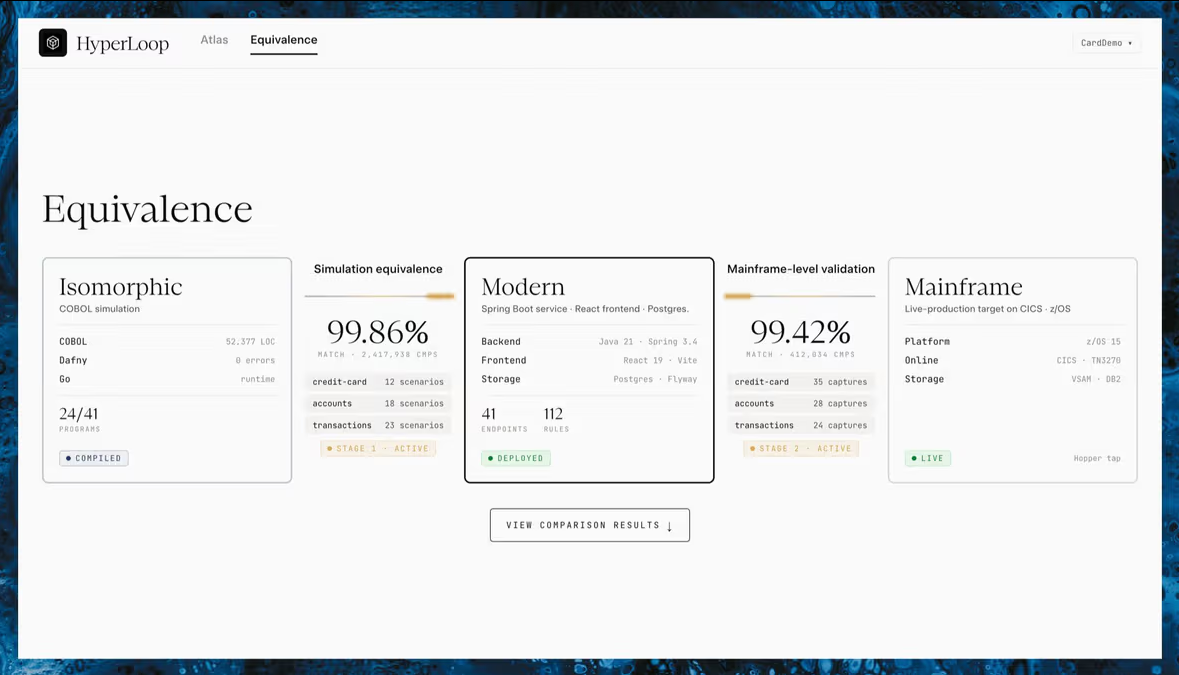
Hypercubic raises $5.3M to map out and rewrite legacy COBOL apps with AI agents

An artificial intelligence startup called Hypercubic Inc. is taking on the problem of modernizing legacy applications written in the COBOL programming language after raising $5.3 million in seed funding today.

SiliconANGLE

Publisher

Aug 18, 2026 at 4:00 PM UTC · Updated 1日前 · 4 分で読める
Hypercubic raises $5.3M to map out and rewrite legacy COBOL apps with AI agents
NewsLayer editorial artwork
翻訳中…

An artificial intelligence startup called Hypercubic Inc. is taking on the problem of modernizing legacy applications written in the COBOL programming language after raising $5.3 million in seed funding today.

The round was led by CIV and saw participation from Y Combinator, Afore Capital, Pioneer Fund, Multimodal Investors and angels including Opendoor Chief Executive Kaz Nejatian and former Amazon Marketplace engineer and Walmart Labs co-founder Venky Harinarayan.

Hypercubic is the brainchild of former Apple Inc. engineers Sai Gurrapu and Aayush Narik. They’ve hit upon the idea of using AI agents to perform the heavy lifting of reading, documenting and then rewriting decades-old COBOL codebases, which is a major headache that continues to stump many of the world’s largest financial institutions and industrial companies.

COBOL, short for Common Business-Oriented Language, is one of the most ancient widely used programming languages in the world today. It was first written in 1959, and is specifically designed for processing business and financial data. Despite its age, it’s still incredibly popular, with an estimated 200 billion-plus lines of COBOL code supporting more than 95% of the world’s swipe transactions and automated teller machines.

Article Intelligence

Topics

Sponsored

Ad

House — Advertise on NewsLayer
NewsLayerLearn more

NewsLayer Premium

Unlock deeper intelligence.

Ad-free reading, exclusive research, and real-time onchain insights.

Go Premium