


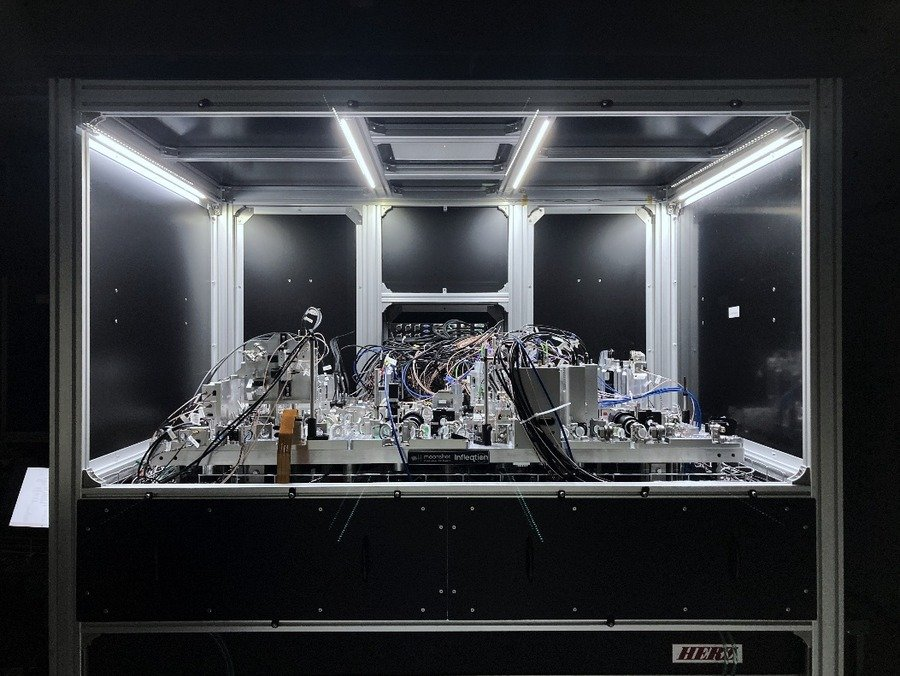
The Institute for Molecular Science (IMS), part of Japan’s National Institutes of Natural Sciences (NINS), has announced that Japan’s first full-stack neutral-atom quantum computer, named “Shunkai” (春海), is now operational. Led by Project Manager Professor Kenji Ohmori under Goal 6 of the Japanese Cabinet Office / JST Moonshot Research and Development Program, the platform was built through a industry-academia consortium partnering with Hitachi, Ltd. for the software stack and Infleqtion, Inc. for the Quantum Processing Unit (QPU) hardware stack.
Japan Operationalizes First Full-Stack Neutral-Atom Quantum Computer “Shunkai”
The Institute for Molecular Science (IMS), part of Japan’s National Institutes of Natural Sciences (NINS), has announced that Japan’s first full-stack neutral-atom quantum computer, named “Shunkai” (春海), is now operational. Led by…
Quantum Computing Report
Publisher
Aug 24, 2026 at 3:31 PM UTC · Updated 1時間前 · 2 分で読める
翻訳中…
| [ IMS Neutral-Atom System Architecture: “Shunkai” ] | ||
|---|---|---|
| Hardware Stack (QPU) | Software & Control Stack | Scale & Roadmap Targets |
| • Neutral Rubidium Atoms | • Hitachi Software Stack | • Phase 1: 50 Physical Qubits |
| • Optical Tweezer Arrays | • Infleqtion QPU Electronics | • Phase 2: 500 Physical Qubits |
| • Room-Temp Qubit Control | • Dynamically Moved Atoms | • 2031 Target: 10k FTQC Qubits |
Full-Stack Integration and Optical Tweezer Control
The “Shunkai” system is named after Harumi (Shunkai) Shibukawa, the Edo-period astronomer who designed Japan’s first indigenous calendar based on celestial calculations. The full-stack platform integrates user-level software directly down to physical laser control and readout systems:
- Optical Tweezer Qubit Trapping: Single neutral atoms are trapped in a two-dimensional grid using optical tweezers created by tightly focused laser beams through high-NA objective lenses. Quantum logic gates are driven via targeted microwave and laser pulses, with individual readout executed via high-resolution fluorescence cameras.
- Room-Temperature Reconfiguration: Operating without cryogenic dilution refrigerators, the platform leverages dynamic atom transport to physically move qubits during runtime, enabling all-to-all connectivity and reconfigurable circuit topologies.
- Consortium Ecosystem: Hardware component integration and QPU packaging were developed in partnership with Infleqtion, while Hitachi engineered the underlying system orchestration and compiler software stack.
Article Intelligence
Key Entities
JustLend
Related Coverage
 QuantumNIST Researchers Supersize Quantum Technology to Help Detect Faint Photons2時間前 · 5 min read
 QuantumJapanese Researchers Put Experimental Neutral Atom Quantum Computer Into Operation in Aichi2時間前 · 1 min read
 QuantumSeoul St. Mary’s Hospital turns to quantum computing to advance cardiovascular blood flow analysis4時間前 · 3 min read
Sponsored
Ad
NewsLayerLearn more
NewsLayer Premium
Unlock deeper intelligence.
Ad-free reading, exclusive research, and real-time onchain insights.
Go Premium