
This website uses cookies
We use cookies to personalise content and ads, to provide social media features and to analyse our traffic. We also share information about your use of our site with our social media, advertising and analytics partners who may combine it with other information that you’ve provided to them or that they’ve collected from your use of their services.
Consent Selection
Details
  • Necessary cookies help make a website usable by enabling basic functions like page navigation and access to secure areas of the website. The website cannot function properly without these cookies.
  • Preference cookies enable a website to remember information that changes the way the website behaves or looks, like your preferred language or the region that you are in.
    • We do not use cookies of this type.

  • Statistic cookies help website owners to understand how visitors interact with websites by collecting and reporting information anonymously.
    • We do not use cookies of this type.

  • Marketing cookies are used to track visitors across websites. The intention is to display ads that are relevant and engaging for the individual user and thereby more valuable for publishers and third party advertisers.
    • We do not use cookies of this type.

  • Unclassified cookies are cookies that we are in the process of classifying, together with the providers of individual cookies.
    • __emg_sidPending
      Maximum Storage Duration: 1 dayType: HTTP Cookie
      __emg_vidPending
      Maximum Storage Duration: 1 yearType: HTTP Cookie
      nl-read-countPending
      Maximum Storage Duration: PersistentType: HTML Local Storage
Cookie declaration last updated on 8/12/26 by Cookiebot
[#IABV2_TITLE#]
[#IABV2_BODY_INTRO#]
[#IABV2_BODY_LEGITIMATE_INTEREST_INTRO#]
[#IABV2_BODY_PREFERENCE_INTRO#]
[#IABV2_BODY_PURPOSES_INTRO#]
[#IABV2_BODY_PURPOSES#]
[#IABV2_BODY_FEATURES_INTRO#]
[#IABV2_BODY_FEATURES#]
[#IABV2_BODY_PARTNERS_INTRO#]
[#IABV2_BODY_PARTNERS#]
About
Cookies are small text files that can be used by websites to make a user's experience more efficient.

The law states that we can store cookies on your device if they are strictly necessary for the operation of this site. For all other types of cookies we need your permission.

This site uses different types of cookies. Some cookies are placed by third party services that appear on our pages.

You can at any time change or withdraw your consent from the Cookie Declaration on our website.

Learn more about who we are, how you can contact us and how we process personal data in our Privacy Policy.

Please state your consent ID and date when you contact us regarding your consent.
NewsLayer.com

Quantum Computer Solves a Problem in 15 Minutes That Classical Methods Can’t Practically Compute

Researchers have demonstrated a quantum computation that appears to exceed the practical capabilities of leading classical simulation methods while also addressing a longstanding problem: how to verify the result.

SciTechDaily

Publisher

Aug 17, 2026 at 11:18 PM UTC · 4 分で読める
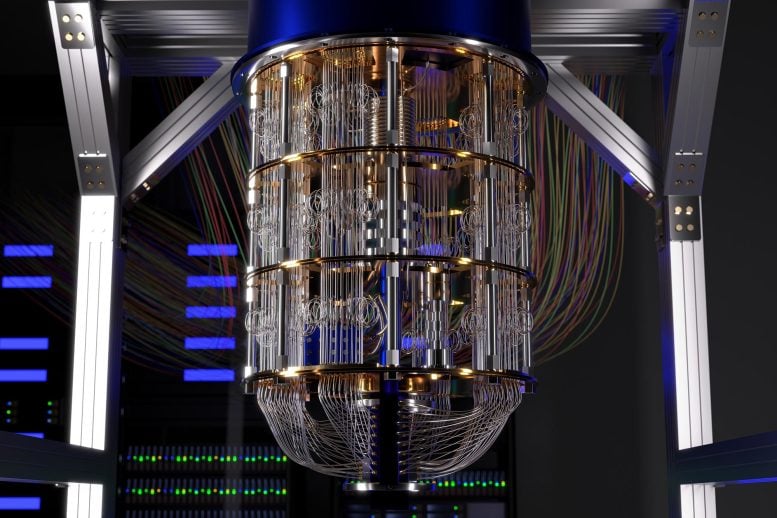
Quantum Computer Solves a Problem in 15 Minutes That Classical Methods Can’t Practically Compute
Image via SciTechDaily

Key Signal

2,415 Logical two-qubit operations

Last Updated

2日前

翻訳中…

Researchers have demonstrated a quantum computation that appears to exceed the practical capabilities of leading classical simulation methods while also addressing a longstanding problem: how to verify the result.

A quantum computer completed a difficult calculation in about 15 minutes, while leading classical simulation methods would require prohibitive amounts of time. Just as importantly, the experiment included a way to establish confidence that the quantum result was accurate.

IBM and University of Chicago researchers announced the demonstration on July 30, 2026, presenting it as evidence that quantum computing has met the central requirements for quantum advantage. This means completing a task beyond the practical reach of leading classical methods while providing a reliable measure of how faithfully the quantum computation was performed.

In a paper published on arXiv, the researchers describe a new design for encoded quantum circuits that allowed them to pursue both goals at once. The experiment became one of the largest demonstrations of logical quantum computing reported so far. The circuits and results have also been released publicly through the Quantum Advantage Tracker.

Article Intelligence

Sponsored

Ad

House — Advertise on NewsLayer
NewsLayerLearn more

NewsLayer Premium

Unlock deeper intelligence.

Ad-free reading, exclusive research, and real-time onchain insights.

Go Premium