

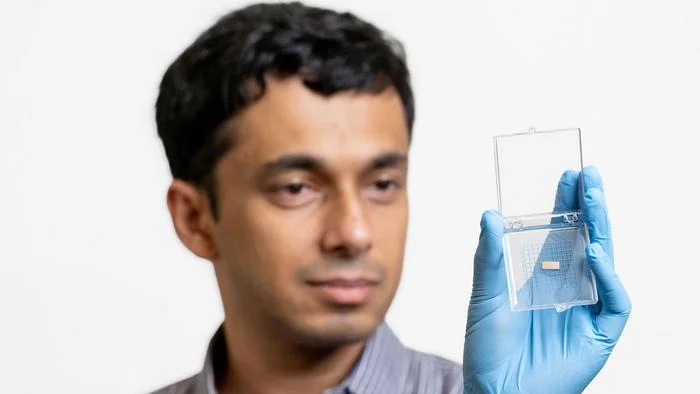
University of Maryland assistant professor Avik Dutt is exploring how quantum properties of light could help drive a major advance in computing performance. Dutt, who teaches mechanical engineering, envisions a leap beyond the long-running trend of computers becoming faster and more powerful.
Quantum ingenuity can sidestep limits of conventional chips—while using commercially accessible components
University of Maryland mechanical engineering professor Avik Dutt is exploring computing advances based on the quantum properties of light. The approach aims to bypass some limits of conventional chips while relying on commercially…
Phys.org Quantum Physics
Publisher
Nov 25, 2026 at 1:00 AM UTC · 1 分で読める

Entities
polygon
Last Updated
2時間前
翻訳中…
The work focuses on quantum ingenuity as a way to sidestep limits associated with conventional computer chips. Quantum technologies seek to use physical effects that differ from the operation of traditional electronic components, potentially opening alternative approaches to computation.
The project’s premise also emphasizes commercially accessible components, suggesting that quantum-oriented hardware concepts need not depend exclusively on entirely bespoke systems. The combination of quantum light-based ideas and accessible parts could be relevant to efforts to make advanced computing platforms more practical to develop and study.
Quantum computing and related photonic technologies remain an active area of research, with developers investigating how quantum effects can be used for specialized computational tasks. Dutt’s vision places the quantum properties of light at the center of a potential next stage in computer capability.
クイック回答
What is the quantum computing approach described in the story?
The story describes an approach using the quantum properties of light to pursue a major advance in computing.
Who is Avik Dutt?
Avik Dutt is an assistant professor of mechanical engineering at the University of Maryland.
Does the approach rely on specialized unavailable hardware?
The excerpt says it uses commercially accessible components, though it does not specify the components involved.
Sourced by
Originally reported by Phys.org Quantum Physics
NewsLayer coverage based on externally reported material.
The Daily Brief
The onchain economy, before your day starts.
Curated markets, onchain insights, and key headlines — delivered every weekday morning.
Weekdays · Free · ~5 minute read
0
Applause
Was this article helpful?
Article Intelligence
Key Entities
Topics
Related Coverage
 QuantumAccelerating Computing With Light18時間前 · 4 min read
 QuantumEthereum Foundation Says AI Is a More Urgent Threat Than Quantum Computing6時間前 · 3 min read
 QuantumQuantum blueprint maps a practical path to testing unusual entanglement4時間前 · 1 min read
Sponsored
Ad
NewsLayerLearn more
NewsLayer Premium
Unlock deeper intelligence.
Ad-free reading, exclusive research, and real-time onchain insights.
Go Premium


