



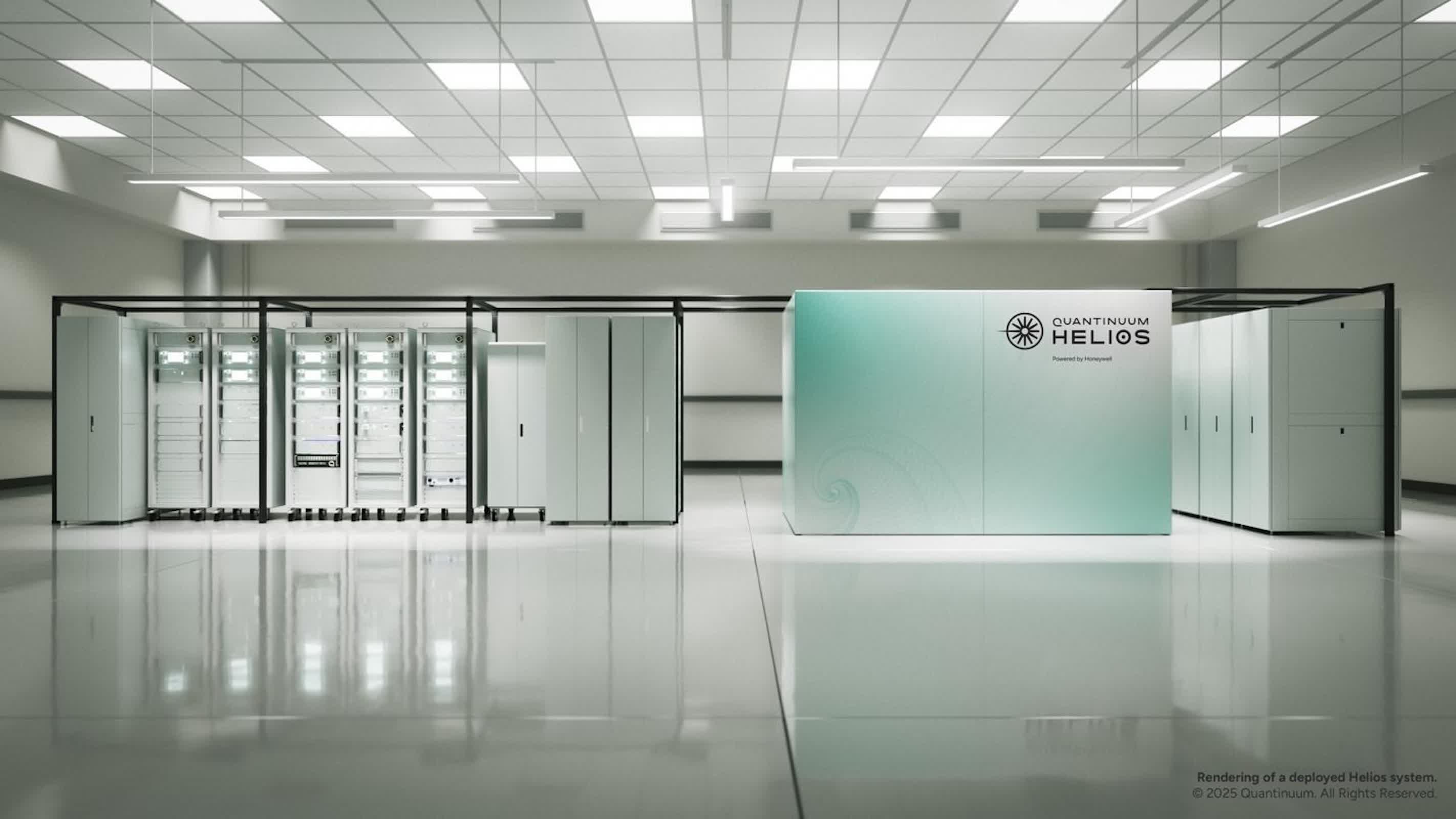
First look: Quantinuum's new Helios processor is a major engineering step for trapped-ion quantum computing, built to solve a problem that gets harder as systems grow: moving qubits through a machine without undermining their performance. The 98-qubit processor uses a four-way junction to route ions between memory and processing areas. It also relies on a control system that plans those movements while coordinating quantum operations. Together, the hardware and software give Helios more room to run operations in parallel than earlier trapped-ion designs.
This 98-qubit quantum computer moves ions around to compute more efficiently
First look: Quantinuum's new Helios processor is a major engineering step for trapped-ion quantum computing, built to solve a problem that gets harder as systems grow: moving qubits through a machine without undermining their…
TechSpot
Publisher
Aug 25, 2026 at 11:58 AM UTC · 3 分で読める
翻訳中…
Helios is the largest trapped-ion quantum computer demonstrated so far. Quantinuum, which is based in Cambridge, UK, and Broomfield, Colorado, previously demonstrated machines with 32 qubits in 2023 and 56 qubits in 2025.
The processor uses charged atoms, known as ions, as qubits. Electromagnetic fields hold the ions above the chip, and laser pulses carry out the quantum gates. Helios follows a quantum charge-coupled device, or QCCD, design. Instead of keeping every qubit in one fixed place, it stores ions in one part of the machine and moves them into separate areas for processing.
Its layout includes a ring-shaped memory region connected to two processing paths. The four-way X junction sits where those regions meet. Earlier QCCD designs could move ions through a line or loop. The new junction gives the system more possible routes and lets it handle multiple tasks at once.
Article Intelligence
Topics
Sponsored
Ad
NewsLayerLearn more
NewsLayer Premium
Unlock deeper intelligence.
Ad-free reading, exclusive research, and real-time onchain insights.
Go Premium