

This website uses cookies
We use cookies to personalise content and ads, to provide social media features and to analyse our traffic. We also share information about your use of our site with our social media, advertising and analytics partners who may combine it with other information that you’ve provided to them or that they’ve collected from your use of their services.
Consent Selection
Details
  • Necessary cookies help make a website usable by enabling basic functions like page navigation and access to secure areas of the website. The website cannot function properly without these cookies.
  • Preference cookies enable a website to remember information that changes the way the website behaves or looks, like your preferred language or the region that you are in.
    • We do not use cookies of this type.

  • Statistic cookies help website owners to understand how visitors interact with websites by collecting and reporting information anonymously.
    • We do not use cookies of this type.

  • Marketing cookies are used to track visitors across websites. The intention is to display ads that are relevant and engaging for the individual user and thereby more valuable for publishers and third party advertisers.
    • We do not use cookies of this type.

  • Unclassified cookies are cookies that we are in the process of classifying, together with the providers of individual cookies.
    • __emg_sidPending
      Maximum Storage Duration: 1 dayType: HTTP Cookie
      __emg_vidPending
      Maximum Storage Duration: 1 yearType: HTTP Cookie
      nl-read-countPending
      Maximum Storage Duration: PersistentType: HTML Local Storage
Cookie declaration last updated on 8/12/26 by Cookiebot
[#IABV2_TITLE#]
[#IABV2_BODY_INTRO#]
[#IABV2_BODY_LEGITIMATE_INTEREST_INTRO#]
[#IABV2_BODY_PREFERENCE_INTRO#]
[#IABV2_BODY_PURPOSES_INTRO#]
[#IABV2_BODY_PURPOSES#]
[#IABV2_BODY_FEATURES_INTRO#]
[#IABV2_BODY_FEATURES#]
[#IABV2_BODY_PARTNERS_INTRO#]
[#IABV2_BODY_PARTNERS#]
About
Cookies are small text files that can be used by websites to make a user's experience more efficient.

The law states that we can store cookies on your device if they are strictly necessary for the operation of this site. For all other types of cookies we need your permission.

This site uses different types of cookies. Some cookies are placed by third party services that appear on our pages.

You can at any time change or withdraw your consent from the Cookie Declaration on our website.

Learn more about who we are, how you can contact us and how we process personal data in our Privacy Policy.

Please state your consent ID and date when you contact us regarding your consent.
NewsLayer

Install NewsLayer

Get the app experience — one tap from your home screen, instant loads and breaking-news alerts.

NewsLayer.com
NewsLayer PulseLIVEBTC$62,981+0.00%ETH$1,879-0.07%SOL$75.15-0.23%XRP$1+0.38%DOGE$0.07+0.01%ADA$0.1788-0.69%Total Cap$2.27T+0.36%Layer Index43 Neutral
BreakingExternal Reporting公開 2時間前

Trump calls on private sector to hack foreign networks behind crypto scams

Donald Trump opens the door to a new form of response against foreign criminal networks. In a memo signed on August 12, 2026, the American president authorizes certain licensed private companies to participate in cyber operations under…

Trump calls on private sector to hack foreign networks behind crypto scams
Publisher Cointribune 5 分で読める
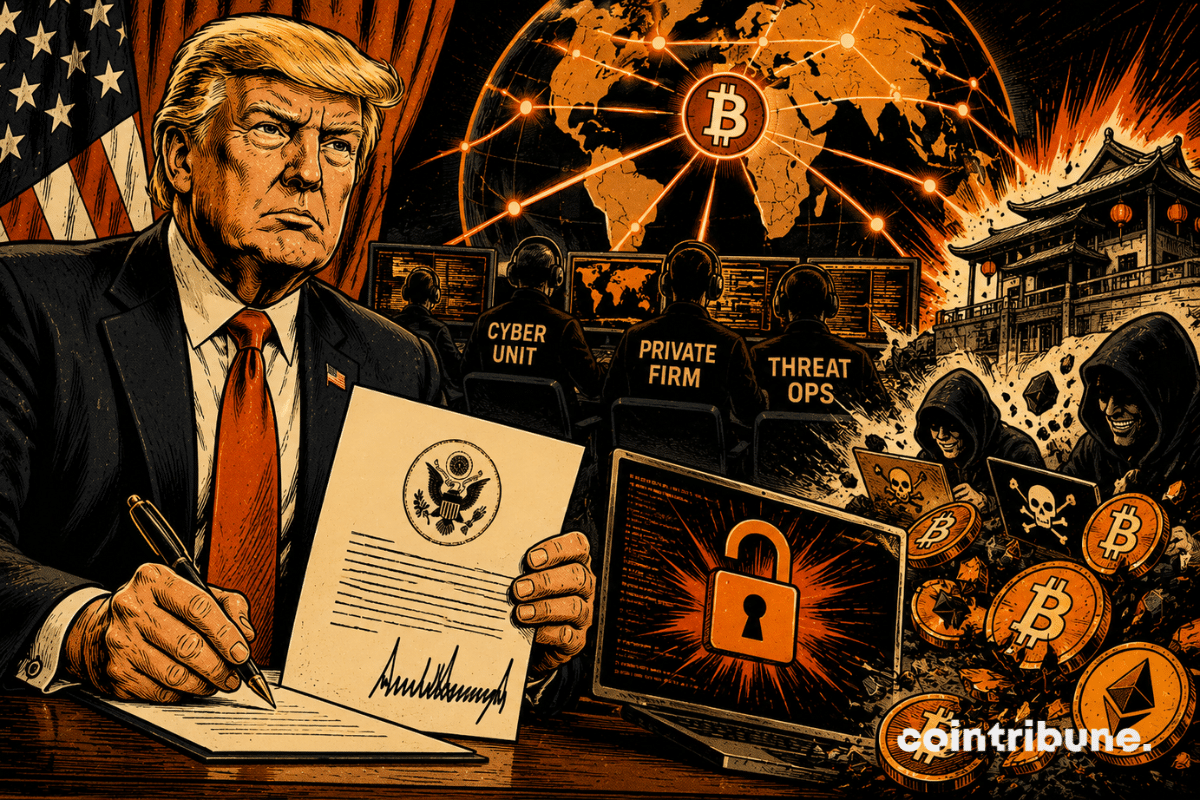
Image via Cointribune

Regulation Context

SEC Crypto Asset Market Structure Rulemaking
JurisdictionUnited States
RegulatorSEC
Statusin progress
Updated8日前

Layer Index

43

↑ 4 pts in 24h

Summarize this article with:

Donald Trump opens the door to a new form of response against foreign criminal networks. In a memo signed on August 12, 2026, the American president authorizes certain licensed private companies to participate in cyber operations under federal supervision. Crypto scam networks are among the targets, but the precise rules of these interventions are still to be written.

In brief

  • The program will be supervised by a coordination center and two leaders from Justice and Homeland Security.
  • The FBI recorded 181,565 complaints involving cryptos in 2025, with 11.366 billion dollars of declared losses.
  • Washington has 60 days to set the operational rules of the program. A first report is expected within 180 days.

Washington wants to go beyond freezing funds

American authorities already have several tools to pursue crypto scam networks. They can seize domains, block assets, or trace laundering circuits. The freezing of over 700 million dollars linked to a Chinese network is a recent illustration.

The memo signed by Donald Trump goes further. It now allows selected American companies chosen by the State to take part in certain operations conducted directly against the infrastructures used by these criminal networks. So it is no longer just about following the money or seizing funds afterward.

In its August 12 text, the White House entrusts the National Coordination Center (NCC) with implementing the program aimed at “Participating Companies.”

To enter, a company must sign a contract with the Department of Justice or the Department of Homeland Security, go through a vetting process, and obtain written authorization before each mission. Two executive directors will oversee the system, one designated by Justice and the other by Homeland Security.

Participating companies are American private firms admitted to the program and authorized to carry out cyber operations under the direction of the United States government.

At first reading, the term “hack” thus simplifies the scope of the text. Cyber-surveillance aims at clandestine information gathering and may involve unauthorized access to a system. 

Cyber effects operations can manipulate, disrupt, degrade or destroy systems or the data they contain. Operations likely to cause death or serious injury, or involving the use of force under international law, are beyond the delegated approval authority of the program directors.

Crypto losses show the scale of the problem

Why does Washington want to expand its arsenal? FBI figures provide part of the answer.

In 2025, the Internet Crime Complaint Center (IC3) recorded 181,565 complaints involving cryptocurrencies. That is 21% more than the previous year. Declared losses reached 11.366 billion dollars, a 22% annual increase.

These data obviously do not represent all victims. They only correspond to cases reported to the FBI. Actual damage may therefore be greater.

The crypto scam report in the United States already showed the extent of the phenomenon. However, the FBI’s 2025 IC3 report gives an important clarification: not all crypto-related complaints necessarily involve investment fraud.

This category alone represents 61,559 complaints and 7.228 billion dollars in losses. Over one year, reports increased by 48%, while losses grew by 25%. 

Behind these figures are sometimes organizations much more structured than a simple fake investment site.

This distinction changes the reading of the memo. The targeted networks are not just sites that collect deposits: “pig butchering” schemes, which gain a victim’s trust before pushing them to a fictitious platform, combine social engineering, cross-border laundering, and in some cases, exploit workers in clandestine complexes. 

Intervention in the infrastructures could accelerate the identification or disruption of networks, but nothing in the memo yet proves it will reduce losses or automatically return stolen funds.

It remains to be seen who will be responsible for errors

The memo does not yet specify the mode of operation. Within 60 days, Justice, Homeland Security, and the Homeland Security Council must establish targeting, coordination, and cessation rules for an operation mistakenly affecting a person or an American system. A report is planned within 180 days, with an annual evaluation.

The FBI file on the Tai Chang network helps to understand what is changing. In this case, the Strike Force claims to have blocked over 700 million dollars in cryptos linked to laundering proceeds from fraud. Until now, this type of action mostly relied on investigation, domain seizures, and asset confiscation.

With the new program, Washington wants to be able to intervene earlier, notably through covert surveillance and technical disruption of infrastructures.

The government may require participating companies to post a bond or escrow deposit of at least 1 million dollars to cover certain cases of non-compliance. However, the public version of the memo does not yet clearly detail the role an independent authority would have in case of error or collateral damage.

The problem is therefore not that private companies can act without any rules. They will remain under the authority of the government.

The real question is rather responsibility: who will be accountable for an operation that exceeds its target or causes harm to a third party?

The procedures expected in the next 60 days should provide a first answer. They will especially reveal how far Washington intends to delegate its cyber capabilities to the private sector.

For crypto users, however, the result will be measured elsewhere. Faced with impersonation scams that continue to target crypto communities, the program’s effectiveness will depend less on the number of infiltrated networks than on its ability to prevent new victims and, when possible, recover stolen funds.

Maximize your Cointribune experience with our "Read to Earn" program! For every article you read, earn points and access exclusive rewards. Sign up now and start earning benefits.

Passionné par le Bitcoin, j'aime explorer les méandres de la blockchain et des cryptos et je partage mes découvertes avec la communauté. Mon rêve est de vivre dans un monde où la vie privée et la liberté financière sont garanties pour tous, et je crois fermement que Bitcoin est l'outil qui peut rendre cela possible.

DISCLAIMER

The views, thoughts, and opinions expressed in this article belong solely to the author, and should not be taken as investment advice. Do your own research before taking any investment decisions.

速報

速報を見逃さない

Advertisement

House — Advertise on NewsLayer
NewsLayerAd

Sourced by

Originally reported by Cointribune

NewsLayer coverage based on externally reported material.

The Daily Brief

The onchain economy, before your day starts.

Curated markets, onchain insights, and key headlines — delivered every weekday morning.

Weekdays · Free · ~5 minute read

関連記事