
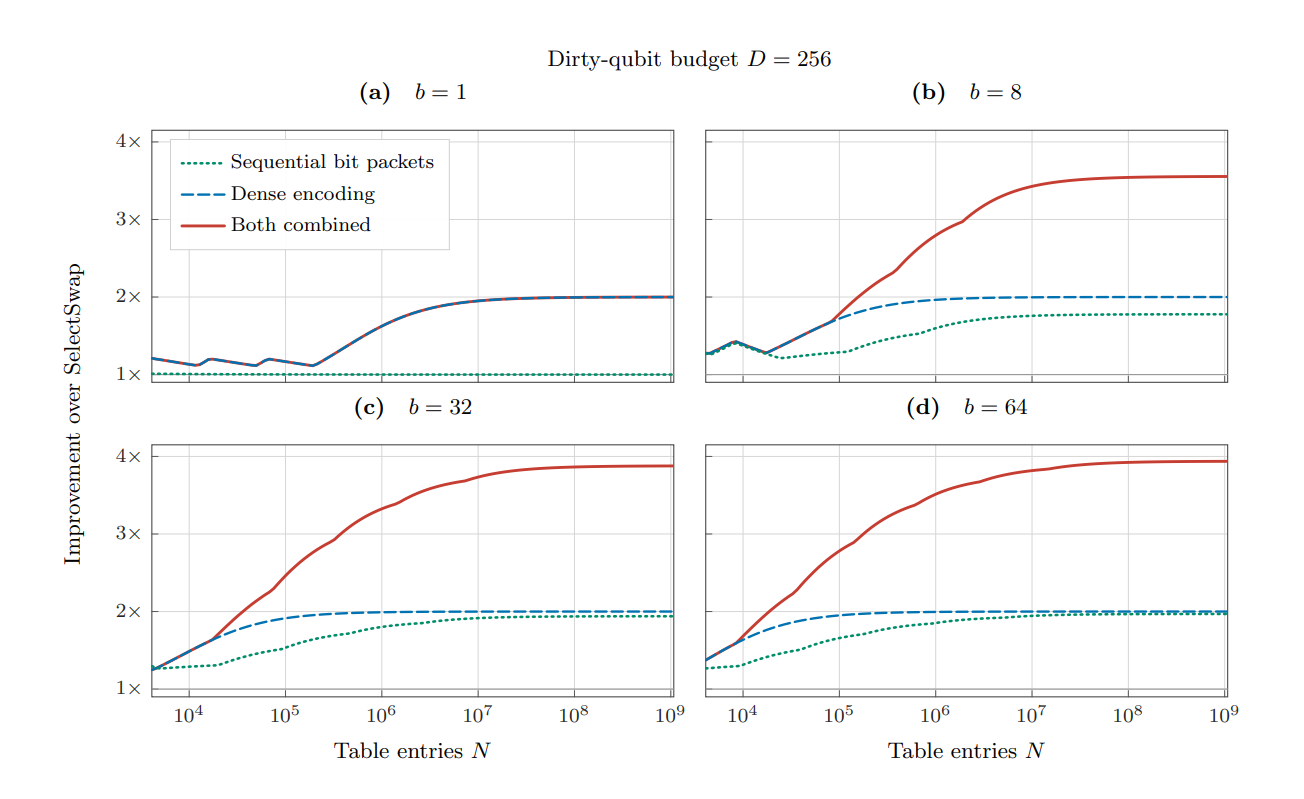
In a pair of research papers published on arXiv, Xanadu Lead Quantum Scientist Danial Motlagh and co-author Matthew Pocrnic have demonstrated an algorithmic technique that reduces the non-Clifford gate cost of Quantum Read-Only Memory (QROM) by nearly 4-fold compared to long-standing industry benchmarks.
Xanadu Cuts Quantum Read-Only Memory Costs by ~4x via Dense Encoding
In a pair of research papers published on arXiv, Xanadu Lead Quantum Scientist Danial Motlagh and co-author Matthew Pocrnic have demonstrated an algorithmic technique that reduces the non-Clifford gate cost of Quantum Read-Only Memory…
Quantum Computing Report
Publisher
Oct 10, 2026 at 7:19 PM UTC · 3 分で読める
Key Signal
3.9x Toffoli gate reduction
Last Updated
14時間前
翻訳中…
QROM is the foundational subroutine used to load classical data (like molecular Hamiltonians or financial matrices) into fault-tolerant quantum algorithms. Because table lookups account for most of the Toffoli gate overhead in practical applications, reducing QROM costs directly shrinks hardware runtimes and qubit requirements.
Xanadu achieved this ~4-fold reduction using two core innovations:
1. Sequential Bit Packets and SelectCopy (May 2026): By replacing controlled swaps with copies and overlapping consecutive data passes, the leading Toffoli gate cost was cut in half, matching clean-qubit performance while using borrowed “dirty” workspace qubits (arXiv:2605.20334).
2. Dense Encoding in Z and X Bases (October 2026): The new construction temporarily writes two classical bits onto a single dirty qubit simultaneously using both its Z and X Pauli bases, doubling the data loaded per pass (arXiv:2610.02321).
Article Intelligence
Sponsored
Ad
NewsLayerLearn more
NewsLayer Premium
Unlock deeper intelligence.
Ad-free reading, exclusive research, and real-time onchain insights.
Go Premium