

Image: DALL-E
After an Earthquake, the Road Map Changes. This AI Model Was Built for That
On October 15, millions of people will participate in the Great California ShakeOut. Cyrus Shahabi, Helen N. and Emmett H. Jones Professor in Engineering and professor in USC Viterbi and USC Stevens‘ Ming Hsieh Department of Electrical…
USC Viterbi School of Engineering
Publisher
Oct 13, 2026 at 5:04 PM UTC · 4 분 소요
번역 중…
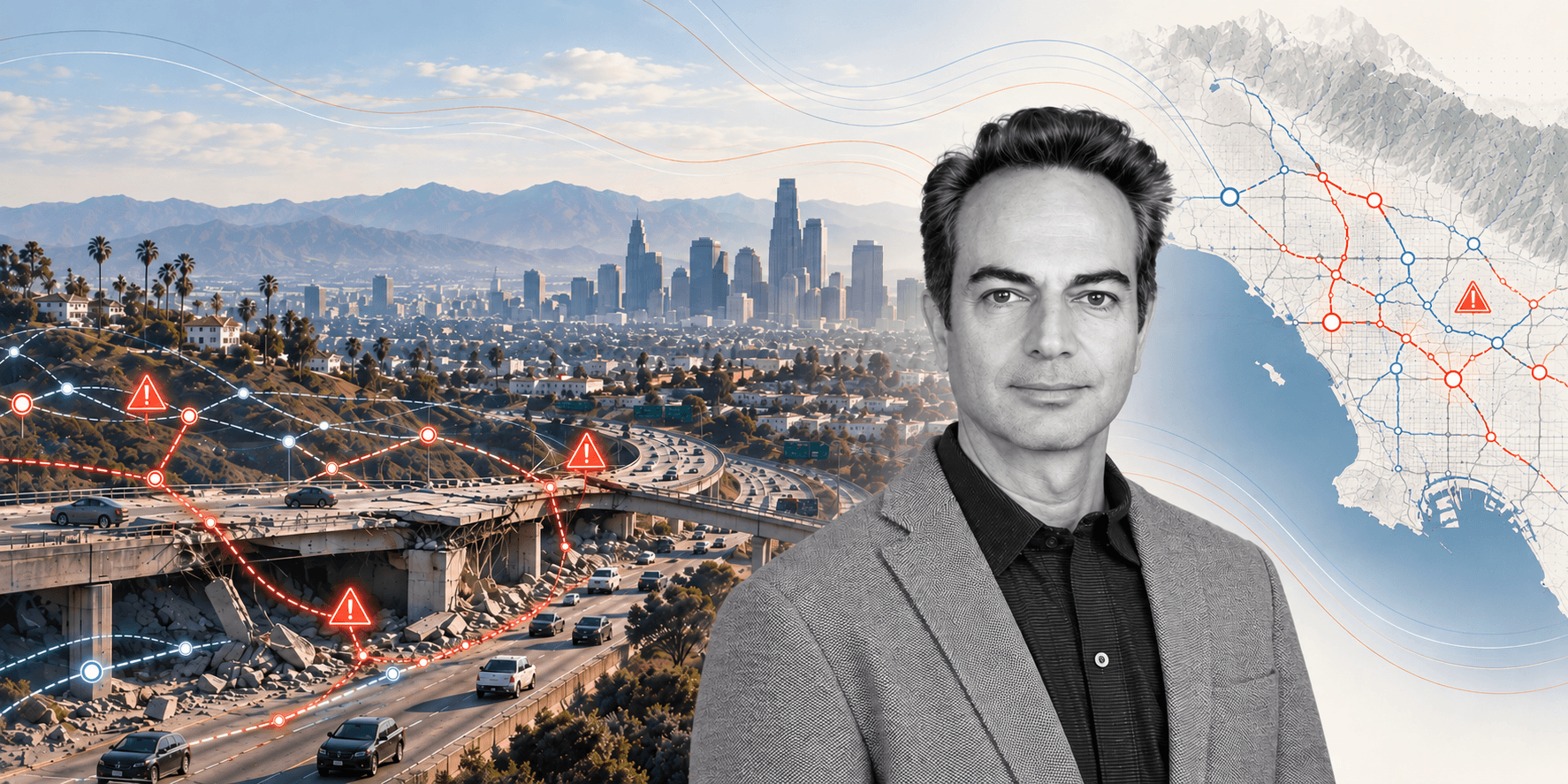
On October 15, millions of people will participate in the Great California ShakeOut. Cyrus Shahabi, Helen N. and Emmett H. Jones Professor in Engineering and professor in USC Viterbi and USC Stevens‘ Ming Hsieh Department of Electrical and Computer Engineering and Thomas Lord Department of Computer Science, studies how AI-based traffic systems respond to disruption in urban road networks. His research combines deep learning, spatial data management and large-scale traffic modeling to improve real-time situational awareness during emergencies in Los Angeles.
When a major earthquake hits Los Angeles, the road network does not just get congested. It becomes a different road network. Certain roads will close entirely for safety reasons. Two-way streets may be converted to one-way evacuation corridors. The map that traffic systems were built on — the one with sensors at known intersections, edges connecting known nodes — is no longer the map.
That shift is not primarily a civil engineering problem. It is a computer science problem. And it is one our current AI tools are not equipped to solve.
Most AI-based traffic forecasting, including my own most-cited work, is built on graph neural networks. The “graph” can represent the traffic network in different ways, for example, intersections as nodes and roads as edges, or sensors as nodes and the road-network distances between them as weighted edges, with relationships learned between specific points over time.
Article Intelligence
Topics
Sponsored
Ad
NewsLayerLearn more
NewsLayer Premium
Unlock deeper intelligence.
Ad-free reading, exclusive research, and real-time onchain insights.
Go Premium