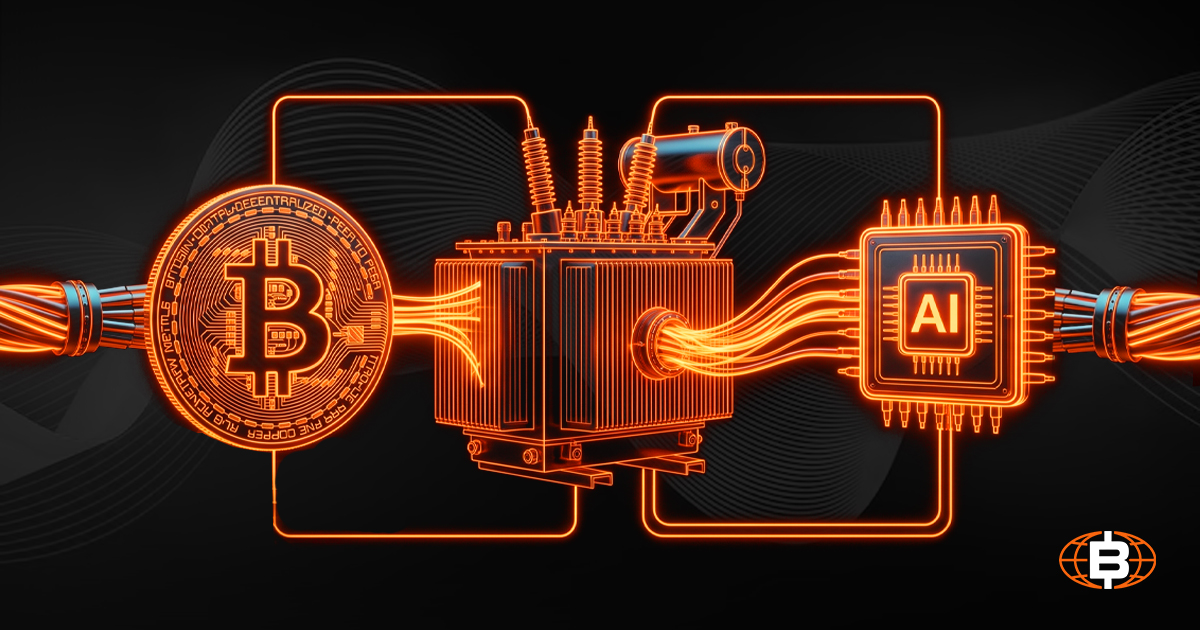
If you’ve scanned headlines over the last year, you’ve likely seen the prevailing market narrative: Bitcoin miners are abandoning their operations and pivoting to AI data centers, signaling a retreat from proof-of-work.
To casual observers, this looks like a surrender. Proof that Bitcoin was just a temporary placeholder until a “better” compute workload arrived.
However, if you look through the lens of power infrastructure and thermodynamics, that story gets the reality completely backwards. The migration isn’t a sign of bitcoin weakness; but a long-overdue, structurally bullish rebalancing of global energy pricing.
Here is the underlying reality that the market completely misunderstood.
AI vs. Bitcoin: Why Big Tech and Bitcoin Rigs Need Totally Different Data Centers
The misconception stems from assuming all digital workloads are created equal. In reality, Artificial Intelligence and Bitcoin Mining require completely opposite physical and digital environments:
An AI training cluster is fragile. If a 100-megawatt facility drops power mid-run, millions of dollars of training state are destroyed. It demands high-grade baseload power, ultra-low latency fiber, and 99.999% continuous uptime.
Bitcoin mining, by contrast, is completely indifferent to latency, location, or uptime. ASICs can operate in a remote desert, next to a stranded hydro dam, or on an off-grid flare gas pad. If grid power prices spike, a miner can shut down in seconds without losing data or damaging its hardware.
The Power Grid Eviction: How AI Is Pushing Bitcoin to Stranded Off-Grid Energy
For the past decade, Bitcoin miners operated on major electrical grids simply because that was where power substations already existed. But using prime, grid-connected baseload electricity to run an interruptible, location-agnostic program was always an economic inefficiency.
Now, AI hyperscalers are running into a massive bottleneck: getting new 100+ megawatt grid interconnections approved by utilities can take 3 to 5 years.
Hyperscalers are buying up every megawatt of prime, grid-tied power real estate they can find. In doing so, AI is pricing Bitcoin off the main electrical grid.
Far from destroying Bitcoin, this eviction restores it to its ideal thermodynamic role. Pushed off the grid, miners are forced to seek out energy that no one else can use: stranded wind in West Texas, flared natural gas in remote oil fields, or off-peak hydro in mountain ranges.
AI takes the expensive grid power; Bitcoin captures the world’s wasted energy at the edge, and acts as the buyer of last resort for stranded, wasted, or curtailed energy sources.