
This website uses cookies
We use cookies to personalise content and ads, to provide social media features and to analyse our traffic. We also share information about your use of our site with our social media, advertising and analytics partners who may combine it with other information that you’ve provided to them or that they’ve collected from your use of their services.
Consent Selection
Details
  • Necessary cookies help make a website usable by enabling basic functions like page navigation and access to secure areas of the website. The website cannot function properly without these cookies.
  • Preference cookies enable a website to remember information that changes the way the website behaves or looks, like your preferred language or the region that you are in.
    • We do not use cookies of this type.

  • Statistic cookies help website owners to understand how visitors interact with websites by collecting and reporting information anonymously.
    • We do not use cookies of this type.

  • Marketing cookies are used to track visitors across websites. The intention is to display ads that are relevant and engaging for the individual user and thereby more valuable for publishers and third party advertisers.
    • We do not use cookies of this type.

  • Unclassified cookies are cookies that we are in the process of classifying, together with the providers of individual cookies.
    • __emg_sidPending
      Maximum Storage Duration: 1 dayType: HTTP Cookie
      __emg_vidPending
      Maximum Storage Duration: 1 yearType: HTTP Cookie
      nl-read-countPending
      Maximum Storage Duration: PersistentType: HTML Local Storage
Cookie declaration last updated on 8/12/26 by Cookiebot
[#IABV2_TITLE#]
[#IABV2_BODY_INTRO#]
[#IABV2_BODY_LEGITIMATE_INTEREST_INTRO#]
[#IABV2_BODY_PREFERENCE_INTRO#]
[#IABV2_BODY_PURPOSES_INTRO#]
[#IABV2_BODY_PURPOSES#]
[#IABV2_BODY_FEATURES_INTRO#]
[#IABV2_BODY_FEATURES#]
[#IABV2_BODY_PARTNERS_INTRO#]
[#IABV2_BODY_PARTNERS#]
About
Cookies are small text files that can be used by websites to make a user's experience more efficient.

The law states that we can store cookies on your device if they are strictly necessary for the operation of this site. For all other types of cookies we need your permission.

This site uses different types of cookies. Some cookies are placed by third party services that appear on our pages.

You can at any time change or withdraw your consent from the Cookie Declaration on our website.

Learn more about who we are, how you can contact us and how we process personal data in our Privacy Policy.

Please state your consent ID and date when you contact us regarding your consent.
NewsLayer

Install NewsLayer

Get the app experience — one tap from your home screen, instant loads and breaking-news alerts.

NewsLayer.com

Bitcoin Grinds Toward $60K as the CLARITY Act Catalyst Shifts to September 15

게시 10시간 전 5 분 소요
Bitcoin Grinds Toward $60K as the CLARITY Act Catalyst Shifts to September 15

Bitcoin Grinds Toward $60K as the CLARITY Act Catalyst Shifts to September 15 Action Forex

TL;DR: Bitcoin is drifting toward the psychologically important $60,000 level in a bearish holding pattern, with September 15’s procedural cloture vote on the CLARITY Act setting up an asymmetric outcome — failure would be a clean negative signal, while success would only keep the legislative process moving.

Why the CLARITY Delay Isn’t the Whole Story

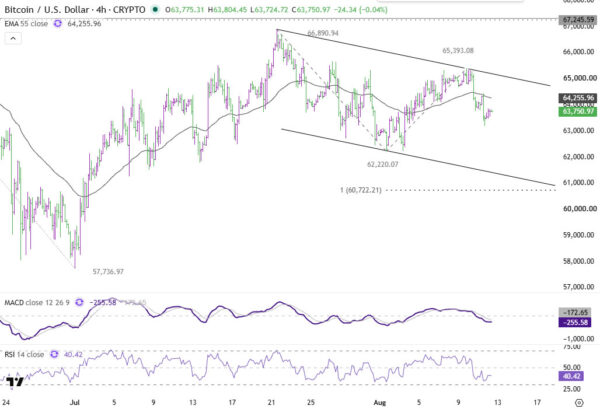
Bitcoin has spent the week grinding lower toward the low-63,000s. Momentum indicators are confirming the move rather than diverging against it — the 4H MACD remains negative and below its signal line, while RSI sits around 40.7 with no bullish divergence forming.

The retreat coincided with confirmation that the CLARITY Act would not get a Senate vote before August recess, and the timing invites an obvious interpretation: bulls may have positioned for progress on the bill’s procedural track, only for the delay to take some of the momentum out of the rally.

That explanation is plausible, but it shouldn’t be treated as settled. This has also been a volatile week across broader markets, with post-NFP Fed repricing, renewed Hormuz escalation lifting oil and Gold, and equities pulling back ahead of US CPI. Any of those forces could have contributed to crypto weakness just as readily as regulatory disappointment.

CLARITY Delay Is a Reasonable Factor, Not a Complete Explanation

Bitcoin’s relationship with single-day catalysts has been inconsistent throughout this cycle. Unlike Gold and Silver, which reacted cleanly and immediately to last week’s payroll shock, Bitcoin has often moved through slower, harder-to-attribute multi-session trends. That makes it difficult to isolate one headline as the sole driver.

The CLARITY delay is therefore best treated as a reasonable contributing factor, rather than proof Washington caused the selloff. Regulatory momentum mattered to the bullish narrative, and pushing the next meaningful Senate step into September removes one potential near-term catalyst. But a week of broad macro volatility doesn’t provide enough evidence to conclude regulatory disappointment alone explains Bitcoin’s decline.

What’s less ambiguous is the technical picture: price is moving lower, momentum is still bearish, and there’s no clear exhaustion signal yet.

ActionForex’s Technical View on Bitcoin

Current structure argues for further downside before the next major regulatory catalyst arrives. The 100% projection of 66,890.94 to 62,220.07 from 65,393.08 lands at 60,722.21. That level gains additional significance because it sits just above the psychological $60,000 figure, where buying interest and stop positioning would naturally become more concentrated.

With the 4H MACD still negative and RSI not yet oversold, there’s little technical evidence the decline has run its course. Unless Bitcoin can break out of the descending channel and recover above recent corrective highs, the 60,722–60,000 zone looks reachable. That doesn’t necessarily imply a major bearish breakdown is already underway — it suggests Bitcoin is drifting toward an important support region while waiting for a stronger catalyst to determine whether the move extends.
September 15 Is the Next Clear Regulatory Test

That catalyst is now shifting toward September 15. But the date needs to be understood correctly: it’s not expected to be a final passage vote on the CLARITY Act. It’s a cloture vote on the motion to proceed — a procedural step that would allow Senate debate to begin.

That distinction matters because the two possible outcomes carry very different market implications. A failed cloture vote would be a clean negative signal, showing the Senate can’t even gather sufficient support to move the legislation formally onto the floor. If Bitcoin were already trading around 60,722 or testing $60,000 at that point, failed cloture could provide a clear catalyst for a break lower.

A successful cloture vote would be constructive, but much less decisive.

Why Failure Could Hurt More Than Success Helps

A successful September 15 vote would restore legislative momentum and could support a relief rally. But it wouldn’t settle the underlying disputes that have slowed the bill all year, including disagreements over ethics provisions, illicit-finance rules, and stablecoin treatment. Most importantly, successful cloture wouldn’t mean the CLARITY Act has passed.

That creates an asymmetric setup: failed cloture could stop the process, while successful cloture only keeps the process moving. The downside implication is therefore cleaner than the upside one. A failed vote could challenge the assumption that meaningful crypto-market legislation is progressing through Congress at all. A successful vote would simply move debate to the next stage, leaving further amendments and an eventual passage vote still ahead — meaning any relief rally after successful cloture may struggle to become a genuine trend reversal without further legislative progress.

65,393–66,890 Is the First Upside Barrier

Technical structure reinforces that asymmetry. A positive September vote could help Bitcoin rebound, but the first meaningful hurdle would sit around the descending channel ceiling, then the recent resistance zone between 65,393 and 66,890.

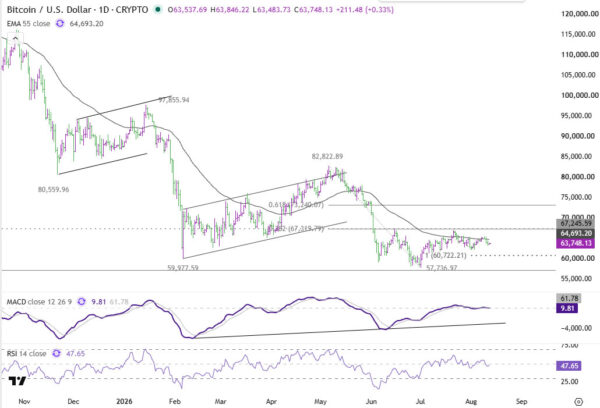
Beyond that, medium-term resistance is even more important. Bitcoin remains capped below the 67,245–67,319 cluster, including the 38.2% retracement of 82,822 to 57,736 at 67,319. Price has also repeatedly failed to sustain gains above the 55-day EMA.

Until those barriers are broken decisively, a successful cloture vote could generate a bounce without altering the broader bearish structure. For a more durable bullish reversal, Bitcoin would likely need both tangible progress on the CLARITY Act and a technical break through 67,245–67,319.

Bitcoin Is in a Bearish Holding Pattern

That leaves Bitcoin in an unusual position into mid-September. It’s not yet making a decisive long-term bearish break, but neither is it simply moving sideways while awaiting Washington. Price is grinding lower inside a descending channel, momentum is still pointed down, and the next obvious technical target sits just above $60,000. The better description is a bearish holding pattern.

Regulatory disappointment may have contributed to this week’s weakness, but the market hasn’t yet provided enough evidence to make the CLARITY Act the sole explanation. What September 15 offers is something cleaner: a discrete event with a much more measurable impact on the legislative path.

Until then, downside risk remains dominant while Bitcoin stays below the channel ceiling and the broader 67,245–67,319 resistance cluster. The immediate question is whether Bitcoin reaches $60,722 before Washington gives bulls another catalyst. The bigger question is what happens if September 15 arrives and that catalyst fails.

Key Takeaways

  • Bitcoin’s decline coincided with the CLARITY Act’s delayed Senate vote, but broader macro volatility (Fed repricing, Hormuz escalation, pre-CPI equity weakness) makes single-cause attribution unreliable.
  • The 60,722 technical target sits just above the psychologically significant $60,000 level, with no oversold or divergence signal yet suggesting the decline has run its course.
  • September 15 is a procedural cloture vote, not a final passage vote — a critical distinction that shapes the asymmetric risk into that date.
  • A failed cloture vote would be a clean negative catalyst; a successful one would only restore momentum without resolving the bill’s underlying disputes or guaranteeing passage.
  • 65,393-66,890 and then the 67,245-67,319 cluster are the key upside barriers; clearing both would likely require tangible legislative progress, not just a successful cloture vote.

Attribution

Originally reported by Action Forex

Get stories like this, daily.

Daily crypto + regulation intelligence, straight to your inbox. Free.

관련 기사