
IBM Quantum has demonstrated a crucial engineering milestone on its path toward modular fault-tolerant quantum computing, operating four meter-scale cryogenic quantum interconnects—designated L-couplers—between two full 120-qubit IBM Quantum Nighthawk R1 superconducting processors. Detailed in an arXiv preprint and an accompanying IBM Research technical overview, the deployment achieved an average inter-chip quantum state transfer fidelity of 99.00% (peaking at 99.29%) and supported inter-processor distant CZ entangling gates averaging 94.75% fidelity.
IBM Unveils Meter-Scale Superconducting L-Couplers: Connecting Dual 120-Qubit Processors with 99% State Transfer Fidelity
IBM Quantum has demonstrated a crucial engineering milestone on its path toward modular fault-tolerant quantum computing, operating four meter-scale cryogenic quantum interconnects—designated L-couplers—between two full 120-qubit IBM…
Quantum Computing Report
Publisher
Oct 27, 2026 at 6:58 PM UTC · Updated 6시간 전 · 4 분 소요
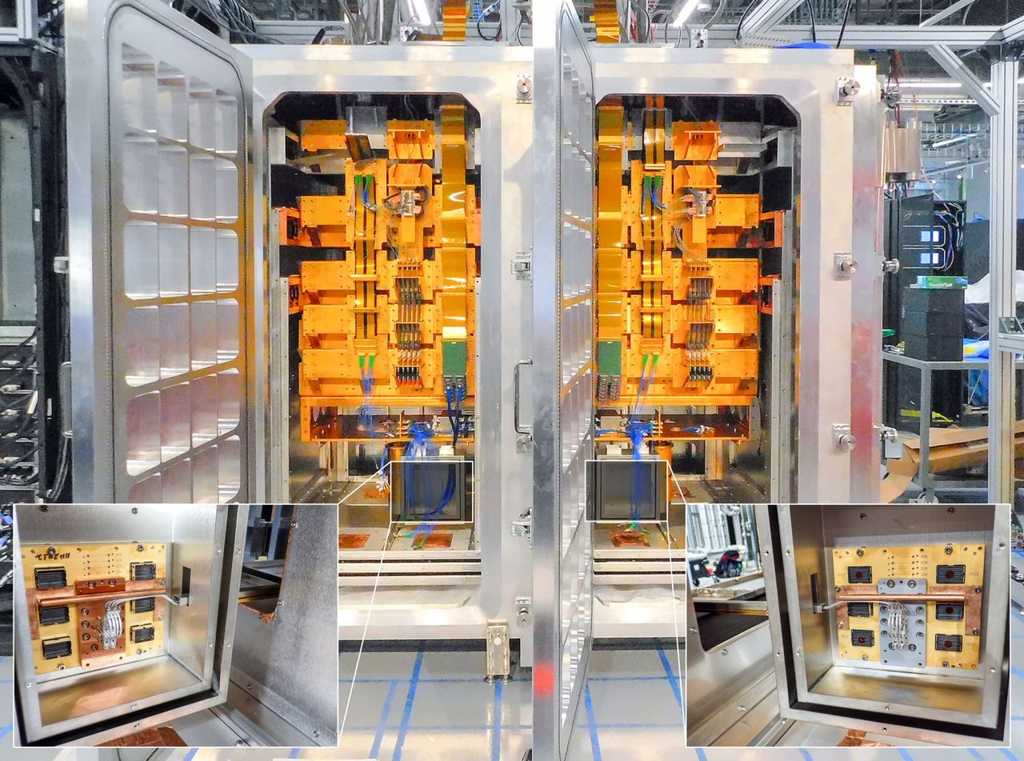
While previous academic and industrial demonstrations have linked few-qubit superconducting chips on laboratory benches, IBM’s implementation represents the first multi-channel, meter-scale interconnect architecture engineered specifically for the mechanical and thermal constraints of large, production-grade quantum processors mounted inside shared dilution refrigerators. The modular architecture serves as the physical backbone for IBM’s upcoming fault-tolerant processor, IBM Quantum Starling, planned for 2029.
| [ IBM L-Coupler Interconnect: Architecture & Benchmark Performance ] | ||
|---|---|---|
| System Parameter | Engineering Implementation | Benchmark Metric & Performance |
| • Physical Interconnect | • 80 cm aluminum-aluminum coax with low-density PTFE (Hqubit System) | • Operates near 5 GHz; standing mode internal quality factor (Qi) averages 0.94 × 10⁶ (single test cable reached 2.0 × 10⁶). |
| • Packaging & Assembly | • Perpendicular cable-to-chip join via room-temperature indium-to-indium pressure bonds | • Installed after modules are mounted in cryostat using spring-loaded holders; survived three full thermal cycles without degradation. |
| • Coupler Circuitry | • Dedicated frequency-tunable “L-qubits” and “i2m” inductive RF-SQUID couplers | • Negative geometric mutual inductance (M0) makes the off-state coupling first-order flux insensitive, suppressing idling dephasing. |
| • State Transfer Fidelity | • Relay-based state transfer protocol benchmarked via Network Benchmarking (NB) | • Mean transfer fidelity across 4 links: 99.00% (best link: 99.29 ± 0.07%); coherence model shows 77% of error driven by L-qubit dephasing. |
| • Distant Two-Qubit Gates | • Inter-module CZ gates composed of 2 state transfers, 3 local CZs, and 4 single-qubit gates | • Mean distant CZ fidelity: 94.75% (best link: 96.42 ± 0.28%); enabled simultaneous Bell-pair generation on adjacent links. |
| • Multipartite Entanglement | • Inter-module Greenberger-Horne-Zeilinger (GHZ) state distribution | • 4-qubit GHZ state across chips: 77.2% raw (91.7% mitigated); 6-qubit GHZ ring state: 67.7% raw (90.9% mitigated). |
Engineering for Assembly: Perpendicular Indium Joins and Cooldown Shielding
A primary bottleneck in multi-chip superconducting scaling has been mechanical: traditional wire-bonding and horizontal planar connectors consume valuable chip perimeter, preventing dense two-dimensional packing. IBM solved this by developing a perpendicular cable-to-chip mating geometry. Aluminum coaxial lines are mounted using spring-loaded fixtures that apply an indium-to-indium pressure bond directly to the chip surface at room temperature after both processor payloads are secured inside the cryostat.
Article Intelligence
Related Coverage
 QuantumIntel’s Classiq Deal May Signal a Pivot From Quiet Quantum Effort To Active Commercialization4시간 전 · 8 min read
 QuantumQuantinuum and GE Vernova Target High-Temperature Superconductivity Using Helios Trapped-Ion Hardware11시간 전 · 3 min read
 QuantumQuantrolOx Raises €12 Million ($13.36 Million USD) Series A2 to Scale Automated Quantum Control Software and U.S. Operations14시간 전 · 2 min read
Sponsored
Ad
NewsLayerLearn more
NewsLayer Premium
Unlock deeper intelligence.
Ad-free reading, exclusive research, and real-time onchain insights.
Go Premium