
Researchers at ParityQC and the University of Innsbruck have detailed a progression for running quantum algorithms on exchange-only spin qubits, charting a course from current noisy devices toward fault-tolerant quantum simulation. These exchange-only qubits encode quantum information using three electron spins across three quantum dots, enabling universal control through electrical pulses.
ParityQC & Innsbruck Team’s EO Maps Algorithms To Spin Qubit Hardware
Researchers at ParityQC and the University of Innsbruck have detailed a progression for running quantum algorithms on exchange-only spin qubits, charting a course from current noisy devices toward fault-tolerant quantum simulation.…
Quantum Zeitgeist
Publisher
Oct 1, 2026 at 7:39 PM UTC · Updated 3일 전 · 3 분 소요
Key Signal
Up to 18 EO qubits demonstrated
Last Updated
3일 전
번역 중…
The team reports providing resource estimates for a range of applications targeting different hardware stages, confirming Parity Twine as a strong candidate for implementing near and mid-term algorithms on these qubits and highlighting the importance of hardware-informed compilation. “By providing quantitative resource estimates and identifying scaling bottlenecks,” the researchers write, “the work offers concrete target values for the development of future spin qubit processors.”
Exchange-Only Spin Qubits: From NISQ to Fault-Tolerance Roadmap
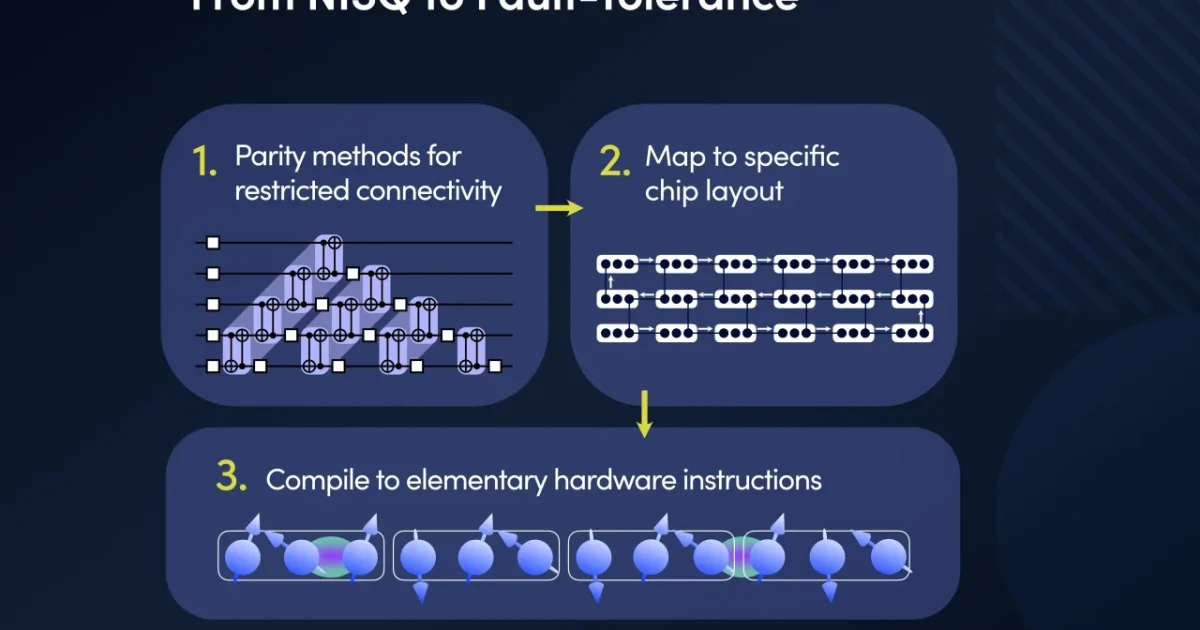
The demonstration of a processing unit containing up to 18 exchange-only (EO) qubits signals a critical shift for the technology, moving the primary challenge from individual qubit fabrication to the efficient mapping of algorithms onto the hardware. Researchers Frederik Lohof, Florian Ginzel, and Wolfgang Lechner detailed this progression in a recent preprint, outlining a roadmap from current noisy intermediate-scale quantum (NISQ) devices to future fault-tolerant systems.
Article Intelligence
Topics
Sponsored
Ad
NewsLayerLearn more
NewsLayer Premium
Unlock deeper intelligence.
Ad-free reading, exclusive research, and real-time onchain insights.
Go Premium