We use cookies to personalise content and ads, to provide social media features and to analyse our traffic. We also share information about your use of our site with our social media, advertising and analytics partners who may combine it with other information that you’ve provided to them or that they’ve collected from your use of their services.
Necessary cookies help make a website usable by enabling basic functions like page navigation and access to secure areas of the website. The website cannot function properly without these cookies.
_cfuvidThis cookie is a part of the services provided by Cloudflare - Including load-balancing, deliverance of website content and serving DNS connection for website operators.
Maximum Storage Duration: SessionType: HTTP Cookie
__cf_bm [x7]This cookie is used to distinguish between humans and bots. This is beneficial for the website, in order to make valid reports on the use of their website.
CookieConsentStores the user's cookie consent state for the current domain
Maximum Storage Duration: 1 yearType: HTTP Cookie
Preference cookies enable a website to remember information that changes the way the website behaves or looks, like your preferred language or the region that you are in.
We do not use cookies of this type.
Statistic cookies help website owners to understand how visitors interact with websites by collecting and reporting information anonymously.
We do not use cookies of this type.
Marketing cookies are used to track visitors across websites. The intention is to display ads that are relevant and engaging for the individual user and thereby more valuable for publishers and third party advertisers.
We do not use cookies of this type.
Unclassified cookies are cookies that we are in the process of classifying, together with the providers of individual cookies.
List of domains your consent applies to: [#BULK_CONSENT_DOMAINS#]
Cookie declaration last updated on 8/12/26 by Cookiebot
[#IABV2_TITLE#]
[#IABV2_BODY_INTRO#]
[#IABV2_BODY_LEGITIMATE_INTEREST_INTRO#]
[#IABV2_BODY_PREFERENCE_INTRO#]
[#IABV2_BODY_PURPOSES_INTRO#]
[#IABV2_BODY_PURPOSES#]
[#IABV2_BODY_FEATURES_INTRO#]
[#IABV2_BODY_FEATURES#]
[#IABV2_BODY_PARTNERS_INTRO#]
[#IABV2_BODY_PARTNERS#]
About
Cookies are small text files that can be used by websites to make a user's experience more efficient.
The law states that we can store cookies on your device if they are strictly necessary for the operation of this site. For all other types of cookies we need your permission.
This site uses different types of cookies. Some cookies are placed by third party services that appear on our pages.
You can at any time change or withdraw your consent from the Cookie Declaration on our website.
Learn more about who we are, how you can contact us and how we process personal data in our Privacy Policy.
Please state your consent ID and date when you contact us regarding your consent.
Install NewsLayer
Get the app experience — one tap from your home screen, instant loads and breaking-news alerts.
Quantum Computer Solves a Problem in 15 Minutes That Classical Methods Can’t Practically Compute
Researchers have demonstrated a quantum computation that appears to exceed the practical capabilities of leading classical simulation methods while also addressing a longstanding problem: how to verify the result.
PublisherSciTechDaily 4 분 소요
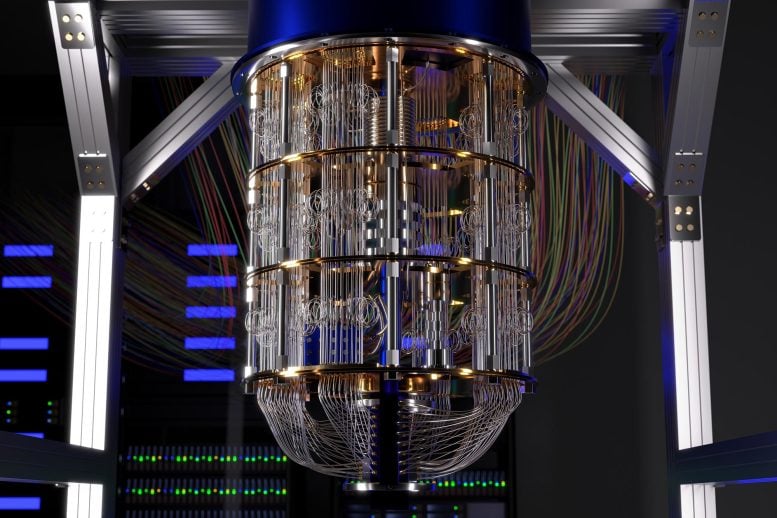
Image via SciTechDaily
2,415Logical two-qubit operations
468Logical T gates completed
15 minutesQuantum task completion time
Why This Matters
The verified 70-logical-qubit demonstration signals progress toward fault-tolerant quantum systems, which could eventually shorten the timeline for cryptographic migration to post-quantum standards. It does not indicate that current public-key encryption or blockchain signatures can be broken today, but it strengthens the case for institutions to inventory and upgrade long-lived cryptographic systems.
Researchers have demonstrated a quantum computation that appears to exceed the practical capabilities of leading classical simulation methods while also addressing a longstanding problem: how to verify the result.
A quantum computer completed a difficult calculation in about 15 minutes, while leading classical simulation methods would require prohibitive amounts of time. Just as importantly, the experiment included a way to establish confidence that the quantum result was accurate.
IBM and University of Chicago researchers announced the demonstration on July 30, 2026, presenting it as evidence that quantum computing has met the central requirements for quantum advantage. This means completing a task beyond the practical reach of leading classical methods while providing a reliable measure of how faithfully the quantum computation was performed.
In a paper published on arXiv, the researchers describe a new design for encoded quantum circuits that allowed them to pursue both goals at once. The experiment became one of the largest demonstrations of logical quantum computing reported so far. The circuits and results have also been released publicly through the Quantum Advantage Tracker.
“This experiment develops techniques to better characterize the fidelity of hard quantum states under noise, increasing confidence that the quantum computer is solving a computationally hard problem,” said UChicago Assoc. Prof. Bill Fefferman. Credit: IBM
Verification has remained the central barrier
Random circuit sampling (RCS) has long served as a benchmark for testing whether quantum computers can outperform classical systems. In this task, a quantum computer produces patterns so complicated that classical computers cannot efficiently recreate them.
The harder the calculation becomes, however, the more difficult it is to confirm that the quantum computer produced the correct output. Eventually, verification itself can become infeasible unless researchers make substantial assumptions about how the machine operates internally.
The IBM and University of Chicago experiment addressed this problem with a more structured alternative to RCS. The researchers proved that the new approach preserves the same standards of computational hardness while allowing errors to be detected as the calculation proceeds.
“Verification remains one of the biggest challenges in firmly establishing experimental quantum advantage,” said Bill Fefferman, Associate Professor at the University of Chicago. “This experiment develops techniques to better characterize the fidelity of hard quantum states under noise, increasing confidence that the quantum computer is solving a computationally hard problem.”
IBM and researchers from the University of Chicago announced a demonstration in quantum computing that meets the fundamental criteria for “quantum advantage”—the point where quantum computers can be confirmed to have outperformed classical computers. Credit: IBM
Soumik Ghosh, PhD student in Fefferman’s group at the University of Chicago, added, “Beyond strengthening experimental validation, advances in verification have the potential to unlock practical applications for the next generation of quantum computers.”
Seventy logical qubits suppress errors
The researchers carried out one of the largest known quantum error correction demonstrations, using 70 logical qubits. Logical qubits encode quantum information across multiple physical components to protect calculations from errors caused by noise.
The system completed 2,415 logical two-qubit operations and 468 logical “T gates,” two measures of quantum circuit complexity. Encoding the circuit reduced the effective logical error rate to one tenth of the physical error rate, allowing the computation to maintain high fidelity despite the large number of operations.
“We are now firmly in the quantum advantage era,” said Jay Gambetta, Director of IBM Research and IBM Fellow. “We have demonstrated a quantum computation beyond the practical reach of classical computers that establishes, with statistical confidence, a lower bound on how faithfully it was executed. This milestone gives scientists, developers, and businesses a new foundation for trusting quantum computers as they scale to problems far beyond what we can achieve classically.”
The IBM quantum computer completed the task in approximately 15 minutes. The researchers found that many leading classical simulation methods would face runtimes too long to be practical.
Reliable error correction and confidence in a computation’s output are both necessary for quantum systems to operate at larger scales. By combining a classically difficult calculation with a method for assessing its accuracy, the experiment represents a significant step toward that goal.
Reference: “Sampling hard circuits with verifiably high fidelity” by Simon Martiel, Jay-U Chung, Alireza Seif, Soumik Ghosh, Ian Hincks, Abhinav Deshpande, Bill Fefferman, Jay M. Gambetta and Ali Javadi-Abhari, July 27, 2026, arXiv. DOI: 2607.25941