
Insider Brief
Quantum Source’s QS-LINK Uses a Single Atom to Help Quantum Processors Connect
Insider Brief PRESS RELEASE — Quantum Source, developer of compound photon-atom technology that makes photonic quantum computers practical, published the first technical details of its proprietary QS-LINK, an interconnect built to break…
Matt Swayne
Publisher The Quantum Insider
Oct 8, 2026 at 2:26 PM UTC · Updated 8시간 전 · 3 분 소요
Entities
chainlink
Last Updated
8시간 전
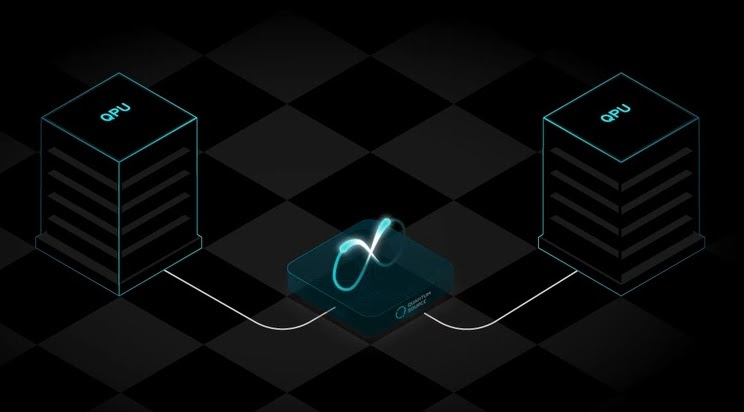
- Quantum Source unveiled QS-LINK, a proposed interconnect that uses a single rubidium atom as quantum memory to link quantum processors without requiring their photons to arrive simultaneously.
- The design could connect different processor types over standard optical fiber, provided they emit compatible photons.
- Modeling projects roughly 60 times fewer attempts to generate 10,000 entangled pairs per second than conventional linear-optics methods, pending a full end-to-end demonstration.
PRESS RELEASE — Quantum Source, developer of compound photon-atom technology that makes photonic quantum computers practical, published the first technical details of its proprietary QS-LINK, an interconnect built to break the bottleneck that keeps quantum computers from scaling beyond a single processor. Using a single rubidium atom as quantum memory, QS-LINK holds the entanglement with a first processor until successfully establishing entanglement with a second one, so processors no longer have to deliver a photon at the same moment, which raises the rate at which they can be linked by orders of magnitude
For all its promise, scale remains the central problem in quantum computing. Fault-tolerant machines will need more qubits than any single quantum processing unit can hold, so they will have to be built from many QPUs linked through shared entanglement. In conventional two-photon schemes, that link only succeeds when photons from both processors arrive in the same attempt, and with each photon delivered about 1% of the time or less, both arriving together happens roughly once in 10,000 tries. QS-LINK removes that requirement with a near-deterministic photon-atom gate that stores the first arrival instead of discarding it. And because the photons interact only with the atom and never with each other, they also never need to be identical, which makes QS-LINK hardware-agnostic.
Article Intelligence
Key Entities
Topics
Related Coverage
 CryptoPicture someone, maybe your mom, standing in a liquor store feeding one $50 or $100 bill after another into a bitcoin ATM. Dollar after dollar gone. See link below ⬇️ 📸 Susan Tompor, Detroit Free Press6시간 전 · 1 min read
 QuantumOratomic Raises $775 Million to Develop Fault-Tolerant Quantum Computers5시간 전 · 1 min read
 QuantumNSF Launches New Programs for Quantum Innovation and STEM Research8시간 전 · 4 min read
Sponsored
Ad
NewsLayerLearn more
NewsLayer Premium
Unlock deeper intelligence.
Ad-free reading, exclusive research, and real-time onchain insights.
Go Premium