This website uses cookies
We use cookies to personalise content and ads, to provide social media features and to analyse our traffic. We also share information about your use of our site with our social media, advertising and analytics partners who may combine it with other information that you’ve provided to them or that they’ve collected from your use of their services.
Consent Selection
Details
  • Necessary cookies help make a website usable by enabling basic functions like page navigation and access to secure areas of the website. The website cannot function properly without these cookies.
  • Preference cookies enable a website to remember information that changes the way the website behaves or looks, like your preferred language or the region that you are in.
    • We do not use cookies of this type.

  • Statistic cookies help website owners to understand how visitors interact with websites by collecting and reporting information anonymously.
    • We do not use cookies of this type.

  • Marketing cookies are used to track visitors across websites. The intention is to display ads that are relevant and engaging for the individual user and thereby more valuable for publishers and third party advertisers.
    • We do not use cookies of this type.

  • Unclassified cookies are cookies that we are in the process of classifying, together with the providers of individual cookies.
    • __emg_sidPending
      Maximum Storage Duration: 1 dayType: HTTP Cookie
      __emg_vidPending
      Maximum Storage Duration: 1 yearType: HTTP Cookie
      nl-read-countPending
      Maximum Storage Duration: PersistentType: HTML Local Storage
Cookie declaration last updated on 8/12/26 by Cookiebot
[#IABV2_TITLE#]
[#IABV2_BODY_INTRO#]
[#IABV2_BODY_LEGITIMATE_INTEREST_INTRO#]
[#IABV2_BODY_PREFERENCE_INTRO#]
[#IABV2_BODY_PURPOSES_INTRO#]
[#IABV2_BODY_PURPOSES#]
[#IABV2_BODY_FEATURES_INTRO#]
[#IABV2_BODY_FEATURES#]
[#IABV2_BODY_PARTNERS_INTRO#]
[#IABV2_BODY_PARTNERS#]
About
Cookies are small text files that can be used by websites to make a user's experience more efficient.

The law states that we can store cookies on your device if they are strictly necessary for the operation of this site. For all other types of cookies we need your permission.

This site uses different types of cookies. Some cookies are placed by third party services that appear on our pages.

You can at any time change or withdraw your consent from the Cookie Declaration on our website.

Learn more about who we are, how you can contact us and how we process personal data in our Privacy Policy.

Please state your consent ID and date when you contact us regarding your consent.
NewsLayer.com

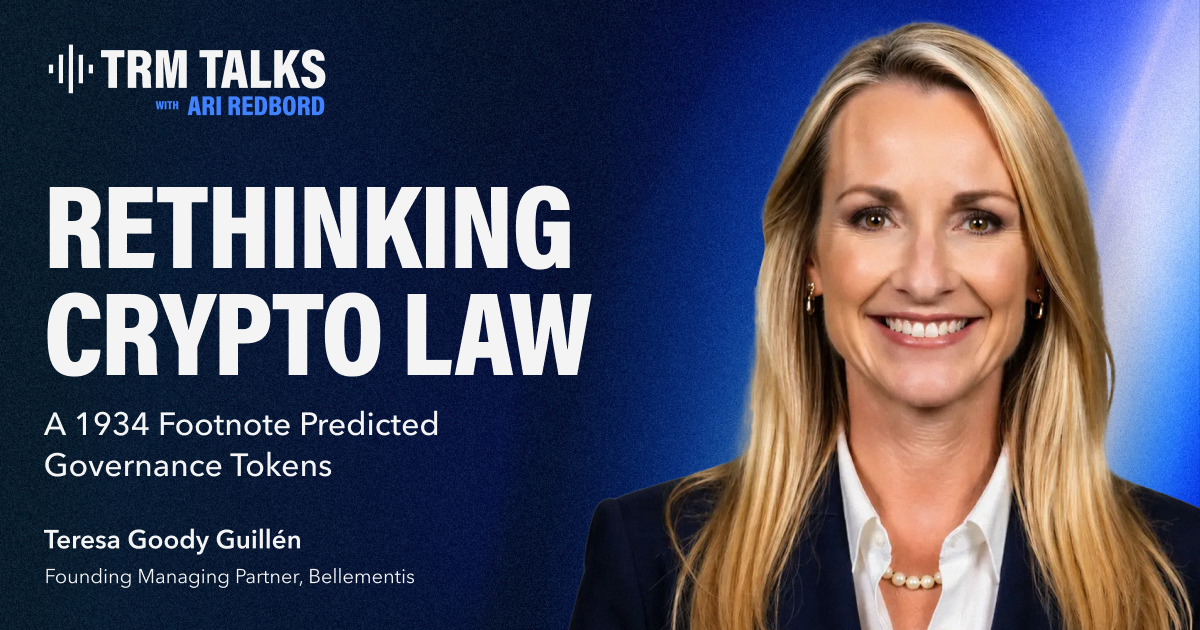
A 1934 Footnote Predicted Governance Tokens: Rethinking Crypto Law with Teresa Goody Guillén

Publicado há 3 horas 23 min de leitura
A 1934 Footnote Predicted Governance Tokens: Rethinking Crypto Law with Teresa Goody Guillén

A 1934 Footnote Predicted Governance Tokens: Rethinking Crypto Law with Teresa Goody Guillén TRM Labs

Ari Redbord (00:02):

I’m Ari Redbord and this is TRM Talks. I'm Global Head of Policy at TRM Labs, we provide blockchain intelligence software to support law enforcement investigations and to help financial institutions and cryptocurrency businesses mitigate financial crime risk within the emerging digital asset economy. Prior to joining TRM spent 15 years in the US federal government, first as a prosecutor at the Department of Justice, and then as a Treasury Department official where I worked to safeguard the financial system against terrorist financiers, weapons of mass destruction proliferators, drug kingpins, and other rogue actors. On TRM Talks, I sit down with business leaders, policymakers, investigators, and friends from across the crypto ecosystem who are working to build a safer financial system.

(00:52):

On today's TRM Talks, I sit down with my friend and the new managing partner of Bellementis, Teresa Goody Guillén. But first, Inside the Lab, where I share data-driven insights from our blockchain intelligence team. On today's Inside the Lab, we're talking about latency, because in this ecosystem, delay equals exposure. With illicit volume reaching 158 billion in 2025 and billions moving within minutes during major incidents, real-time ingestion is not an optimization, it's survival. Real-time blockchain ingestion means transactions are processed as they confirm, normalized across chains and made immediately available for clustering, risk scoring, and network expansion. This changes investigative posture from retrospective analysis to live situational awareness. If funds are moving across five chains within 10 minutes, you cannot afford hourly data refresh cycles. You need contextual scoring and entity mapping in operational timeframes. In digital finance, velocity is the threat multiplier. Real-time analytics is the countermeasure.

(02:04):

For much more on this, read the blog post from our engineering team on how they ingest blockchains in real time. And now, Teresa Goody Guillén. Today, I am joined by my friend, the founding partner of Bellementis, and really one of the great legal minds in our space, Teresa Goody Guillén.

Teresa Goody Guillén (02:25):

Thanks. It's great to see you. Great to talk to you.

Ari Redbord (02:28):

Would you talk a little bit about your journey to becoming, I think, really one of the true expert lawyers in this space?

Teresa Goody Guillén (02:34):

My journey, I think, is important in understanding too, how I do approach all of this, because the journey is how my mind has evolved and how my thinking has evolved and my approaches. And I was really fortunate to have some amazing mentors, something that I think is underrated these days and harder to find. But I started my career actually in law school, going to school at night. So I put myself through college and law school and working full-time. And I worked at a plaintiff's law firm, which was a different experience certainly from now. And it was really helpful at the beginning because plaintiff's law firms are a bit scrappy, and you get the opportunity to do so many things that sometimes it takes people 10 years of their career to get to. So starting at a plaintiff's law firm was really helpful. I was fortunate it was one of the top, I think, 50 lawyers, trial lawyers in the United States, and so medical malpractice and other types of plaintiff's injuries.

(03:42):

But at the highest level, it was Patrick Reagan. He actually was one of the reasons that helped me get a clerkship later on in my career was the fact that I had worked for him.

Ari Redbord (03:52):

But you mentioned mentors, which a lot of people, young lawyers in particular, I think are listening to the show. And I often talk about, I did a federal clerkship in North Carolina for a really extraordinary judge named Mac Howard, Malcolm Howard. He passed away recently. He's buried in Arlington. Just an amazing guy, Reagan appointee so many years ago. And just like you have these people in your life who've really shaped it, it sounds like, I know you clerked for Judge Urbina in the DC District Court, place where I practiced for many years as well. Tell me about that experience for sure.

Teresa Goody Guillén (04:22):

That really shaped my career immensely. And the reason I did a clerkship first was I didn't feel like I was ready to practice law. And it's amazing how much confidence I got from that experience because after I saw what people were doing, I though, "Oh, I can do this."

Ari Redbord (04:37):

Talk to me a little bit about your time at the SEC.

Teresa Goody Guillén (04:40):

It was very helpful coming from criminal defense work and investigations, civil and criminal work that I did at a big law firm, and then transitioning over to see from the regulator standpoint and the other standpoint. And it was really helpful just to see the operations even. And the resources constriction, more operational type of things were very insightful to me and how it functioned and how people think. I started litigating on behalf of the commission and then working more on some of the investigations that were going on internally. And this was after the financial crisis, which was one of the reasons that drew me there because with the financial crisis, I wanted to understand more about why that happened. How does that happen? What are our systems in place that keep that from happening or are involved in that where the guardrails? And so it was a lot of, again, my curiosity is what led me to the SEC, just being in this moment in time of wanting to know more about it.

(05:50):

And so I really took that opportunity to learn. Luckily, I was in the office of the general counsel's office, so I could do this. All the different divisions. I had to work with all the different divisions for everything that I was working on. And so I learned a lot about enforcement, and then it was moving. So Harvey Pitt, former SEC chairman, approached me really from the SEC and asked me to come work with him. So otherwise I would've stayed there longer. But how could I not accept a job with Harvey Pitt? The opportunity to work alongside one of the most brilliant, I think, lawyers who's ever practiced. I learned to know and love the commission and securities laws even more with him and almost through his eyes. So that's another mentor who just completely changed the way that I think, the way that I lawyer.

Ari Redbord (06:45):

You mentioned obviously becoming this expert on SEC, on securities law, your time in the commission, your time working with Harvey Pitt. I know you've worked at large law firms doing this today, but is there a moment when digital assets really became front and center for you?

Teresa Goody Guillén (07:02):

Yes, it's very clear in my mind. And so in 2015, Harvey, it was the first time somebody paid for my school, he sent me to go get an MBA. So I got an MBA and I decided I wanted to launch my own law firm for the first time. But my first client wanted to do a swaps transaction, and the underlying asset was a digital asset. And there was no swaps regime. There were thousands of pages of proposed rules. There was nothing on digital assets yet. And so I looked at it and I said, "Well, I could see this could be a commodity or a security. I can see the argument on both sides." So I called my friends at the SEC and my friends at the CFTC, and they both said,"Yes."

Ari Redbord (07:47):

No idea.

Teresa Goody Guillén (07:49):

Yes, I have jurisdiction.

Ari Redbord (07:50):

Yeah, exactly.

Teresa Goody Guillén (07:51):

And I was like, "Oh, that's so funny. You guys can't both have jurisdiction. Let's all get a room and chat and just talk this out."

Ari Redbord (07:57):

10 years later, it has not been worked out.

Teresa Goody Guillén (08:00):

Finally we do have Paul Atkins and Selig talking.

Ari Redbord (08:05):

Exactly. That's cool. I love that perspective. That's amazing. And then honestly, was it from that first sort of engagement with a client that you realized, "Hey, this is a really interesting issue and I can have a unique perspective on it?"

Teresa Goody Guillén (08:16):

Yeah, it was. I always look at what is the goal you're trying to accomplish? How can we accomplish this goal when it looks like we can't do it this one way? And it was interesting because I had a lot of clients who came to me and I said, "Well, we can do your transactions one way, but that would be a securities transaction, so we have to follow one of the exemptions and do it that way. Or we can change a little bit of the model that you're using right now. And if we can implement some technological changes, then we can put it into a different kind of category." And so two things, we can do it either way and I can find either solution. And they said, "Well, there's this big law firm and they said I can just do it this way." Okay, well, I do defense work too, so keep my card.

(09:12):

And so that really fascinated me. And then I don't know, you can't how people practice in this space without understanding the technology. So I taught digital law and policy at Georgetown too. And I remember the first painful time for the engineers, not painful for me, where we were walking through lines of code of a smart contract and they were explaining to me what it did, and then I would tell them the legal implication of each of those. And it was a very helpful experience for me, although painful for them, I think.

Ari Redbord (09:45):

Totally. It's so important. People ask all the time, it's like, "Hey, how can I get more involved in this space or understand it better?" And I'm always like, "Look, the space is the technology and you've got to really start to understand it. I do not at all profess to be a data scientist or an engineer, but I've really tried to touch this stuff and play with it and spin up a MetaMask wallet and mess with NFTs and fund a liquidity pool and work through those issues. I think it becomes really powerful in terms of your ability to engage with clients in that way. What are the major issues that clients are coming in with today in terms of your practice? And then I think there's a lot of questions right now, especially for US developers. While we have some really good guidance, if you will, from the SEC today that we didn't have even a few months or certainly a few years ago, CFTC, US Treasury, the Fed, we still don't have legislation.

(10:43):

How are you thinking about navigating that right now for your clients?

Teresa Goody Guillén (10:48):

Well, I have a lot of conversations with regulators like I used to before the last administration. It's a similar approach that I had taken for most of my career is going and talking to the regulators. And so we have a product, we have something, I'm working through a few different exemptive programs. People don't realize the breadth of the exemptive relief from the SEC and the CFTC, and it's nothing novel. Harvey and I used to do this all the time, going to the SEC and asking them for some exemptive relief because you can basically exempt anyone or any transaction or any instrument. As long as it fulfills certain requirements, then you get these exemptive relief. So I'm working doing that considerably. I talk to the crypto task force and make sure that what we're thinking about is not inconsistent. Obviously they can't provide me with any kind of specific information, but we want to make sure that the way that we're thinking about this is not something that's inconsistent with what the commissions are going to be doing or wanting to do.

(11:58):

But they could fully regulate the markets without any legislation. I think legislation is really helpful and is necessary certainly at some point to have things codified, but their exemptive relief collectively would enable them to regulate the markets efficiently and effectively.

Ari Redbord (12:15):

You're doing this really from a different platform. You left leading two practice groups at a large law firm to start your own thing, which as someone who joined a seven-person startup six years ago after a time in the government, it's like there's nothing I admire or respect more than someone who takes that step. You're building Bellementis. I think of it as this whole group of experts on securities, on market structure coming together in a technology-first type of way to build maybe a new model of law firm. But I also want to start with Bellementis. Tell me about the name.

Teresa Goody Guillén (12:50):

So the name means roughly, not exactly, but A Beautiful Mind. And I am a fan of John Nash and everything. I do use some of that in the game theory in my legal work, but it's more of, to me, the law is this beautiful craft. And we don't see that as much. We don't see people practicing it as this craft. It's one of the oldest crafts, and it is so beautiful. And the thought process and the minds and the thinking of it to me is just, it's so fun. I get lost in it. This is why I write my own legislation in my spare time because I just love it. It's so fascinating to me and all these puzzles. And so a lot of it is preserving this beautiful craft as a craft. So we're very selective in the people who work at Bellementis. They all are extraordinarily high quality.
(13:49):

And while it's a full service law firm, our flagship is financial and digital markets. And so the convergence of those. So you'll see everyone has expertise in traditional financial markets as well as digital markets.

Ari Redbord (14:05):

Amazing. How do you deal with, dig into an issue? How do you try to solve it?

Teresa Goody Guillén (14:10):

It's so fascinating to me, and it's so critical to get it right. And I feel like people just started just going without thinking. And that prep process, that thinking process about how to approach something is the most important one. Then everything from there is following generally the plan. But people just started originally just saying, "Is it a commodity or security?" And that's not the right question to me. And so what I did was I sat back and though about, "Okay, what are these assets?" And I did a lot of reading and contemplating. And the way that I think about them actually comes from a footnote written in the '30s by Adolf Burl and thinking more about how these different types of economic rights, property rights evolved through time. And I thought I always go back to history to learn because history repeats itself and it's different.

(15:12):

Things change, but you can always get lessons. So I started just looking, well, what did people do before? How did people approach analyzing new assets? We've obviously had them. And so I just did a deep dive into economic treatises of legal principles and the evolution of the corporate structure. And when you started separating ownership and control, because that's what a lot of this came down to with these assets was what are the rights and liabilities? What's the bundle of rights? What does this do? So he separates it into passive property and active property. And so passive property is when a shareholder has passive property, and then the active property is management and they're working. And it was fascinating because when you separated those two and you could have a shareholder separate from the company managers and controllers, they actually analyzed, does the shareholder, does the owner still have the same economic rights in that property as they did before when they controlled it?

(16:19):

And they went through that analysis and it made me think even deeper about what are all of these rights? And so the footnote, he said at some point we could possibly have a passive property right in active property. So it's having a passive right in the control of a company, which is basically a governance token. And so when I read it and he says, "But that's for another day. We don't have anything like that, and that's not even possible right now, so it's for another day." And I was like, "That day is today. How amazing that Adolf Burrell thought of this could happen, this principle." And he already did a bunch of the work for us in setting up how to look at it. He already started that. And so then I followed a little bit of his teaching with economic treatises and property treatises, securities treatises, all sorts of different things that I just read to think about it.

(17:23):

And then I came up with how I would approach it if I were to start from scratch.

Ari Redbord (17:28):

I love so much about this. The process, quite frankly, is the most interesting part. There's a historic perspective, there's this technology perspective. Obviously, Bellementis has that feel obviously all over it, just given your leadership and who you are. I do have the sense in terms of really leaning in technology, I know you're building AI tools, AI legal tools to really leverage for Bellementis and beyond. Just talk me a little bit through what it means to be a technology-first law firm and how you're thinking about the use of AI in legal practice.

Teresa Goody Guillén (17:56):

Yeah, absolutely. And I think it's really critical in something that is, I feel it's like that saying, if you can, you must. And I feel like I can, and therefore it's almost like I have a duty and I must. And I see the way that AI is being used in the legal practice and it really lessening the quality of our lawyering and the lessening the quality of lawyers' product. And it's helpful because being the CEO of an AI company as the founded and managing partner of a law firm gives me quite an advantage of being able to create and implement these things together. So Sophie Lex is not just my daughter Sophia, but Sophia means wisdom. In Lex, everybody knows it means law, but it also means defender of mankind. And so this is this wise platform of law that we're creating that helps to defend mankind.

(18:53):

The practice of law is so critical to me, and I don't know that it's really fully appreciated how our democracy depends on it. Our entire society depends on it.

Ari Redbord (19:05):

How do you approach this from a legal tech perspective or even just sort of like, I know you don't believe that lawyers are going to be replaced by this stuff, but some people do. Talk me through just what you're building with Sophie Lex and then how you see this just really civilization changing moment that we're in.

Teresa Goody Guillén (19:25):

Yeah, I don't think that it will replace lawyers, but it will replace certain things that they do. And AI could be used to really amplify and scale lawyers. And that's how we're using it at Bellementis, and that's what we're developing at Sophie Lex. I came up with this because I kept having to work 48 hours straight and over and over again. And that's just not sustainable because there was so much work and there was so much to do to get it right. And so I started researching, well, how could I not duplicate myself, but scale? How could I create a mini? I always say I need a Teresa. And so I started researching it and this gets to how it developed. And I am fortunate enough to have friends and clients who are just the visionaries in technology in blockchain and AI and talking to them through this and walking through it.

(20:18):

And also being able to see understanding the technology that's being applied to law where you have these more generic type of frontier models that are using generally a vector predictive methodology method to come up with the answers and responses and then putting it on top of law. And we are approaching it differently and we are creating a lot of our own proprietary AI and it's implementing some of my reasoning. And not all my reasoning, not all my secret sauce.

Ari Redbord (20:54):

No, I get it. AI is these incredibly powerful tools, but we can't forget they're only as powerful as the experts that are building the agents.

Teresa Goody Guillén (21:05):

And then also the data, it can only answer the data that it has. And so I will go in and type in a question and it'll tell me, "Oh, I can't make that argument. There's no legal precedent." Well, that's not true. There is legal precedent for that. It's just not in that dataset that they have. And I run into this, this is another thing with the curiosity and the willingness of lawyers to still operate in that way where they go to find the answer. So even when I was at a big law firm, I had other partners and associates coming to me saying, "Oh, I can't find precedent for that." I'm like, "Yes, you can. You're just not looking in the right place. You just have to go beyond these couple of data sets that you go to and you can look here and here." And sometimes you have to do a pacer search in one court to find a case because you know that it's going to have a document in there that will direct you to another court, and that's the document you need.

(22:02):

But people are not thinking enough. And we have to go so fast. There's so many things to do. And that's why I think AI is so important to scale and amplify, but not replace because you can have something where it automatically does some of these processes for you. And so you can get those types of documents. But then if you just give an AI tool saying, "Go find me a precedent," and it's just going to come back and say, no, well, that's not the useful tool. The useful tool is the one that can actually find the document.

Ari Redbord (22:39):

For sure.

Teresa Goody Guillén (22:40):

And so it's helping to implement that process. And I want everybody, I want all lawyers to be their best lawyers. And the fact that there's so much legal work and more legal work that has to be done, it has to be done so quickly that I think all lawyers need this. This is why I'm creating something that will be available to everyone, all lawyers, whether solo or big law or in-house. And then the next stage is for something for everyone. It shouldn't be so hard and expensive to know what your wants are. My daughter's four. She does not consent to searches.

Ari Redbord (23:17):

Amazing. Amazing. I love that. Lawyer up. You heard it here. Seven years old, lawyer up. Call my mother. Exactly. Get my mother on the phone. Going back to the SEC, your name has come up a time or two over the last couple of years as a potential candidate for chair of the SEC, which is not surprising when people hear you talk. How did that make you feel? And yeah, any perspective on when that type of thing happens?

Teresa Goody Guillén (23:47):

It was an honor and a privilege just to even be considered, and especially with the company I was in. So I think the world of Paul Atkins, and he of course was a commissioner when Harvey was chairman. And so I've got the opportunity to work with him when I was particularly at Calorama. And so to be thought of and considered alongside him is an honor.

Ari Redbord (24:16):

I mean, he really has come in and sort of revolutionized in many ways the way the SEC thinks about technology, I think broadly. And I love his talking point around how we need to modernize regulations and encourage innovation. At the end of the day, that's the most important thing. It's the outcome is encouraging innovation, encouraging builders to build in the United States. How do you see the priorities, particularly through that lens as he's talked about that? And obviously it's so interesting now, you're building a technology company, you're building a law firm. I feel like there's so much interesting interplay there.

Teresa Goody Guillén (24:51):

I'm so thrilled with everything that he and the CFTC chairman, Mike Selig have been doing. And he exactly is approaching it the same way that I do and taking a step back and modernizing it, but it's like, what is the point? We don't have regulation just to have regulation. It serves a purpose. Why does it exist in the first place? Does that reason even still exist? And then with technology, we need to be using technology and not getting behind. We can't have everything going offshore. But then so does the technology, does it reduce a certain risk or does it create a risk, amplify a risk? Let's assess it for what it is. Very common sense. He is so practical and so thoughtful and just a common sense of let's answer the basic questions.

Ari Redbord (25:40):

It does almost feel like these are questions that the industry's been asking for years. Let's just answer them. I mean, is that where we see the steady drumbeat of that happening? What other things have you seen that you've been like, okay, yes, now I have an answer for a client who comes in with this question today?

Teresa Goody Guillén (25:56):

Yeah. Well, one, two is the openness to actually have these conversations and take a position and be able to stand behind that position. And I think he's taking on this monumental task and the industry, we need to help support him. And this is how the SEC used to operate, and this is how we had the markets develop in the '40s and the '50s, '70s, was this kind of similarly. And moving everything on-chain, what does that mean? How can industry help? What are the solutions? Be forward-thinking, be problem solvers. And he encourages that, and that's where we should be. Our market should be on chain. And I think the SEC and the CFTC have to be so coordinated. And you do need to have these different assets transacting on the same platform because one of the most overlooked risks is derivatives risk.

(26:53):

Even just calling something a security and then saying it's a security and it'll be regulated that way. If it actually has a large part of a derivatives aspect to it, that really doesn't help the investor or purchaser, consumer, whoever. And so purpose fit, just very common sensical. He's doing so many things that are Herculean tasks, each one in its own, but then there's so many. And the disclosure regimes that have just gone out of control. So sunlight being the best disinfectant, yes. But I always give Troy Pres the credit for this, but sunlight is also blinding.

Ari Redbord (27:37):

Yeah, you're so practical, and I think it's so critical and refreshing to hear this. Teresa, thank you for joining TRM Talks. It's interesting, that conversation was actually a lot different in terms of the things that were key takeaways for me than I thought going in. I thought I was going to talk about the five issues facing the SEC today and having Teresa break them down. But this was much better. And I thought what you heard really was from a lawyer's lawyer on how to represent clients. But really more than that, it's how do you dig into the hardest issues? And you go back in history and you look at footnotes from 1930s and you kind of break it down and you go line by line through the code with the builders who are building this technology to understand it, to say, "Hey, this line of code makes sense, but you really need to understand this regulatory angle to it." And this is really someone who's gone deep in the technology from a legal perspective, from a legislative perspective, and it just shows what it really takes to dig into an idea.

(28:38):

And I love that her new firm, Bellementis, is beautiful mine because I'm picturing this graph from the movie or whatever where she's really working so hard to dig into these issues at the highest level. So I think just so much about what she's learned from her mentors about practicing law, the beauty of the practice of law. My father is a solo practitioner in New Jersey who is an advisor to his clients in the most real sense of the word. And I feel like that's the beauty of the law that I've always seen in my life. And I love the way Teresa was describing the beauty of law in her practice. On the next TRM Talks, I sit down with Brad Brown of Australia's AUSTRAC. If you love the show, leave a review wherever you're listening to it, and follow us on LinkedIn to get the latest news on crypto regulation, compliance, and investigations.

TRM Labs (29:34):

TRM Talks is brought to you by TRM Labs, the leading provider of blockchain intelligence and anti-money laundering software. This episode was produced in partnership with Voltage Productions. The music for this show was provided by iKOLIKS.

Ari Redbord (29:50):

Now, let's get back to building.

Attribution

Originally reported by TRM Labs

Get stories like this, daily.

Daily crypto + regulation intelligence, straight to your inbox. Free.

Notícias Relacionadas