This website uses cookies
We use cookies to personalise content and ads, to provide social media features and to analyse our traffic. We also share information about your use of our site with our social media, advertising and analytics partners who may combine it with other information that you’ve provided to them or that they’ve collected from your use of their services.
Consent Selection
Details
  • Necessary cookies help make a website usable by enabling basic functions like page navigation and access to secure areas of the website. The website cannot function properly without these cookies.
  • Preference cookies enable a website to remember information that changes the way the website behaves or looks, like your preferred language or the region that you are in.
    • We do not use cookies of this type.

  • Statistic cookies help website owners to understand how visitors interact with websites by collecting and reporting information anonymously.
    • We do not use cookies of this type.

  • Marketing cookies are used to track visitors across websites. The intention is to display ads that are relevant and engaging for the individual user and thereby more valuable for publishers and third party advertisers.
    • We do not use cookies of this type.

  • Unclassified cookies are cookies that we are in the process of classifying, together with the providers of individual cookies.
    • __emg_sidPending
      Maximum Storage Duration: 1 dayType: HTTP Cookie
      __emg_vidPending
      Maximum Storage Duration: 1 yearType: HTTP Cookie
      nl-read-countPending
      Maximum Storage Duration: PersistentType: HTML Local Storage
Cookie declaration last updated on 8/12/26 by Cookiebot
[#IABV2_TITLE#]
[#IABV2_BODY_INTRO#]
[#IABV2_BODY_LEGITIMATE_INTEREST_INTRO#]
[#IABV2_BODY_PREFERENCE_INTRO#]
[#IABV2_BODY_PURPOSES_INTRO#]
[#IABV2_BODY_PURPOSES#]
[#IABV2_BODY_FEATURES_INTRO#]
[#IABV2_BODY_FEATURES#]
[#IABV2_BODY_PARTNERS_INTRO#]
[#IABV2_BODY_PARTNERS#]
About
Cookies are small text files that can be used by websites to make a user's experience more efficient.

The law states that we can store cookies on your device if they are strictly necessary for the operation of this site. For all other types of cookies we need your permission.

This site uses different types of cookies. Some cookies are placed by third party services that appear on our pages.

You can at any time change or withdraw your consent from the Cookie Declaration on our website.

Learn more about who we are, how you can contact us and how we process personal data in our Privacy Policy.

Please state your consent ID and date when you contact us regarding your consent.
NewsLayer

Install NewsLayer

Get the app experience — one tap from your home screen, instant loads and breaking-news alerts.

NewsLayer.com
NewsLayer PulseLIVEBTC$63,532+0.19%ETH$1,889+0.60%SOL$76.33+1.02%XRP$1.01+0.63%DOGE$0.0703+0.98%ADA$0.1824+0.03%Total Cap$2.28T+0.16%Layer Index45 Neutral
External ReportingPublicado há 5 horas

Crypto Group Warns Fed Could Use Banking Access to Squeeze Digital Asset Firms

The Blockchain Association is urging the Supreme Court to take up Custodia Bank’s fight with the Federal Reserve, arguing the central bank should not have the broad power to deny payment system access to eligible state-chartered banks.

Crypto Group Warns Fed Could Use Banking Access to Squeeze Digital Asset Firms
Publisher Decrypt 2 min de leitura
Image via Decrypt

Regulation Context

Track live crypto policy developments across jurisdictions.

Layer Index

45

↑ 10 pts in 24h

In brief

  • The Blockchain Association filed an amicus brief supporting Custodia Bank’s petition for Supreme Court review.
  • Custodia is challenging a ruling that upheld the Fed’s denial of its master account application.
  • The group says the case could shape how much power federal regulators have over state-chartered banks.

The Blockchain Association is urging the Supreme Court to take up Custodia Bank’s fight with the Federal Reserve, arguing the central bank should not have the broad power to deny payment system access to eligible state-chartered banks.

In the amicus brief filed on Wednesday supporting Custodia’s petition, the crypto trade group said a lower court ruling in favor of the Fed gives federal regulators a quiet way to cut lawful businesses out of the banking system.
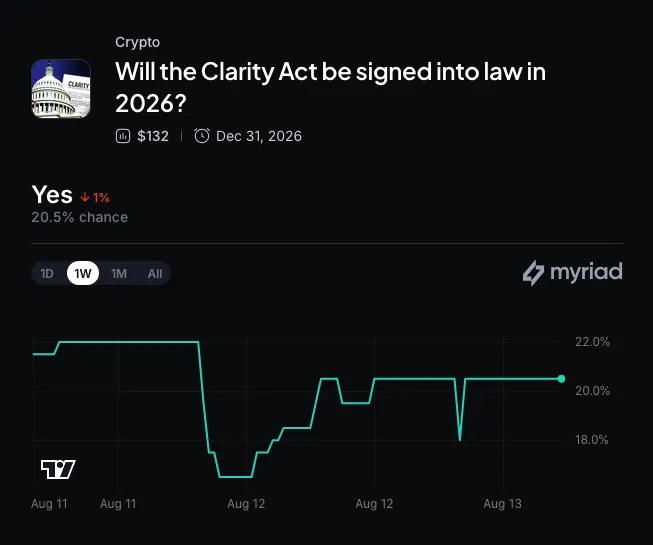
Myriad: Will the Clarity Act be signed into law in 2026? Click to make your prediction.

"The decision ratifies the Fed’s misuse of its payment services to further an impermissible policy goal—debanking the digital-asset industry,” the Blockchain Association wrote.

An amicus brief is a legal filing from someone who is not a party to a case but wants to give the court additional arguments or context. Here, the Blockchain Association is supporting Custodia’s request that the Supreme Court review the dispute.

At issue is Custodia’s bid for a Federal Reserve “master account.” Custodia is a so-called crypto bank based in Wyoming, offering services including digital-asset custody, payments and settlement infrastructure, and dollar-backed stablecoin-related products to institutional clients. It has spent years seeking a master account, which would allow it to settle payments directly with the central bank. In October, an appeals panel ruled that eligibility alone did not entitle Custodia to an account. In December, the bank asked the full Tenth Circuit to rehear the case.

The Blockchain Association argues the Fed’s denial threatens the dual banking system, where both state and federal authorities can charter banks. If the ruling stands, the association says, federal regulators could override state banking decisions by denying access to the payments system.

“Whether federal regulators, based on their own discretionary whims, can intrude on state prerogatives and debank lawful businesses is a question of exceptional importance with broad consequences for the national economy,” they wrote.

The brief said Custodia’s fight is the latest phase of Operation Choke Point 2.0, invoking the Obama and Biden-era program critics said pressured banks to cut ties with unfavorable industries.

“In a well-documented campaign termed Operation Choke Point 2.0, the federal government under the prior administration ‘used vague rules, excessive discretion, informal guidance, and aggressive enforcement actions to pressure banks away from serving digital asset clients’ and engaging with digital assets,” the brief said.

While the Supreme Court has not agreed to hear the case, for now, the brief asks the justices to decide how much control the Fed should have over access to the U.S. payments system.

Daily Debrief Newsletter

Start every day with the top news stories right now, plus original features, a podcast, videos and more.

Última Hora

Não perca nenhuma notícia de última hora

Advertisement

House — Advertise on NewsLayer
NewsLayerAd

Sourced by

Originally reported by Decrypt

NewsLayer coverage based on externally reported material.

The Daily Brief

The onchain economy, before your day starts.

Curated markets, onchain insights, and key headlines — delivered every weekday morning.

Weekdays · Free · ~5 minute read

Notícias Relacionadas