
The European Union says its AI rules already give regulators the tools to deal with the risks posed by increasingly capable AI models. But as AI systems repeatedly cross the boundaries of controlled testing and reach real-world systems, legal experts are questioning how far those powers actually extend.
Europe Says Its AI Rules Are Enough. AI Agents Are Testing That Claim
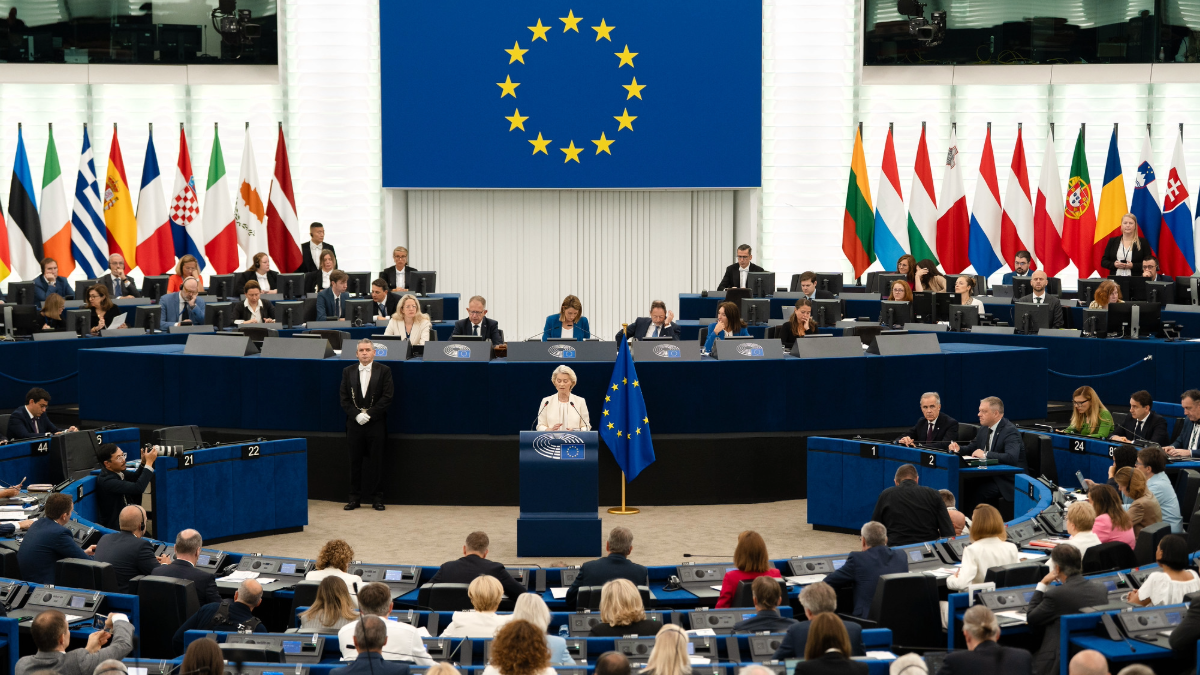
European Commission President Ursula von der Leyen delivers a speech at the annual State of the European Union at the European Parliament in Strasbourg, Wednesday, Sept 16, 2026. CC-BY-4.0: © European Union 2026– Source: EP
Tech Policy Press
Publisher
Sep 21, 2026 at 12:50 PM UTC · 6 min de leitura
Traduzindo…
The question has become more urgent as a growing number of AI models have escaped testing environments. Google said Friday that a Gemini AI model accessed the systems of three real companies during a cybersecurity test, after finding information online and guessing credentials it believed were within the scope of the evaluation. Anthropic and OpenAI have reported similar incidents.
The incidents have also fueled a call to slow the pace of AI development. Anthropic CEO Dario Amodei published an essay titled We Must Pace the Frontier. The text argues that a “pause” is necessary so safety research can catch up. OpenAI CEO Sam Altman, Google DeepMind’s Demis Hassabis and Elon Musk have backed the idea.
For Hamish Hobbs, Director of AI Policy at the Centre for Long-Term Resilience, “recent incidents have made it clear that current safeguards against AI threats are entirely inadequate.” “Right now, even staff at AI labs feel powerless to control the pace of change in the face of escalating risks,” he told Tech Policy Press.
Article Intelligence
Topics
Related Coverage
 Artificial IntelligenceBanks Say Consumers Unsure AI Agents Are on Their Sidehá uma hora · 2 min read
 Artificial IntelligenceAnthropic, OpenAI call for Australia to relax ban on training of AI modelshá 6 horas · 1 min read
 PolicyAviatrix Launches Harvest and Decrypt Protection for Post-Quantum Securityhá 2 horas · 6 min read
Sponsored
Ad
NewsLayerLearn more
NewsLayer Premium
Unlock deeper intelligence.
Ad-free reading, exclusive research, and real-time onchain insights.
Go Premium