
Insider Brief
Game On: Quantinuum Demonstrates Exponential Edge Over Classical Strategies
Insider Brief A Quantinuum-led research team has demonstrated an exponentially widening gap between quantum and classical strategies in a test designed to verify quantum behavior without relying on unproven assumptions about…
Matt Swayne
Publisher The Quantum Insider
Sep 8, 2026 at 11:21 AM UTC · Updated há 3 horas · 8 min de leitura
Traduzindo…
- Quantinuum researchers demonstrated an exponentially growing quantum advantage in a game that can be verified efficiently without relying on unproven computational-hardness assumptions.
- Experiments on Quantinuum’s trapped-ion H2 systems used thousands of circuits and as many as 55 qubits, producing scores above the best possible classical limit.
- The test still requires trusted components, while larger demonstrations will likely depend on improved hardware and quantum error correction.
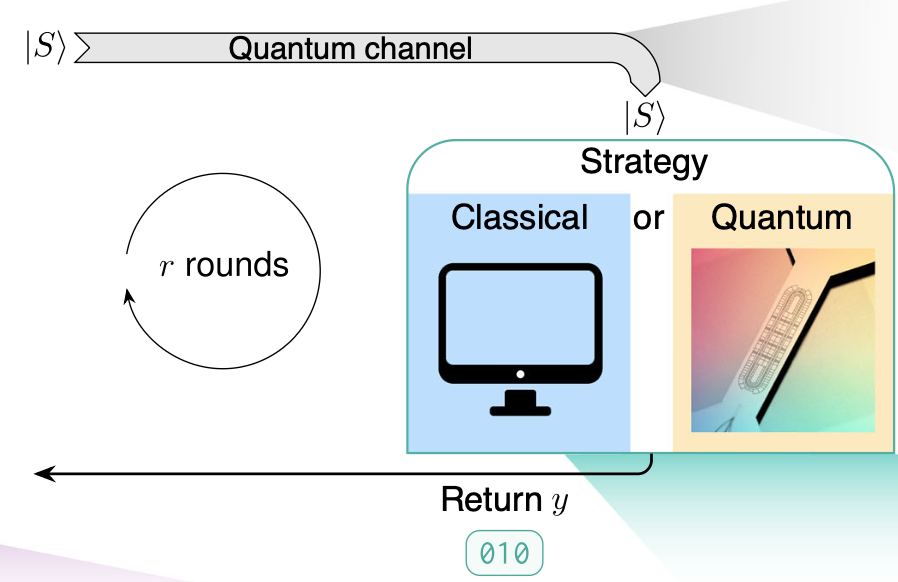
A Quantinuum-led research team has demonstrated an exponentially widening gap between quantum and classical strategies in a test designed to verify quantum behavior without relying on unproven assumptions about computational difficulty.
The study, published in Nature Communications, describes a game that asks a computer to produce an answer excluded from a hidden set of possible answers. Quantinuum’s trapped-ion quantum computer consistently outperformed the best possible classical strategy across experiments using as many as 55 physical qubits.
The researchers reported evidence that the quantum advantage grew exponentially as they increased the size of the problem. They tested thousands of distinct circuits on Quantinuum’s System Model H2 computers, including experiments based on bit strings as long as 37 bits.
Article Intelligence
Related Coverage
 QuantumQuantinuum Finalizes $100M CHIPS Funding Agreement for Trapped-Ion Quantum Computinghá 3 horas · 2 min read
 QuantumSuperfluid qubit could help scale up quantum computershá uma hora · 1 min read
 QuantumNEC has quietly quit quantum computing hardware development, report claims — company says it will continue to evaluate practical applications and industrialization of quantum technologieshá 4 horas · 3 min read
Sponsored
Ad
NewsLayerLearn more
NewsLayer Premium
Unlock deeper intelligence.
Ad-free reading, exclusive research, and real-time onchain insights.
Go Premium