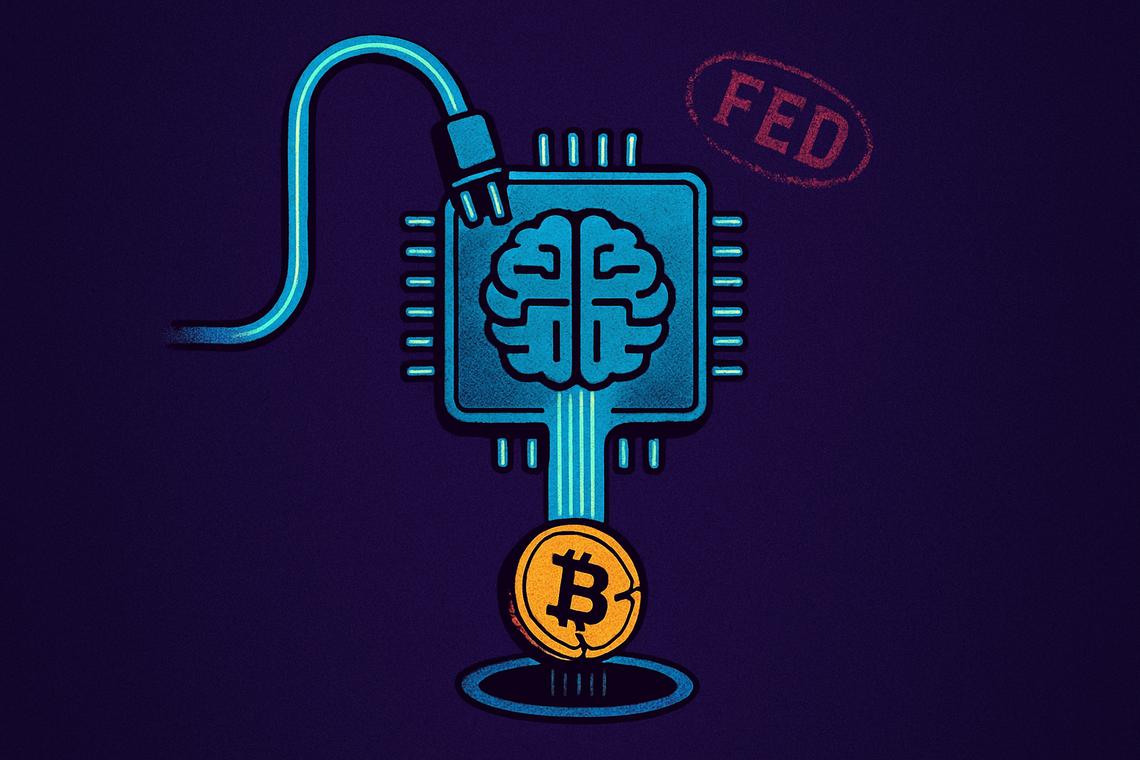
Bitcoin’s sluggish momentum this year has a lot of crypto traders scratching their heads, but according to one of the industry’s biggest liquidity providers, the answer may not be inside crypto at all. Spencer Hallarn, Head of Markets at GSR, the prominent GSR crypto market maker, said in a recent interview that the slowdown gripping digital assets is being driven in large part by capital quietly rotating into artificial intelligence infrastructure, pulling liquidity away from crypto markets just as investors had hoped for a fresh leg higher.
Key takeaways
- GSR’s Spencer Hallarn says the crypto market slowdown is partly driven by capital shifting toward AI investments.
- Big tech firms issuing equity to fund AI infrastructure are tightening broader market liquidity.
- Clients are leaning more on long-term budget planning, OTC hedging, and real-world assets (RWAs).
- Walled-garden tokenization platforms with heavy KYC rules are struggling to generate meaningful transaction volume.
- Liquidity could improve — and support higher Bitcoin prices — if AI investment cools and the Federal Reserve cuts rates.
Capital Rotation to AI Investments Drains Crypto Liquidity
The short version of GSR’s read on the market: money that might otherwise be chasing crypto is instead flowing toward the AI buildout, and that is squeezing the liquidity crypto traders rely on. Hallarn’s comments point to a structural competition for capital rather than a crypto-specific problem, which changes how the current stall should be interpreted.
Big Tech Equity Issuance Tightens Market Liquidity
Big tech companies have been raising huge sums to fund AI infrastructure, and much of that funding is coming through equity issuance. That process pulls cash out of the broader financial system and into data centers, chips, and compute capacity. Hallarn’s point is straightforward: when massive tech firms tap equity markets at this scale, it tightens liquidity conditions across asset classes, and crypto is not immune to that squeeze.
Client Shift Toward Long-Term Planning and Hedging
That tighter backdrop is changing how crypto clients behave day to day. Instead of chasing short-term momentum, GSR says clients are now putting more weight on long-term budget planning, over-the-counter (OTC) hedging structures, and real-world assets, or RWAs. It’s a defensive posture that reflects a market waiting for clearer signals rather than one betting aggressively on a near-term breakout.
Tokenization Faces Structural Challenges
Tokenization has been billed as one of crypto’s biggest growth stories, but Hallarn’s assessment suggests the hype has outpaced the actual usage on many platforms. The core issue, in his view, isn’t demand for tokenized assets — it’s the design of the platforms themselves.
Low Transaction Volumes on KYC-Heavy Platforms
Many so-called walled-garden tokenization platforms impose heavy know-your-customer (KYC) requirements, and Hallarn noted that these venues generally lack meaningful transaction volume as a result. The friction built into onboarding and compliance appears to be limiting activity, even as the broader tokenization narrative keeps generating headlines.
True Opportunity Lies in Fixing Banking and Settlement Systems
For Hallarn, the real prize isn’t in wrapping assets into tokens for their own sake. It’s in repairing the plumbing behind traditional banking and settlement systems — the infrastructure that moves money and assets between institutions. This matters because it reframes tokenization less as a crypto product play and more as an infrastructure fix, one that could have far broader implications for how financial markets settle transactions if it gains traction.
Conditions for Liquidity Improvement and a Crypto Bull Run
Whether crypto sees a renewed bull run largely comes down to two variables outside the industry’s control, according to Hallarn’s outlook: the pace of AI-driven capital spending and the direction of Federal Reserve policy.
Impact of Cooling AI Investments and Federal Reserve Rate Cuts
If AI-related investment activity begins to cool and the Federal Reserve starts cutting interest rates, Hallarn expects liquidity conditions to ease. That combination — less capital being absorbed by AI infrastructure spending and cheaper access to capital more broadly — would loosen the financial conditions that have been weighing on crypto markets throughout this stretch.