

Insider Brief
Haiqu Releases AgenticOS to Plan and Check Quantum Research
Insider Brief PRESS RELEASE — Existing AI models have advanced to the point that they can contribute to real science, but they have their limits. An AI agent can produce convincing math and working code, but it might alter the…
Matt Swayne
Publisher The Quantum Insider
Oct 7, 2026 at 3:42 PM UTC · Updated há 21 dias · 4 min de leitura
Key Signal
3.4% Distance from exact reference
Last Updated
há 21 dias
Traduzindo…
- Haiqu launched AgenticOS, a system that coordinates specialized AI agents to plan, validate and prepare quantum research experiments for hardware execution under human oversight.
- In a chemistry test, Haiqu reported that four of 10 unassisted AI agent runs violated setup instructions, while AgenticOS maintained the approved protocol and produced a simulated result within approximately 3.4% of an exact reference.
- Haiqu reported that AgenticOS developed and ran a 3-by-3 Hubbard model experiment on an IBM quantum computer, reducing circuit depth by 75% and proposing a calibration that aligned hardware results with an error-free simulation of the same method.
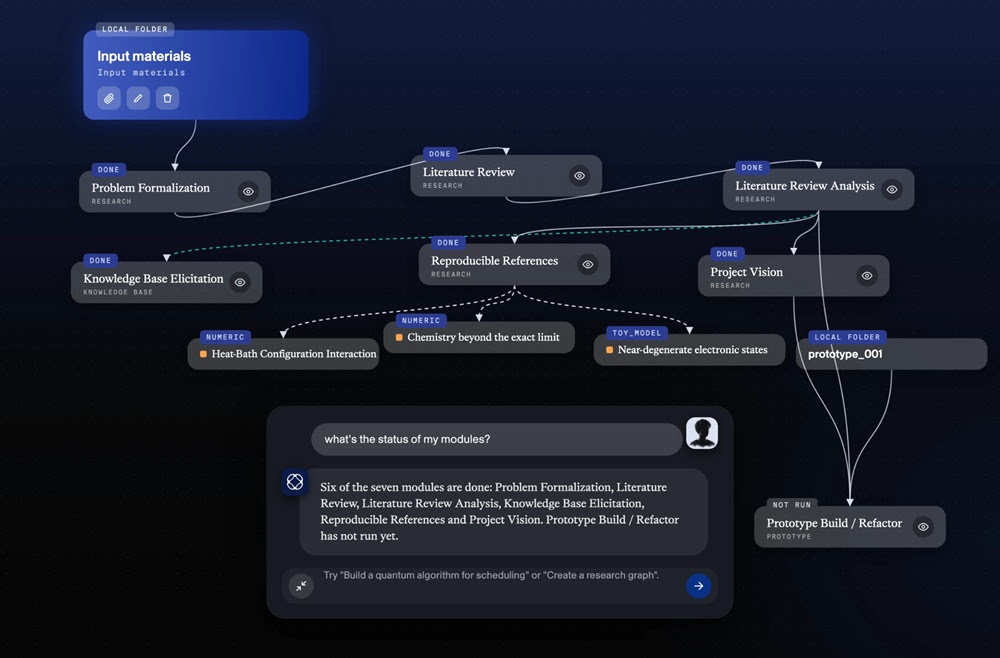
PRESS RELEASE — Existing AI models have advanced to the point that they can contribute to real science, but they have their limits. An AI agent can produce convincing math and working code, but it might alter the underlying science while doing so, leaving researchers with results that look right but aren’t. Today, Haiqu is addressing that by unveiling AgenticOS, giving quantum researchers a team of AI agents that are built for scientific exploration, and designed to catch mistakes before they happen.
In complex scientific calculations, general-purpose AI agents can make small changes no one asked for, like shifting a molecular geometry or slipping in an unapproved approximation. The calculation then answers a different question, or returns a result that is simply incorrect. With the Haiqu AgenticOS, researchers can now design an entire quantum project — from the initial question to an experiment that’s ready for quantum hardware — and assign multiple teams of AI agents to validate and confirm the research findings every step of the way. The team overseeing the experiment can then inspect each assumption and conclusion to determine how to proceed.
Article Intelligence
Sponsored
Ad
NewsLayerLearn more
NewsLayer Premium
Unlock deeper intelligence.
Ad-free reading, exclusive research, and real-time onchain insights.
Go Premium