
Insider Brief
New Method Generates Photons That Are Virtually Indistinguishable
Insider Brief PRESS RELEASE — Working in close collaboration, researchers from Paderborn University, the University of Basel and Ruhr University Bochum have made a significant breakthrough in the field of quantum communication. In their…
Matt Swayne
Publisher The Quantum Insider
Oct 2, 2026 at 3:28 PM UTC · 3 min de leitura
Traduzindo…
- Researchers improved the similarity of photons generated by semiconductor quantum dots, advancing light sources for quantum communication and information processing.
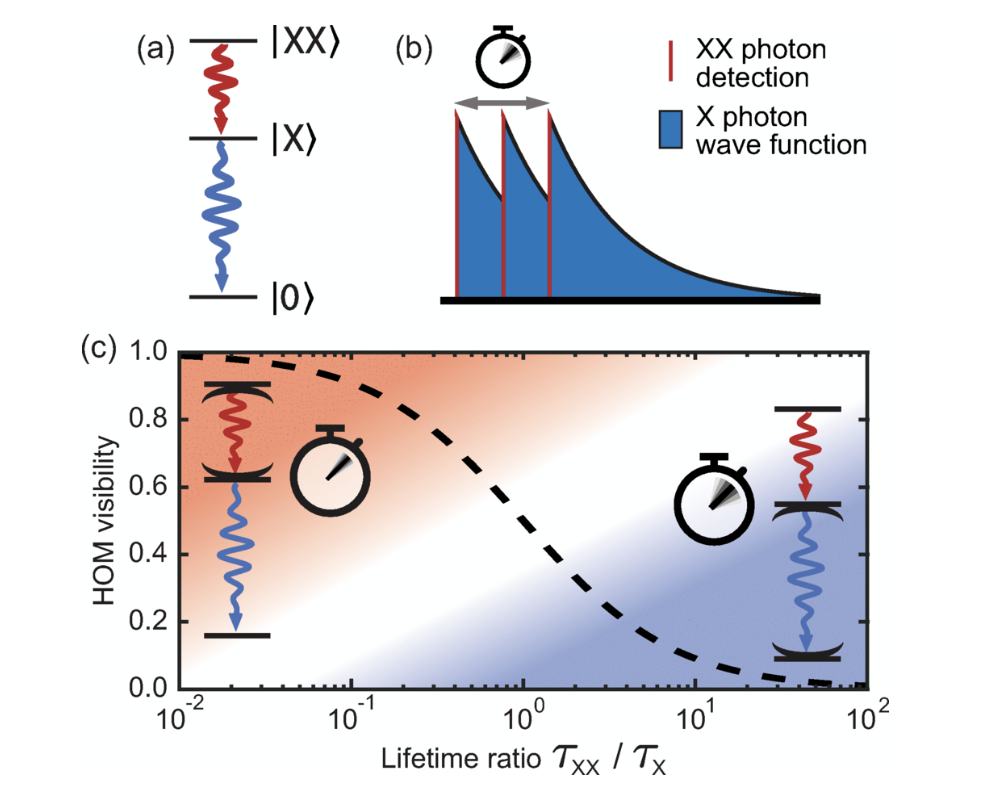
- An optical cavity controlled and accelerated photon emission, increasing photon indistinguishability from 60% to 90%.
- The researchers found that the cavity can also improve photon purity, with remaining limits linked to vibrations in the semiconductor’s crystal lattice.
PRESS RELEASE — Working in close collaboration, researchers from Paderborn University, the University of Basel and Ruhr University Bochum have made a significant breakthrough in the field of quantum communication. In their recently published paper in the prestigious journal Physical Review Letters, they demonstrate how special semiconductor nanostructures can be used to generate individual photons and pairs of photons that are almost perfectly identical. These ‘indistinguishable’ particles form the basis for quantum entanglement and quantum interference.
Biexciton decay
In quantum information processing, photons are the ideal carriers of information. However, in order to use these light particles for complex calculations, they must possess exactly the same properties – an aspect known as ‘indistinguishability’. Until now, such sources have suffered from the fact that the photons generated were temporally correlated or out of focus, which greatly reduced their indistinguishability and thus their quality. A team of doctoral candidates from Basel and Paderborn has now solved this problem using a process known as ‘biexciton decay’ in semiconductor quantum dots within an optical resonator.
Article Intelligence
Sponsored
Ad
NewsLayerLearn more
NewsLayer Premium
Unlock deeper intelligence.
Ad-free reading, exclusive research, and real-time onchain insights.
Go Premium