
Insider Brief
Penn Researchers Demonstrate Room-Temperature Diamond System That Entangles Four Qubits 10 Times Faster
Insider Brief Researchers have entangled four qubits inside a diamond at room temperature using a single gate, cutting the operation time by about 90% while improving its accuracy over the conventional approach. The experimental system…
Matt Swayne
Publisher The Quantum Insider
Sep 14, 2026 at 11:43 AM UTC · Updated há 6 horas · 7 min de leitura
Traduzindo…
- Researchers entangled four qubits in a room-temperature diamond system about 10 times faster than with a conventional sequence of two-qubit gates.
- The parallel gate completed the operation in 14.8 microseconds with a fidelity of 0.92, compared with 0.69 for the sequential method.
- The approach could support more sensitive quantum sensors and more efficient error correction, but it remains a four-qubit laboratory demonstration.
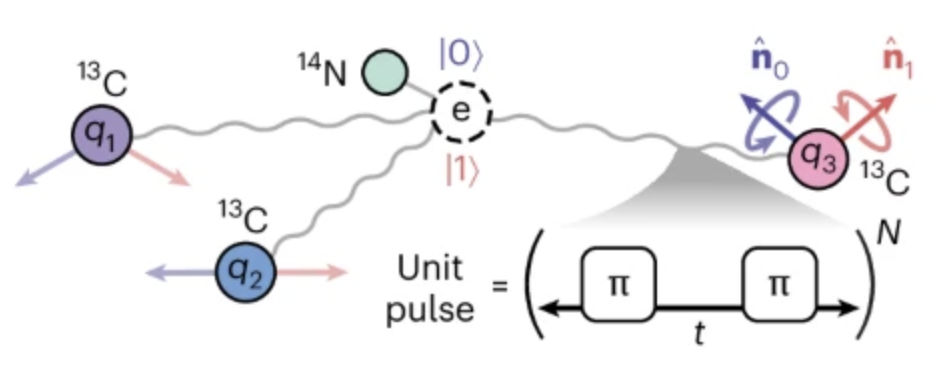
Researchers have entangled four qubits inside a diamond at room temperature using a single gate, cutting the operation time by about 90% while improving its accuracy over the conventional approach.
The experimental system produced a four-qubit entangled state in 14.8 microseconds, which researchers report was about 10 times faster than a sequence of two-qubit gates. According to the study published in Nature Nanotechnology, the parallel gate achieved a fidelity of 0.92, meaning its operation closely matched the intended result. The conventional method, which entangled the qubits two at a time through a series of separate operations, achieved a fidelity of 0.69.
The findings could lead to more capable room-temperature quantum sensors and more efficient error correction in solid-state quantum processors. They also demonstrate a way to turn unwanted interactions among qubits, normally treated as a source of errors, into a tool for controlling several qubits simultaneously.
Article Intelligence
Regulation Signal
in progressUpdated há um mês
SEC Crypto Asset Market Structure RulemakingRelated Coverage
 QuantumQuandela Publishes White Paper on Photonic QPU Integration With NVIDIA Infrastructurehá 3 horas · 3 min read
 CryptoWhy crypto tax reporting now hinges on knowing your customerhá 3 horas · 2 min read
 PolicyWebinar | Post-Quantum on Deadline: What EO 14412 Means for the Public Sectorhá 3 horas · 1 min read
Sponsored
Ad
NewsLayerLearn more
NewsLayer Premium
Unlock deeper intelligence.
Ad-free reading, exclusive research, and real-time onchain insights.
Go Premium