
Researchers Demonstrate Building Blocks for Zinc Oxide Spin Qubits
Insider Brief PRESS RELEASE — Researchers at Tohoku University, in collaboration with the National Institute for Materials Science (NIMS) and the University of Tokyo, have taken an important step toward semiconductor quantum computing…
Matt Swayne
Publisher The Quantum Insider
Oct 1, 2026 at 11:20 AM UTC · 2 min de leitura
Skip to content
Researchers Demonstrate Building Blocks for Zinc Oxide Spin Qubits
Insider Brief
- Researchers demonstrated charge sensing, high-frequency reflectometry and a few-electron double quantum dot in zinc oxide, establishing tools for developing semiconductor spin qubits.
- An integrated sensor and radio-frequency circuit enabled faster detection of electron charge changes, while the device confined individual electrons in two quantum dots.
- The team next plans to demonstrate electron spin readout and manipulation and measure how long spin states persist and retain quantum coherence.
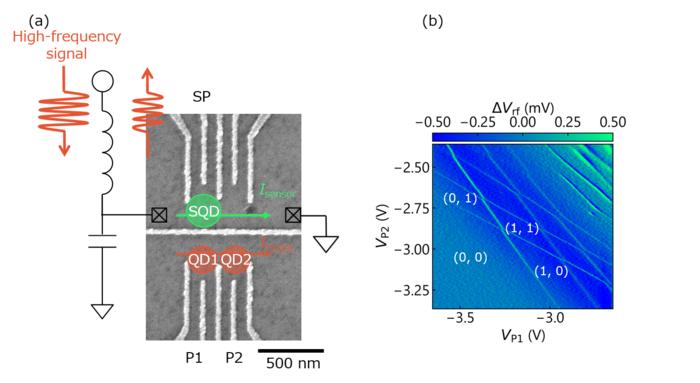
- Image: (a) The structure of the gate electrodes on the ZnO device used in the experiment in this paper. (b) The charge stability diagram indicating the formation of ZnO double quantum dot in few-electron regime. (Kosuke Noro et al.)
PRESS RELEASE — Researchers at Tohoku University, in collaboration with the National Institute for Materials Science (NIMS) and the University of Tokyo, have taken an important step toward semiconductor quantum computing using zinc oxide (ZnO). The team successfully demonstrated charge sensing, high-frequency reflectometry, and the formation of a few-electron double quantum dot in a ZnO device – three key technologies for developing and evaluating spin qubits.
Semiconductor quantum dots are promising building blocks for scalable quantum computers because they can confine individual electrons and use their spins to store quantum information. Silicon and gallium arsenide have been extensively studied for this purpose, while ZnO has emerged as an alternative material with attractive properties, including a low nuclear spin environment that may help preserve electron spin states and a direct bandgap for possible optical coupling.
However, rapidly and accurately detecting the charge state of electrons in ZnO quantum dots has remained a challenge. To address this, the researchers fabricated a ZnO device containing two target quantum dots (QD1 and QD2) alongside a sensor quantum dot (SQD), which acts as a sensitive electrometer. By integrating the sensor with a radio-frequency resonant circuit, they achieved high-frequency reflectometry, enabling much faster detection of changes in electron charge.
“For quantum computing, technologies that enable rapid readout of quantum states are essential,” says Associate Professor Tomohiro Otsuka of the Advanced Institute for Materials Research (WPI-AIMR), Tohoku University. “By demonstrating high-frequency reflectometry in zinc oxide, we have established an important measurement technique for high-speed evaluation of quantum states in this unique material.”
Using the integrated device, the researchers also successfully confined individual electrons and confirmed the formation of a few-electron double quantum dot. This configuration is an important foundation for investigating and operating spin qubits.
“This achievement bridges a critical experimental gap for zinc oxide quantum devices,” says Otsuka. “We now have a high-speed measurement platform that will allow us to investigate fundamental spin properties, including spin relaxation and coherence times, bringing us closer to realizing high-performance quantum devices based on new semiconductor materials.”
The study was published online in Physical Review Applied on July 21, 2026.
The research team’s next steps include demonstrating electron spin readout and manipulation in ZnO quantum dots, as well as measuring key properties such as spin relaxation and coherence times.
One of our team will be in touch to learn more about your requirements, and provide pricing and access options.
We use cookies to analyse traffic and improve your experience. Privacy Policy
Sourced by
Originally reported by The Quantum Insider
NewsLayer coverage based on externally reported material.
The Daily Brief
The onchain economy, before your day starts.
Curated markets, onchain insights, and key headlines — delivered every weekday morning.
Weekdays · Free · ~5 minute read
0
Applause
Was this article helpful?
Article Intelligence
Sponsored
Ad
NewsLayerLearn more
NewsLayer Premium
Unlock deeper intelligence.
Ad-free reading, exclusive research, and real-time onchain insights.
Go Premium

