This website uses cookies
We use cookies to personalise content and ads, to provide social media features and to analyse our traffic. We also share information about your use of our site with our social media, advertising and analytics partners who may combine it with other information that you’ve provided to them or that they’ve collected from your use of their services.
Consent Selection
Details
  • Necessary cookies help make a website usable by enabling basic functions like page navigation and access to secure areas of the website. The website cannot function properly without these cookies.
  • Preference cookies enable a website to remember information that changes the way the website behaves or looks, like your preferred language or the region that you are in.
    • We do not use cookies of this type.

  • Statistic cookies help website owners to understand how visitors interact with websites by collecting and reporting information anonymously.
    • We do not use cookies of this type.

  • Marketing cookies are used to track visitors across websites. The intention is to display ads that are relevant and engaging for the individual user and thereby more valuable for publishers and third party advertisers.
    • We do not use cookies of this type.

  • Unclassified cookies are cookies that we are in the process of classifying, together with the providers of individual cookies.
    • __emg_sidPending
      Maximum Storage Duration: 1 dayType: HTTP Cookie
      __emg_vidPending
      Maximum Storage Duration: 1 yearType: HTTP Cookie
      nl-read-countPending
      Maximum Storage Duration: PersistentType: HTML Local Storage
Cookie declaration last updated on 8/12/26 by Cookiebot
[#IABV2_TITLE#]
[#IABV2_BODY_INTRO#]
[#IABV2_BODY_LEGITIMATE_INTEREST_INTRO#]
[#IABV2_BODY_PREFERENCE_INTRO#]
[#IABV2_BODY_PURPOSES_INTRO#]
[#IABV2_BODY_PURPOSES#]
[#IABV2_BODY_FEATURES_INTRO#]
[#IABV2_BODY_FEATURES#]
[#IABV2_BODY_PARTNERS_INTRO#]
[#IABV2_BODY_PARTNERS#]
About
Cookies are small text files that can be used by websites to make a user's experience more efficient.

The law states that we can store cookies on your device if they are strictly necessary for the operation of this site. For all other types of cookies we need your permission.

This site uses different types of cookies. Some cookies are placed by third party services that appear on our pages.

You can at any time change or withdraw your consent from the Cookie Declaration on our website.

Learn more about who we are, how you can contact us and how we process personal data in our Privacy Policy.

Please state your consent ID and date when you contact us regarding your consent.
NewsLayer

Install NewsLayer

Get the app experience — one tap from your home screen, instant loads and breaking-news alerts.

NewsLayer.com
NewsLayer PulseLIVEBTC$63,566+0.84%ETH$1,900+0.97%SOL$75.53+0.27%XRP$0.9985-0.15%DOGE$0.0701+0.25%ADA$0.1741-1.15%Total Cap$2.28T+0.69%Layer Index43 Neutral
External ReportingPublicado há 3 dias

South Korea tightens crypto rules as $367M in stablecoins move offshore

South Korea’s tightening restrictions are making it harder for local crypto users to move between domestic and offshore markets. The shift began with Bybit, MEXC, and HTX losing access to the local Google Play Store, limiting direct…

South Korea tightens crypto rules as $367M in stablecoins move offshore
Publisher AMBCrypto 2 min de leitura
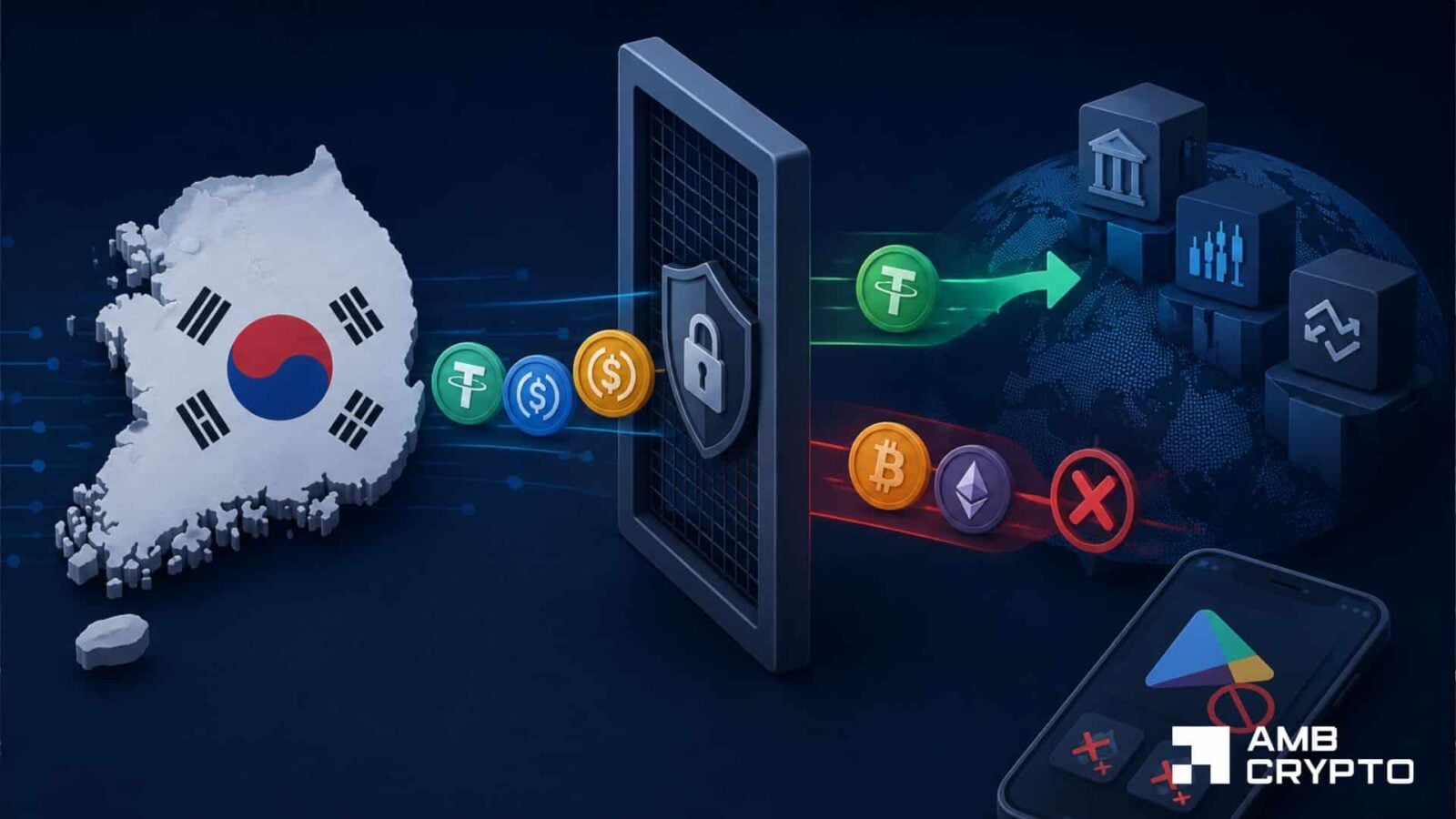
Image via AMBCrypto

Layer Index

43

↑ 1 pts in 24h

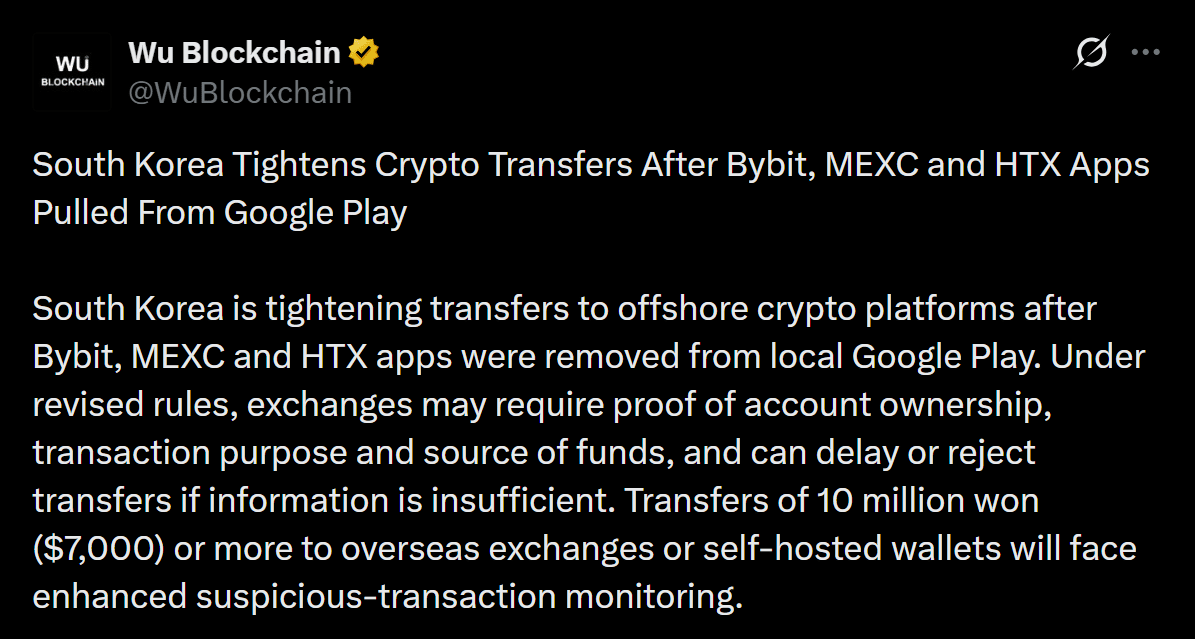
South Korea’s tightening restrictions are making it harder for local crypto users to move between domestic and offshore markets. The shift began with Bybit, MEXC, and HTX losing access to the local Google Play Store, limiting direct mobile distribution.

Restrictions on transferring funds have further extended these barriers. This will enable exchanges to ask for information about user accounts, including names, the reasons behind each transfer, and where the funds originated from.

Therefore, users could face more checks before capital can leave domestic platforms, potentially slowing offshore liquidity flows.
Source: X

That aside, transfers worth more than 10 million won, translating to roughly $7,000, will receive enhanced monitoring when sent overseas or to self-hosted wallets.

These regulations may encourage the migration of trading volume away from non-compliant onshore exchanges. Still, they also create significant friction associated with withdrawing assets from the same exchanges.

However, users may turn to web access or other channels, limiting how effectively app restrictions contain offshore activity.

South Korea narrows offshore access

As those transfer checks make funding offshore accounts harder, the next question is how much access users still retain. Google Play restrictions now cover at least 29 unregistered derivative platforms, limiting their reach among new Android users.

Source: X

Although existing installations continue to operate, they will eventually lose automated update capabilities. With time this could reduce their functionality. Yet access has not disappeared, since web interfaces and some iOS listings remain available.

Putting it simply, this means the restrictions currently reshape how users reach offshore venues rather than shutting them out completely. Meanwhile, registered domestic exchanges face fewer access barriers, potentially strengthening their position within the local market.

Whether that advantage grows will depend on enforcement expanding beyond Android and transferring into the remaining offshore access routes.

Tighter regulations on South Korean exchanges will be tested by capital flows leaving the country’s exchanges.

In June alone, five major exchanges saw a total of $367 million worth of stablecoins move off their respective exchange systems, continuing an 18-month trend.

Source: KoreaTimes

Gross outbound transfers reached 2.76 trillion won, compared with 2.20 trillion won flowing back into domestic platforms. Meanwhile, cumulative net outflows have been about 14.9 trillion won since January 2025 as well, indicating consistent interest in exchanges beyond those located within South Korea.

This gives regulators a significant flow pattern to target once enforcement begins. If net outflows and large transfers decline after implementation, the restrictions are limiting offshore movement; if they remain elevated, capital is finding alternative routes.


Final Summary

Última Hora

Não perca nenhuma notícia de última hora

Advertisement

House — Advertise on NewsLayer
NewsLayerAd

Sourced by

Originally reported by AMBCrypto

NewsLayer coverage based on externally reported material.

The Daily Brief

The onchain economy, before your day starts.

Curated markets, onchain insights, and key headlines — delivered every weekday morning.

Weekdays · Free · ~5 minute read

Notícias Relacionadas