
Insider Brief
Technology Used by Optical Atomic Clocks May Jump From Lab to Consumer
Insider Brief PRESS RELEASE — University of Auckland research may help the world to miniaturize the laser tools used for ultraprecise measurements such as atomic clocks and quantum computing. There are big scientific and commercial…
Matt Swayne
Publisher The Quantum Insider
Oct 9, 2026 at 10:00 AM UTC · 4 min de leitura
Traduzindo…
- University of Auckland and U.S. researchers demonstrated a chip-based optical frequency comb that could support smaller precision measurement systems, including portable atomic clocks.
- The design uses two lasers with frequencies an octave apart to generate evenly spaced light frequencies between them, addressing control and stabilization challenges in existing systems.
- The researchers demonstrated precise optical frequency generation, low-noise millimetre-wave signals and optical clock readout, with potential applications in navigation, telecommunications and sensing.
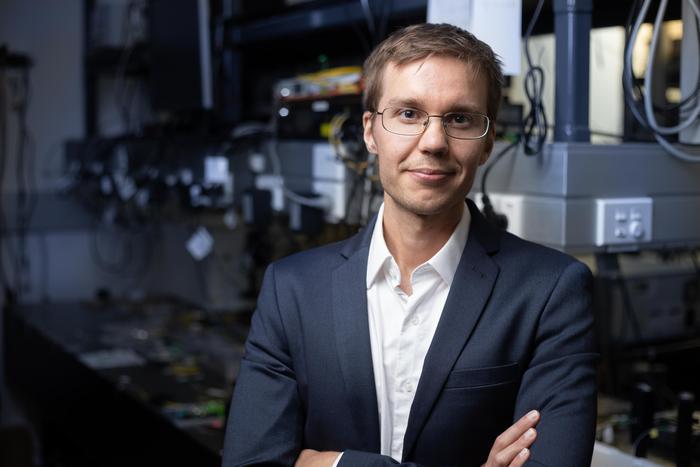
- Image: Professor Miro Erkintalo (University of Auckland)
PRESS RELEASE — University of Auckland research may help the world to miniaturize the laser tools used for ultraprecise measurements such as atomic clocks and quantum computing.
There are big scientific and commercial implications.
So far, the laser tools called optical frequency combs have been trapped in the lab because of their size and expense. Optical frequency combs are the standard tools for measuring the frequency – or colours – of light. They are sometimes called `light rulers’ or ‘rainbow rulers’.
But research by University of Auckland and US scientists, reported in the prestigious journal Nature, suggests a new path for shrinking the technology to chip size for future navigation systems, communications networks, precision sensors and portable atomic clocks.
Article Intelligence
Related Coverage
 QuantumFujitsu to build quantum computing research center in New Mexicohá 4 horas · 1 min read
 QuantumFujitsu and New Mexico to Establish Quantum Computing Research Centerhá 12 horas · 4 min read
 QuantumFujitsu launches collaboration with State of New Mexico to establish quantum computing research centerhá 17 horas · 1 min read
Sponsored
Ad
NewsLayerLearn more
NewsLayer Premium
Unlock deeper intelligence.
Ad-free reading, exclusive research, and real-time onchain insights.
Go Premium