- Bitcoin has continued to trade sideways in the $65,000 range, as risk appetite for speculative assets weakened amid Fed tightening fears, Middle East tensions, and delays to the Clarity Act.
- The market is also facing added downward pressure from Strategy's large Bitcoin sale and cuts to its price target and Bitcoin price target.
- At the same time, bullish calls for Bitcoin to top $1 million, driven by whale buying and net inflows into spot ETFs, are clashing with bearish forecasts that it could fall into the $40,000 range.
Forecast Trend Report by Period
Fed Tightening Fears, Middle East Tensions Weigh
Clarity Act Delay Also Hurts Sentiment
Whale Buying Supports Bullish View
Calls for More Losses Persist

Bitcoin has remained volatile, alternating between sharp drops and modest rebounds after a steep selloff. Risk appetite for speculative assets has weakened as investors brace for the possibility of another Federal Reserve rate increase this year and as tensions in the Middle East flare again. Delays in the Clarity Act, a US bill tied to the crypto market, have also weighed on prices. Forecasts in financial markets remain deeply divided, with some calling for Bitcoin to top $1 million and others warning it could slide into the $40,000 range.
String of Negative Catalysts Hurts Sentiment
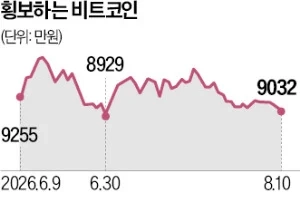
According to Upbit, Bitcoin traded at 90.322 million won, or about $65,500, as of 9 a.m. on August 10, down 0.8% from a day earlier. After falling to 90.5 million won, or about $65,600, intraday in early June, Bitcoin rebounded and climbed back above 100 million won, or about $72,500, within 10 days. It quickly turned lower again and fell into the 88 million won range, or about $63,800, on August 1. The token then rose gradually to the 97.8 million won range, or about $70,900, before resuming its decline. It has recently traded sideways in the 90 million won range, or about $65,200. That is roughly half its record high from October last year, when it reached the 179 million won range, or about $129,700.
Concern over tighter Fed policy is weighing on Bitcoin, market participants say. The Fed left its benchmark rate unchanged at 3.5% to 3.75% at its regular Federal Open Market Committee meeting in late July, but three FOMC members dissented from the decision. Markets interpreted the move as a hawkish hold that signaled possible rate increases ahead. Even Fed Governor Lisa Cook, who backed the decision at the time, has recently mentioned the possibility of a rate hike. That has kept risk appetite subdued. Middle East tensions have added to the pressure after Iran recently moved to advance legislation that would bar ships linked to hostile countries, including the US and Israel, from passing through the Strait of Hormuz.
Delays to the Clarity Act have also been cited as a factor behind Bitcoin's decline. Disagreement over ethics provisions related to President Donald Trump has pushed consideration of the bill back to after September. The Clarity Act would classify digital assets as either securities or commodities and split oversight authority between the US Securities and Exchange Commission and the Commodity Futures Trading Commission.
Strategy's repeated Bitcoin sales have further hurt sentiment. The company said on August 3 that it sold 1,637 Bitcoin. Half of the proceeds were used to pay preferred-stock dividends. Strategy is the world's largest publicly traded corporate holder of Bitcoin. Cantor Fitzgerald recently cut its price target on Strategy to $186 from $212 and lowered its Bitcoin target to $98,000 from $111,000.