
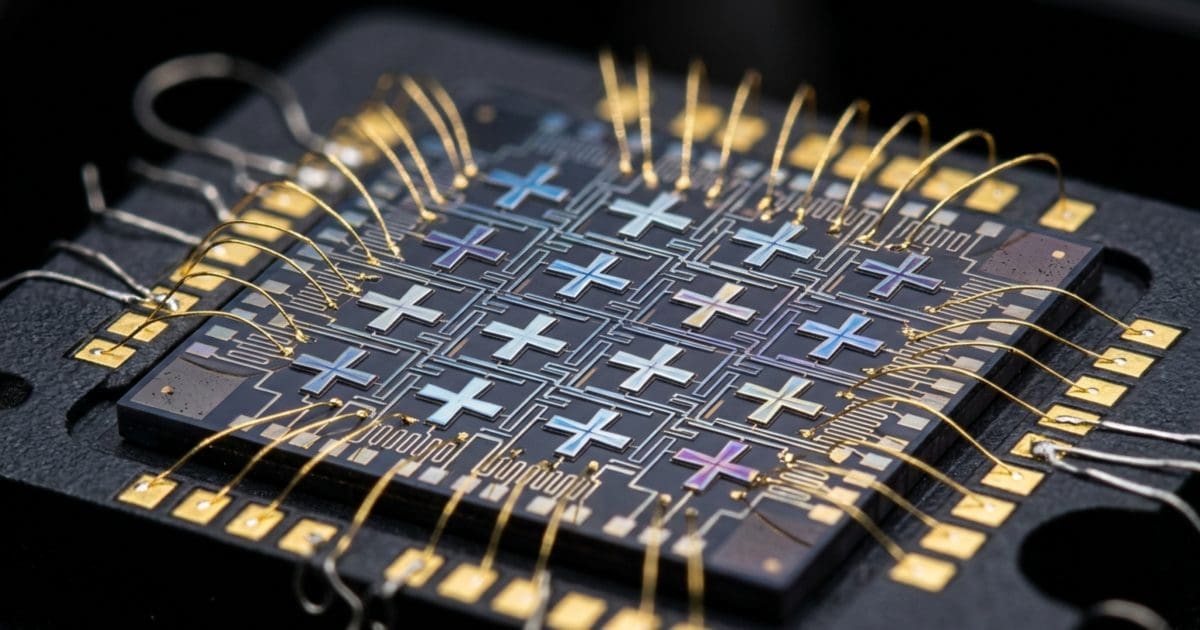
Researchers at the Max-Planck-Institut für Quantenoptik have extended the coherence of nuclear spin qubits to exceed 0.2 seconds, a duration that significantly advances the feasibility of practical quantum memory. The team achieved this milestone by embedding erbium dopants within yttrium orthosilicate and utilizing a cryogenic Fabry-Perot cavity with a linewidth of 65 MHz, smaller than the 0.9 GHz separation of hyperfine levels, to enable frequency-selective enhancement. This combination of nuclear-spin qubits, frequency-selective addressing, and photon emission in the minimal-loss telecommunications C-band positions erbium as a leading candidate for long-range, fiber-based quantum networks.
Freezing Impurities Extends Spin Qubit Coherence To 0.2 Seconds
Researchers at the Max-Planck-Institut für Quantenoptik have extended the coherence of nuclear spin qubits to exceed 0.2 seconds, a duration that significantly advances the feasibility of practical quantum memory. The team achieved this…
Quantum Zeitgeist
Publisher
Aug 30, 2026 at 9:24 AM UTC · Updated bir dakika önce · 6 dk okuma
Çevriliyor…
Cavity-Enhanced Readout of 167Er Nuclear Spin Qubits
A coherence time exceeding 0.2 seconds has been demonstrated in nuclear spin qubits embedded within yttrium orthosilicate, expanding the potential for practical quantum memory and long-distance quantum communication. Researchers at the Max-Planck-Institut für Quantenoptik achieved this milestone by carefully controlling the environment of erbium-167 dopants, effectively silencing disruptive magnetic noise that typically limits qubit performance.
Article Intelligence
Topics
Regulation Signal
in progressUpdated 23 gün önce
SEC Crypto Asset Market Structure RulemakingRelated Coverage
 CryptoRussia’s Sber eyes USDT loans, questions digital ruble demandbir saat önce · 1 min read
 CryptoThe next shadow-banking problem comes from insurance companies, where nobody was looking for a bank run2 saat önce · 6 min read
 CryptoSberbank plans to accept Bitcoin, Ethereum, and USDT as loan collateral after regulatory approval.3 saat önce · 1 min read
Sponsored
Ad
NewsLayerLearn more
NewsLayer Premium
Unlock deeper intelligence.
Ad-free reading, exclusive research, and real-time onchain insights.
Go Premium